The Doctor Told Me I Was Pregnant—But I Hadn’t Been With a Man in Six Years. Then I Remembered My Friend’s Strange Visits…
For six years, I had lived alone.
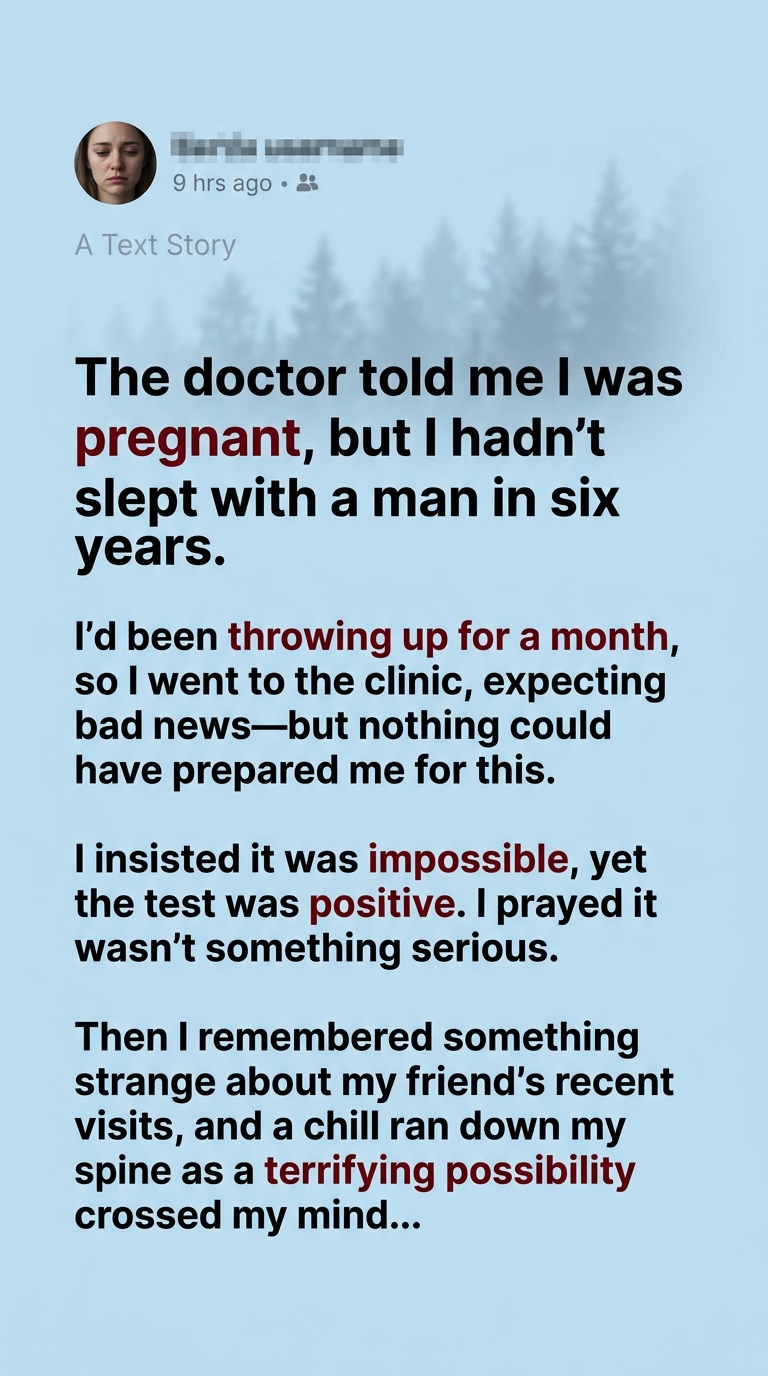
I was thirty-four, divorced, and had no interest in dating. After a painful breakup, I had built a quiet life around my work, my books, and my small apartment. I rarely went out, never brought anyone home, and certainly hadn’t slept with a man in six years.
So when I began throwing up every morning, I assumed something was wrong with my stomach.
After nearly a month of nausea, dizziness, and exhaustion, I finally went to a clinic.
The doctor ordered blood tests and asked me a series of routine questions. Then she returned with my results and sat down across from me.
“Your pregnancy test is positive.”
For a moment, I thought I had misheard her.
“That’s impossible,” I whispered. “I haven’t been with a man in six years.”
She checked the results again. “The test indicates pregnancy. We’ll need an ultrasound to confirm it and determine how far along you are.”
I shook my head, laughing nervously because I didn’t know what else to do.
“There must be a mistake.”
But the ultrasound confirmed it.
I was pregnant.
I walked out of the clinic in a daze, clutching the paperwork so tightly that my fingers hurt. I kept telling myself there had to be a medical explanation. Maybe the clinic had mixed up my results. Maybe there was something seriously wrong with my body.
Then I remembered my friend Melissa.
Melissa and I had known each other for eleven years. She had been beside me through my divorce, my mother’s death, and the lonely years that followed. She was the person I called when I couldn’t sleep, the person who brought me soup when I was sick, and the only person who had a spare key to my apartment.
For the past two months, she had been visiting more frequently.
At first, I thought it was sweet. She would stop by while I was at work, saying she wanted to tidy up or leave groceries in my refrigerator. Sometimes she insisted I take a nap while she handled things around the apartment.
But there had been strange moments.
Once, I returned home unexpectedly and found her standing in my bedroom. She jumped when she saw me and claimed she had been looking for a phone charger.
Another time, I noticed that a small bottle of vitamins had disappeared from my kitchen cabinet. Melissa said she had thrown it away because it was expired.
I had trusted her without question.
Now, sitting alone in my car outside the clinic, I began replaying every visit.
A terrible possibility entered my mind.
Could Melissa have done something to me?
The thought was so horrifying that I immediately tried to dismiss it. She was my closest friend. She knew everything about me. She would never deliberately hurt me.
Would she?
I drove home and checked my medical records again. The doctor had confirmed the pregnancy, but she hadn’t explained how it could have happened. I needed answers before I accused anyone of anything.
That evening, I called Melissa.
“Can you come over?” I asked.
“Of course,” she replied. “Are you okay?”
“I need to talk to you about something important.”
She arrived forty minutes later carrying groceries and wearing the same warm smile I had known for years.
I watched her put the bags on the counter.
“Melissa, have you been giving me anything to eat or drink when I wasn’t looking?”
Her smile faded.
“What kind of question is that?”
“I went to the doctor today.”
She stopped moving.
“They told me I’m pregnant.”
For several seconds, neither of us spoke.
Then Melissa sat down heavily in a chair.
“Oh, God,” she whispered.
My heart began pounding.
“What does that mean?”
She covered her face with both hands.
“I never thought this would happen.”
I stepped backward.
“What did you do?”
She started crying, but I no longer felt comforted by her tears.
“Tell me the truth,” I demanded. “Right now.”
Melissa looked up at me.
“I didn’t put anything in your food. I swear. But there’s something I’ve been hiding from you.”
I stood frozen as she reached into her handbag and pulled out a folded envelope.
Inside were several medical documents and a letter from a fertility clinic.
I stared at the papers, struggling to understand what I was seeing.
Then Melissa finally spoke.
“Six months ago, you told me you wished you could have a child someday, even if you never found another husband. Do you remember?”
I did. I had made that confession one night after attending a baby shower. I had told her that I sometimes regretted how completely I had given up on the idea of becoming a mother.
“You said you were afraid it was too late,” Melissa continued. “I thought I could help you.”
My mouth went dry.
“Help me how?”
She looked down at the letter.
“My cousin works at a fertility clinic. I asked questions about fertility treatments and donor conception. I wanted to find a way for you to have a baby without having to date anyone.”
I stared at her.
“You discussed my private medical future with your cousin?”
“I know. I should never have done that without your permission.”
“Then how am I pregnant?”
Melissa began shaking.
“I need to tell you everything.”
She explained that, weeks earlier, she had arranged an appointment for me at the clinic, claiming it was for a routine health screening. She had told me the appointment was simply to discuss my hormone levels, but I remembered no such consent to fertility treatment.
She insisted she had never administered medication or performed any procedure herself. She said she had contacted the clinic because she believed she could persuade me to consider treatment after I learned more about my options.
But the documents in the envelope were incomplete. They did not establish that I had consented to any procedure, and Melissa could not explain why my pregnancy test was positive.
I pushed the papers away.
“Are you telling me someone has used my medical information without my permission?”
“I don’t know,” she whispered. “I thought I was helping you. I never imagined—”
“Stop saying you were helping me!”
My voice echoed through the apartment.
“You made decisions about my body without asking me. You went into my home when I wasn’t there. You hid things from me. And now you’re standing here telling me you don’t know how this happened?”
Melissa began sobbing.
I wanted to believe there was an innocent explanation. I wanted her to tell me that the paperwork belonged to someone else, that the clinic had made a mistake, that the pregnancy was the result of some rare medical condition.
But I couldn’t trust her explanations anymore.
I told her to leave.
That night, I called the clinic and requested a complete copy of my medical records, including appointment logs, consent forms, medication records, and any documentation connected to fertility treatment. I also arranged to speak with the doctor privately.
The following day, the doctor reviewed the records with me.
There was no evidence that Melissa had personally performed a medical procedure, and the records did not support her claim that I had authorized fertility treatment. The clinic began an internal review, and I sought independent medical advice to understand the pregnancy and protect my health.
The doctor also explained something I had been too frightened to consider: a pregnancy after years without sexual intercourse is possible if reproductive material is introduced through assisted reproduction. However, the positive test alone could not establish how conception had occurred or who was responsible.
I left the clinic with more questions than answers.
Over the next several weeks, I worked with the clinic and appropriate authorities to investigate what had happened. I saved every message from Melissa, preserved the documents she had given me, and refused to let anyone pressure me into accepting an explanation that couldn’t be verified.
Eventually, the investigation uncovered evidence that my personal information had been used in connection with an unauthorized fertility-related arrangement. The clinic’s records were inconsistent, and the people involved were required to explain their actions. The investigation did not give me every answer immediately, but it confirmed that my concerns deserved to be taken seriously.
Melissa admitted that she had crossed boundaries she had no right to cross. She had convinced herself that she knew what was best for me and had treated my private wish to become a mother as permission to interfere in my life.
It wasn’t permission.
I ended our friendship.
For months, I struggled with fear, anger, and uncertainty. I had to attend medical appointments, make difficult decisions, and learn to live with a future I had never planned. I also sought counseling because the betrayal had shaken my ability to trust people I loved.
Eventually, I stopped asking myself why I hadn’t noticed the warning signs sooner.
Trusting a friend wasn’t a crime. Wanting a child wasn’t consent. And no one had the right to make decisions about my body because they believed they knew what would make me happy.
I still didn’t know exactly what motherhood would look like for me. I didn’t know whether I would ever forgive Melissa, and I wasn’t ready to pretend that everything would be fine.
But I knew one thing.
Whatever happened next, the decisions would finally be mine.
The most frightening part of that day wasn’t the positive pregnancy test.
It was discovering that someone I had trusted for eleven years believed my life belonged to her enough to make choices I had never agreed to.
And that was a betrayal I would never forget.