My Ex-Wife Slammed the Door When I Explained Why Our Daughter Missed School. Three Days Later, I Got a Call From Her School—and Finally Understood What Was Going On.
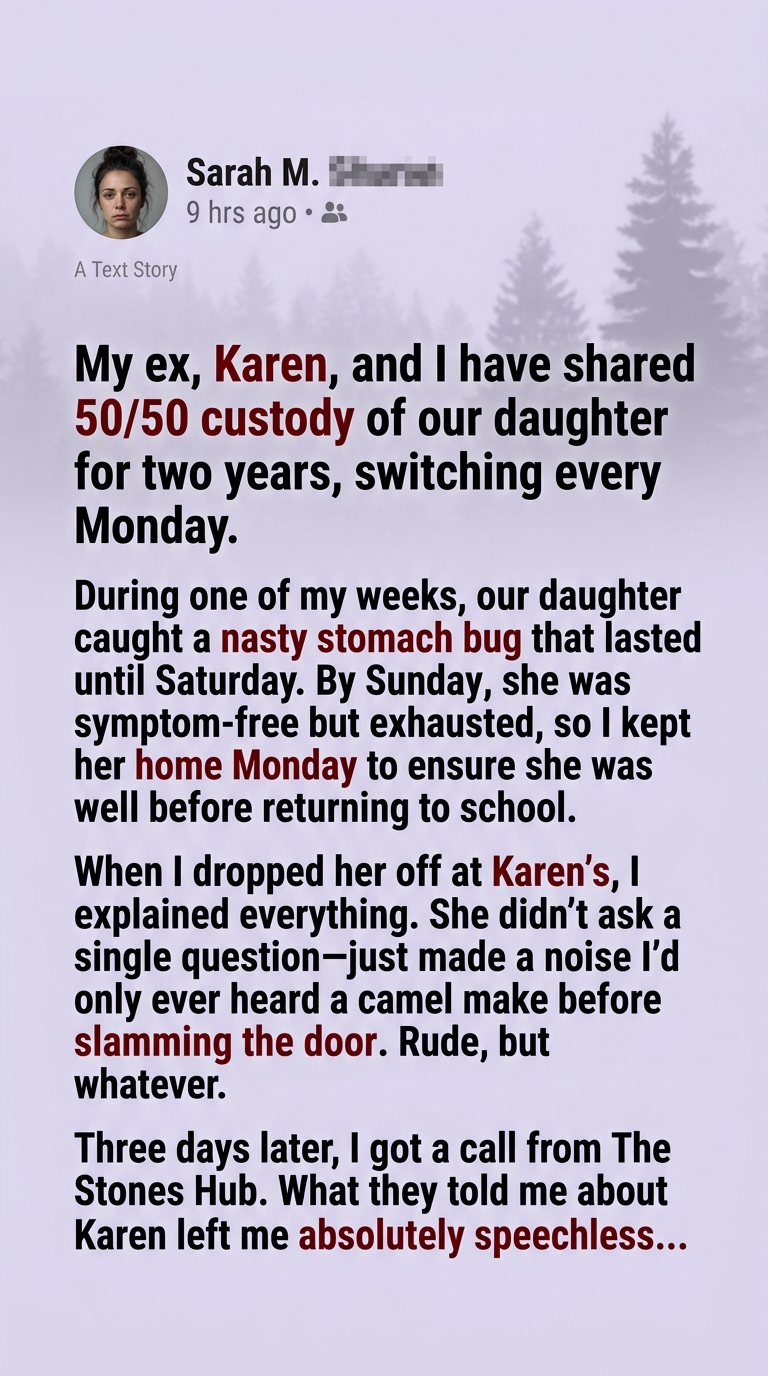
My ex, Karen, and I had shared 50/50 custody of our daughter for two years. We switched every Monday, which meant I only had to deal with Karen in person once a week.
Honestly, that arrangement was one of the few things about our divorce that worked.
Karen and I had never been particularly good at communicating, but we had developed a routine. We kept conversations short, exchanged school information, and avoided discussing anything that wasn’t directly related to our daughter.
It wasn’t friendly, exactly, but it was manageable.
Then our daughter caught a stomach bug during one of my weeks.
It started on Thursday morning. By that evening, she was miserable, and I was changing sheets, cleaning the bathroom, and trying to get her to drink enough fluids to stay hydrated.
Friday was worse.
By Saturday, the worst of it seemed to be over. She stopped vomiting and was finally able to keep food down, but she was completely drained.
On Sunday, she seemed much better. She watched cartoons on the sofa, ate some toast, and even managed a small smile when I made a terrible joke about her favorite television show.
But she still looked exhausted.
When Monday morning arrived, I decided to keep her home for another day. I wanted to make sure she was genuinely recovering before sending her back to school.
I messaged Karen to explain the situation, then drove our daughter to her mother’s house that afternoon.
Karen opened the door with her usual expression: the one that suggested my existence was a personal inconvenience.
“She was sick from Thursday through Saturday,” I explained. “She’s been symptom-free since then, but she’s still tired. I kept her home today so she could rest. She’s eating normally again, though, and she’s drinking plenty of fluids.”
Karen stared at me.
“Okay,” she said flatly.
I waited to see whether she had any questions.
She didn’t.
I added, “I’ll send you the details of what she ate today and when she last had symptoms.”
Karen made a noise I can only describe as something a camel might produce after discovering its favorite waterhole had been replaced with a parking lot.
Then she slammed the door.
I stood there for a moment, wondering whether I’d missed some important detail in the conversation.
Apparently, explaining that our sick child needed rest was now a personal attack.
I shrugged, got back into my car, and went home.
Three days later, I received a phone call that changed how I understood the entire situation.
The caller identified herself as a staff member from The Stones Hub, our daughter’s school.
“Hello,” she said. “We’re calling about your daughter and her recent absence.”
My stomach tightened.
“Is everything okay?”
“Yes, she’s fine. We just wanted to clarify something about the attendance record. Karen contacted us regarding the missed school day, and there seems to be some confusion about what happened.”
I sat up straighter.
“What kind of confusion?”
The staff member paused.
“Karen told us that you had refused to send your daughter to school because you wanted to interfere with the custody arrangement. She said your daughter had been perfectly healthy and that you were using illness as an excuse to keep her longer.”
I stared at the wall.
I actually laughed, because I thought I must have misunderstood.
“She was vomiting until Saturday,” I said. “I told Karen that when I dropped her off.”
“Yes, we understand that now. We spoke with the school nurse, who reviewed the information available to us, and we’ve documented the illness-related absence. We wanted to hear your account directly rather than rely on conflicting reports.”
I felt a knot form in my stomach.
Karen hadn’t simply been rude at the door.
She had contacted our daughter’s school and suggested I was deliberately interfering with her time.
“Did she say anything else?” I asked.
The staff member hesitated.
“She expressed concern that this wasn’t the first time you had kept your daughter home unnecessarily. She asked whether the school could notify her whenever you reported an illness.”
I closed my eyes.
This was the same woman who had ignored my explanation three days earlier.
Now she was presenting herself to the school as a concerned parent who had been kept in the dark.
I thanked the staff member for calling and asked what documentation they needed from me. I sent the dates of the symptoms, the messages I’d exchanged with Karen, and a brief summary of our daughter’s recovery.
I didn’t accuse Karen of anything. I didn’t demand that the school take sides.
I simply provided the facts.
After the call, I sat at my kitchen table for a long time.
The frustrating part wasn’t that Karen disagreed with my decision. Parents could reasonably differ about when a child was ready to return to school.
The problem was that she had turned a straightforward health decision into an allegation about my intentions without even asking me a question.
And our daughter was caught in the middle.
That evening, I sent Karen a message.
The Stones Hub called me about our daughter’s absence. I explained that she was sick Thursday through Saturday and still exhausted on Monday. If you have concerns about a medical or school decision, please ask me directly before making claims about my intentions.
She read it.
No response.
I wasn’t surprised.
The following week, I requested a meeting with the school’s attendance coordinator. I explained that Karen and I shared custody and asked whether the school could communicate attendance information to both of us equally, using the same process.
The coordinator agreed to review the school’s contact arrangements and clarify how absences should be documented. She also explained that the school couldn’t determine which parent was right in a custody disagreement; its responsibility was to record attendance accurately and support our daughter’s education.
That was all I wanted.
I also began keeping a simple record of illnesses, school absences, medication instructions, and important messages. Not to build a case against Karen, but because I wanted both parents to have the same information.
A few days later, Karen finally messaged me.
You made me look bad at the school.
I stared at the screen.
I hadn’t contacted the school to complain about her. The school had contacted me because she had raised concerns about me.
I replied:
I gave them the information they requested. I want us to communicate about our daughter’s health without making assumptions about each other.
She responded with a single thumbs-up.
It wasn’t an apology, but I wasn’t expecting one.
Over the next few weeks, things became slightly more organized. We used written messages for health updates and school information. If our daughter was sick, we recorded her symptoms and discussed when she was ready to return to class. The school began sharing attendance information through its usual channels so neither parent had to rely entirely on the other.
We didn’t suddenly become friends.
But our daughter deserved a system that worked even when her parents didn’t get along.
A month later, she came home from school and told me that she’d been chosen to help organize a classroom activity.
She talked excitedly about the decorations, the snacks, and which friends she hoped would participate.
As I listened, I realized how much energy I’d wasted trying to predict Karen’s next reaction.
I couldn’t control whether she interpreted my decisions fairly. I couldn’t force her to communicate respectfully. And I couldn’t undo the years of resentment that had accumulated between us.
But I could keep my own actions clear, consistent, and focused on our daughter.
The camel noise at the door still made me laugh whenever I remembered it.
The school call, however, taught me something more important: when co-parenting becomes difficult, the answer isn’t to trade accusations. It’s to document the facts, communicate directly, and keep the child out of the conflict.
Karen and I still had a long way to go.
But the next time our daughter got sick, I knew exactly what I would do.
I’d take care of her, keep the relevant records, inform her mother, and make decisions based on her needs—not on whether Karen approved of me.
Because our daughter didn’t need parents who won every argument.
She needed two parents who remembered that her health mattered more than their history.
And that was one thing I was determined never to forget.