His Son Threw Away His Father’s Tackle Box—Then I Discovered What Was Hidden Inside
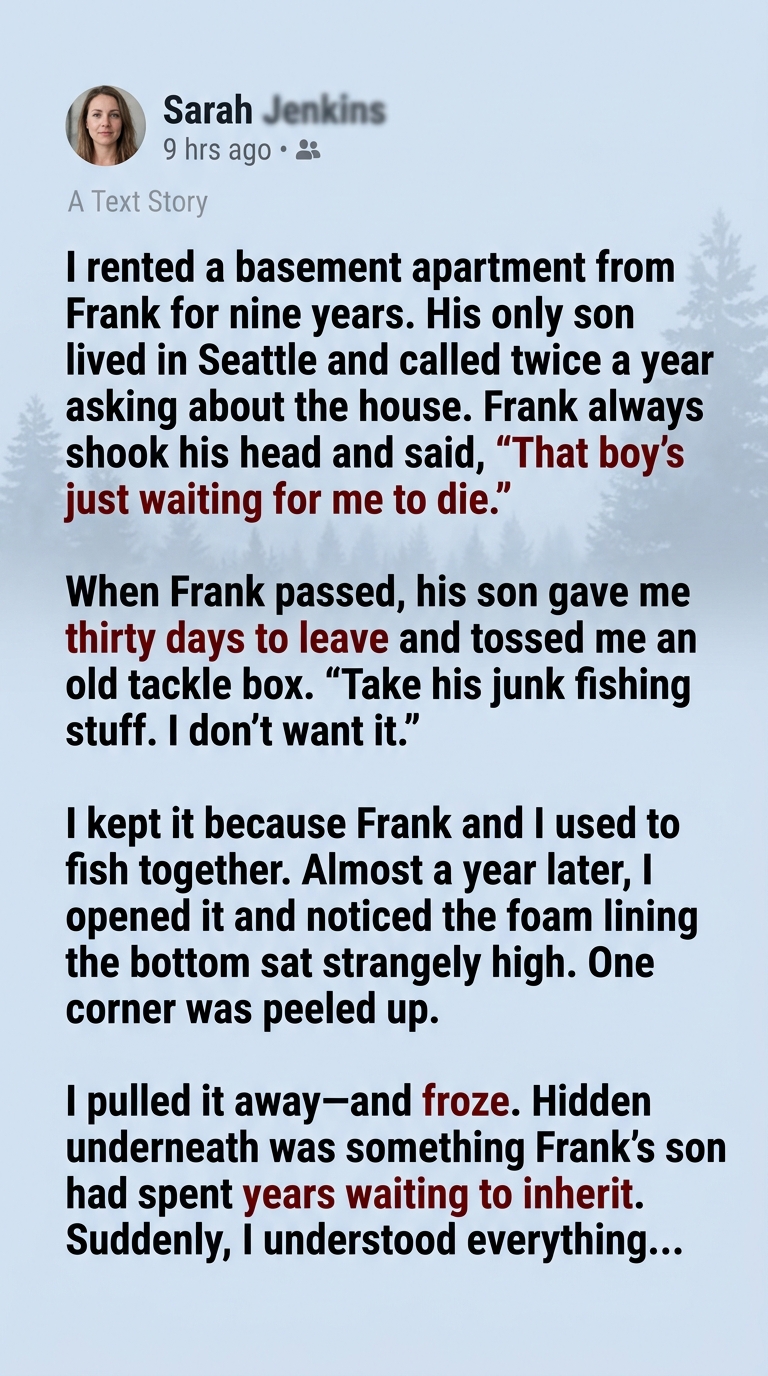
I rented a basement apartment from Frank for nine years. He was seventy-two when I first moved in, a quiet man with weathered hands, a crooked smile, and a habit of waking before sunrise to make coffee strong enough to strip paint.
His only son, Richard, lived in Seattle. He called twice a year, usually around Christmas and Frank’s birthday. Their conversations were short and awkward, and whenever Frank hung up, he’d stare out the kitchen window for a while.
“That boy’s just waiting for me to die,” he’d mutter.
I never knew what to say.
Frank rarely talked about his family, but he talked about fishing. Every Saturday morning, weather permitting, we’d drive to the lake with a thermos of coffee and two sandwiches wrapped in wax paper. He taught me how to tie knots, read the water, and recognize when a fish was testing the bait.
“Patience,” he’d say whenever I got frustrated. “The best things don’t come just because you want them.”
Those mornings became the best part of my week.
I wasn’t Frank’s child, and I never pretended to be. I was his tenant. But over the years, we became friends. I helped him carry groceries, drove him to appointments when his old truck wouldn’t start, and sat with him on evenings when the house felt too quiet.
He never asked me to do any of it.
And he never made me feel like I owed him for the kindness he showed me.
Then, one winter, Frank became ill.
His steps grew slower. He stopped fishing. The coffee remained strong, but he often left half of it untouched. I checked on him every day, sometimes bringing dinner upstairs when he was too tired to cook.
Richard visited once during those final months.
He spent most of the afternoon making phone calls and asking questions about the house, the property taxes, and whether Frank had updated his will.
After Richard left, I found Frank sitting at the kitchen table, staring at an old photograph of himself holding a fish.
“Did you have a good visit?” I asked.
He placed the photograph facedown.
“He wanted to know where I keep the important papers.”
I sat across from him.
“Maybe he was trying to help.”
Frank looked at me for a long moment.
“Maybe.”
But he didn’t sound convinced.
Frank died six weeks later.
At the funeral, Richard cried during the service. I wanted to believe the tears were genuine, and perhaps they were. Grief is complicated, especially when people have spent years avoiding the conversations they needed to have.
But three days after the funeral, Richard knocked on my door with a folder in his hand.
“My father is gone,” he said. “I need you to move out within thirty days.”
I stared at him.
“I understand the lease may need to change, but thirty days?”
“The house is part of the estate. I’m going to deal with it.”
I had rented the basement for nine years. I’d paid every month on time, kept the space clean, and never caused trouble. I knew I couldn’t assume I had a permanent right to stay, but I hadn’t expected to be treated like an inconvenience so soon after Frank’s death.
Richard glanced around my apartment.
“Dad kept a lot of junk down here. You can take whatever fishing stuff you want. I’m not dealing with it.”
He walked to the storage cupboard and dragged out an old green tackle box.
The paint was chipped. Rust had gathered around the hinges, and one corner was dented.
“Here,” he said, dropping it onto my table. “Take his junk fishing stuff. I don’t want it.”
Then he left.
I sat staring at the tackle box for a long time.
Eventually, I opened it.
Inside were fishing hooks, bobbers, a few rusty lures, spools of old line, and a pair of pliers Frank had used for years. The foam lining at the bottom was stained and brittle.
I packed everything carefully and took the box with me when I moved into a small apartment across town.
For months, I could barely look at it without thinking about Frank.
Life, however, has a way of demanding attention. I found a new place, adjusted to the higher rent, and returned to work. The tackle box sat in the back of my closet, untouched.
Almost a year passed.
Then, one rainy Sunday, I decided to clean out the closet.
I pulled out the tackle box and set it on the floor. As I lifted the lures, I noticed something odd about the foam lining. It sat strangely high along one edge, almost as though another layer had been placed underneath it.
I pressed down.
The foam shifted.
One corner had peeled away, revealing a narrow gap between the lining and the metal base.
I pulled it back.
And froze.
Hidden beneath the foam was a flat, oilcloth-wrapped envelope secured with an elastic band. Underneath it lay a small brass key and a folded sheet of paper.
My hands began to tremble.
I carefully opened the envelope.
Inside were copies of property records, a series of bank documents, and a handwritten letter addressed to me.
The first page was a deed.
I read it once, then again, struggling to understand what I was seeing.
The document described a small parcel of waterfront land that Frank had purchased decades earlier, long before the lake became a popular destination. The parcel included an old boathouse and a narrow strip of shoreline beyond the main property.
The next document was a statement from a local bank. It referred to a safe-deposit box and listed a number that matched the tag attached to the brass key.
I unfolded the letter.
Dear Sam,
If you’re reading this, I suppose I didn’t get the chance to explain everything in person.
First, don’t panic. The papers in this box are copies. The originals are stored safely, and the key will help you find them.
You may wonder why I’m telling you this instead of Richard.
I have tried for years to repair my relationship with my son. I love him. That will never change. But he has spent too much of his life measuring people by what they can give him. When he visits, he asks about the house, the land, and the money. He rarely asks whether I’m lonely.
You never asked what you would inherit. You simply showed up.
I had to stop reading.
My eyes filled with tears.
I wiped them and continued.
The waterfront parcel has been important to me since I was a young man. I bought it with money I saved from working at the mill. I built the little boathouse with my own hands, and your first fishing lesson happened on that shoreline.
Over the years, I kept the property separate from the main house. I had plans for it, but I never knew whether I’d live long enough to see them through.
I want you to understand that this isn’t a reward for helping me. You never helped me because I promised you anything. You helped because you cared, and that mattered more to me than you know.
Please contact the attorney named in the envelope before you do anything with these documents. She has the original records and instructions concerning the property. Don’t assume that a piece of paper makes something yours. Find out what is true first.
Whatever happens, remember our mornings at the lake. Those were good years.
Your friend,
Frank.
I sat on the floor with the letter in my lap, crying harder than I had at the funeral.
Frank had left me something far more complicated than an old tackle box.
But the letter made one thing clear: I needed to verify everything before drawing conclusions.
The following morning, I called the attorney named in the envelope.
Her name was Elaine Porter. After I explained who I was and what I’d found, she asked me to bring the documents to her office.
She examined the copies carefully, then checked her records.
“I was wondering when you’d discover this,” she said quietly.
My heart jumped.
“You knew about the tackle box?”
“Frank told me he’d hidden copies of certain documents in an item he expected you to keep. He didn’t tell me exactly where. He wanted you to find them naturally, without feeling pressured to do anything.”
She explained that Frank had purchased the waterfront parcel decades earlier and had later established a separate legal arrangement for it. He had worked with her to document his wishes and ensure that the property would be handled according to a valid estate plan.
The original records were in secure storage, and the brass key corresponded to a safe-deposit box holding additional paperwork.
“But what does this mean for me?” I asked.
Elaine folded her hands.
“It means we need to review the original documents and confirm the current title. If Frank’s estate plan is valid and the required steps were completed, the parcel may pass to you according to his instructions. We should not make promises until the records have been verified.”
For the next several weeks, she did exactly that.
She retrieved the original documents, confirmed the property’s legal status, and reviewed the estate records. There were questions about an old boundary description and a minor discrepancy in a survey, but those were resolved through the appropriate process.
Finally, she called me into her office.
“The documents are in order,” she said. “Frank’s plan was properly executed. The waterfront parcel and boathouse are to pass to you.”
I stared at her.
“You’re sure?”
“Yes. The transfer is being completed through the estate. There are still taxes, maintenance costs, and other practical matters to consider, but the legal basis for the transfer is sound.”
I thought about the old boathouse, the worn dock, and the mornings Frank and I had spent watching the water.
I hadn’t known the land was his separate property. I hadn’t known he’d made plans for it. And I certainly hadn’t expected to become its owner.
I asked Elaine whether I should tell Richard.
She explained that the estate process would require appropriate notices and disclosures. I had no intention of hiding anything or creating a dispute. I agreed to let her handle the communication.
Richard called me three days later.
His voice was furious.
“You knew about the waterfront land, didn’t you?”
“No,” I said. “I found documents in the tackle box you gave me.”
“You expect me to believe Dad left you property?”
“I don’t expect you to believe anything without seeing the records. Speak with the estate attorney.”
He accused me of manipulating his father.
That accusation hurt more than I expected.
I had spent nine years being there for Frank because I cared about him. I hadn’t known about the land. I’d never asked for a gift. And if Richard had kept the tackle box himself, he might have discovered the documents long before I did.
But I refused to argue.
Elaine sent him the relevant information and explained that the estate plan had been reviewed and the transfer was being handled properly. If he had concerns, he could raise them through the legal process.
He didn’t apologize.
For a while, I wondered whether Frank had been too harsh in his judgment of his son. I knew only the parts of their relationship I’d witnessed. Richard might have carried regrets and pain that I never understood. A strained relationship isn’t always the fault of one person.
But I also knew that Frank had been entitled to make his own estate plans, and he had taken formal steps to do so.
Eventually, I visited the waterfront parcel.
The boathouse was weathered, its paint peeling, and weeds had grown between the boards leading to the dock. I stood on the shore for a long time, remembering Frank’s voice.
The best things don’t come just because you want them.
I decided not to sell the land immediately. I had the property inspected, arranged insurance, and learned what it would cost to maintain. I repaired the dock where necessary and cleaned the boathouse, keeping the old tools and a few things Frank had left behind.
I couldn’t afford to turn it into a grand vacation property, and I didn’t try. I wanted to preserve the place as it was, with enough improvements to keep it safe.
The following spring, I carried the green tackle box down to the water.
I replaced the brittle foam, organized the lures, and placed Frank’s letter in a protective sleeve at home. The brass key went into a small wooden box beside the photograph of us fishing together.
Then I cast a line from the dock.
For a while, I caught nothing.
I smiled.
I could almost hear Frank telling me to be patient.
Richard never became my friend. We exchanged a few necessary messages through the attorney, but the warmth I had once hoped might grow between us never came. I felt sad about that, though I didn’t believe I could repair a relationship that he wasn’t willing to work on.
What I did have was a place that reminded me of a man who had treated me with kindness without asking what he might get in return.
Frank’s son had spent years waiting to inherit the house and everything he assumed came with it.
In the end, the thing he dismissed as junk fishing equipment held the documents that revealed his father’s most private plans.
But the real inheritance wasn’t the land, the boathouse, or whatever the property might someday be worth.
It was the memory of those quiet mornings, the lessons Frank had taught me, and the knowledge that kindness can matter even when nobody is watching.
I still keep the tackle box by the door.
Every time I open it, I remember the old man who taught me to fish—and who, in his own careful way, made sure I would always have a place beside the water.