Eleanor’s Secret: The Box Her Family Never Wanted Me to Open
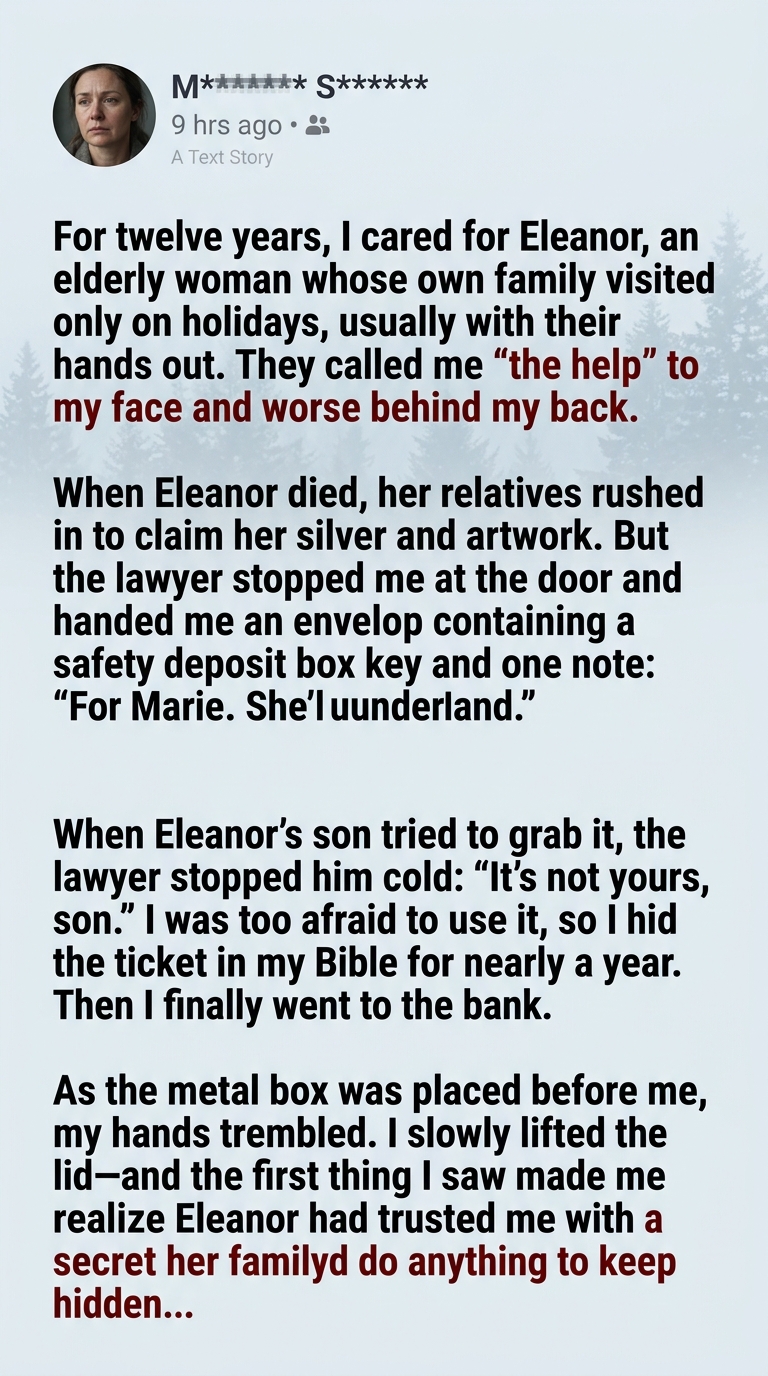
For twelve years, I cared for Eleanor Whitmore, an elderly woman whose own family visited only on holidays, usually with their hands out.
Her son, Richard, called me “the help” as if I were furniture. Her daughter, Caroline, smiled at me in public but complained that I was “taking advantage of a lonely old woman” whenever Eleanor paid me a Christmas bonus.
Neither of them knew how many nights I had sat beside Eleanor’s bed when her breathing grew difficult. They never saw me hold her hand through thunderstorms because she was afraid of dying alone. And they certainly never heard her whisper, “Marie, you’re the only person who comes here because you want to see me.”
I never expected anything from Eleanor. I had a modest apartment, a small pension from my late husband, and enough money to live comfortably. I stayed because Eleanor had become more than an employer. She had become family.
During my final year caring for her, something changed.
Eleanor began asking me strange questions.
“Marie, do you still keep your Bible beside your bed?”
“Of course,” I answered.
“And if someone gave you something important, something that might upset powerful people, would you have the courage to protect it?”
I laughed nervously. “At my age, Eleanor, I’m mostly trying to protect my knees.”
She smiled, but her eyes remained serious.
“Promise me you won’t let anyone convince you that your kindness makes you foolish.”
I promised, though I had no idea why she was asking.
Three months later, Eleanor died peacefully in her sleep.
I was holding her hand when she took her final breath.
Her children arrived the following morning. Richard barely glanced at me before asking where their mother kept her jewelry. Caroline walked through the house, making a list of paintings and antique furniture before the funeral arrangements were even finished.
I stood quietly in the hallway, feeling as though twelve years of my life had suddenly become invisible.
That afternoon, Eleanor’s attorney, Mr. Bennett, asked me to stay behind after the family meeting.
He closed his office door and removed a small envelope from his briefcase.
“Eleanor instructed me to give this to you personally,” he said.
Inside was a safety deposit box key, a bank location, and a handwritten note.
For Marie. She’ll understand.
I stared at the words, confused.
Before I could ask a question, Richard appeared in the doorway.
“What is that?”
Mr. Bennett immediately took a step between us.
“It’s a private bequest from your mother to Marie.”
Richard’s face darkened. “My mother wouldn’t give that woman anything without telling us.”
“Your mother’s instructions were clear,” the attorney replied. “And the contents of this envelope are not yours, son.”
Richard reached toward me, but Mr. Bennett raised his hand.
“I strongly suggest you leave Marie alone.”
I slipped the envelope into my handbag and hurried outside.
That night, I barely slept.
What could Eleanor have left me? Money? Jewelry? A letter? Something that might make her children accuse me of manipulating her?
I was frightened of being dragged into a family dispute I couldn’t afford to fight.
So I hid the envelope inside my Bible.
And there it stayed for nearly a year.
Sometimes I would open the Bible to read, see the edge of the envelope, and close it again. I told myself I was respecting Eleanor’s wishes by waiting until I felt ready.
But deep down, I was afraid.
Then, one rainy Tuesday morning, I remembered something Eleanor had said during our last Christmas together.
“Promises are only meaningful if we keep them when they become difficult.”
I put on my coat, took the envelope from my Bible, and drove to the bank.
The manager examined the key and my identification before leading me into a secure room. A few minutes later, a small metal box was placed on the table.
My hands trembled.
I inserted the key, turned it, and lifted the lid.
The first thing I saw was a thick stack of old photographs tied with a faded blue ribbon.
Beneath them lay a birth certificate, several letters, a sealed document, and a small velvet pouch.
I picked up the birth certificate.
The mother’s name was Eleanor Whitmore.
The father’s name was Thomas Whitmore, Eleanor’s late husband.
But the child’s name made my breath catch.
Richard Whitmore.
I turned the paper over, confused. Richard was Eleanor’s son. Why would she hide his birth certificate in a safety deposit box?
Then I noticed the date.
It was dated nearly a year before the date Richard had always claimed as his birthday.
I opened the first letter.
It was written by Eleanor’s husband, Thomas, decades earlier.
Eleanor, I know what we agreed to tell the children. Richard must never discover what happened before we married. But keeping this secret has cost us more than I imagined. If the truth ever comes out, I hope someone will protect the innocent.
My fingers went cold.
I opened the next letter. Then another.
Piece by piece, the truth emerged.
Richard was not Eleanor’s biological son.
He had been adopted as an infant after his birth mother, a young woman named Margaret, died shortly after childbirth. Eleanor and Thomas had been unable to have children, and they had welcomed Richard into their home, promising the adoption agency they would give him a safe and loving life.
For years, they had intended to tell him.
But Richard had grown increasingly volatile whenever the subject of adoption arose. Thomas eventually persuaded Eleanor to wait until Richard was older and more settled. Then Thomas died suddenly, and Eleanor lost the courage to reopen the subject.
The secret had become a wall between them.
But that wasn’t the worst part.
At the bottom of the box lay a second folder containing copies of letters from Richard to Eleanor, written over the previous decade.
They weren’t letters about the adoption.
They were letters about money.
Richard had repeatedly pressured his mother to change her will, threatening to stop visiting if she refused. In one letter, he accused her of loving Caroline more than him because she had once helped Caroline through a financial crisis.
In another, he wrote that if Eleanor wanted to remain part of his life, she needed to “start acting like a mother who appreciates what her son deserves.”
I had heard Richard speak cruelly to Eleanor, but I had never seen the full extent of it in writing.
Then I found a letter dated just six weeks before Eleanor died.
Marie has been kinder to me than my own children have been in years. Richard believes she is trying to inherit my property. He has no idea that I know what he has been doing. If anything happens to me, I want Marie to have these documents so she can protect herself from any accusations he might make.
My eyes filled with tears.
Eleanor had known.
She had known Richard might accuse me of manipulating her. She had known her family might try to intimidate me. And she had prepared for it.
But why had she chosen me?
I found the answer in the final envelope.
Inside was a letter addressed directly to me.
My dearest Marie,
If you are reading this, I am no longer there to explain myself. I am sorry for placing this burden in your hands.
You never asked me for money, jewelry, or a place in my will. You asked whether I had eaten, whether I was warm, whether I had slept well. You treated me like a person when my own family sometimes treated me like an obligation.
The papers in this box explain a secret my husband and I kept for too long. They are not yours to use against Richard, and I do not want you to hurt him with them. But I fear he may try to hurt you because he believes you have something that belongs to him.
I have left you a separate gift through my attorney. It is not payment for twelve years of care. No amount of money could measure what you gave me. It is simply my way of helping you live the years ahead without fear.
Please remember this: you were never just the help. You were the person who helped me feel human when I was old, frightened, and forgotten.
With all my love,
Eleanor.
I pressed the letter against my chest and cried.
Then I opened the velvet pouch.
Inside was a simple gold locket. It contained a tiny photograph of Eleanor as a young woman, standing beside a man I recognized from the old family portraits: Thomas.
Engraved on the back were six words.
Love is proven by showing up.
I stayed in that room for nearly an hour, reading every document carefully. I didn’t take anything that wasn’t meant for me. I asked the bank to make authorized copies of the relevant papers and returned the originals to the box.
Before leaving, I called Mr. Bennett.
He listened patiently as I explained what I had found.
“Eleanor anticipated this,” he said quietly. “She created a separate bequest for you, and the documents were preserved to protect her wishes. You don’t have to confront anyone yourself. Bring everything to my office, and we’ll make sure the records are handled properly.”
Two days later, I sat across from him and reviewed the documents connected to my own inheritance.
Eleanor had left me enough money to pay off my apartment and establish a modest retirement fund. It wasn’t a fortune, but it meant I would never again have to worry about choosing between groceries and electricity.
Mr. Bennett also confirmed that Eleanor’s estate plan had been properly documented.
Richard, however, was furious when he learned I had visited the bank.
He called me that evening.
“What did she leave you?” he demanded.
“I followed Eleanor’s instructions,” I replied.
“You had no right to take anything from that box.”
“The key was given to me by your mother’s attorney.”
“You think she loved you more than she loved her own children?”
His question hurt, but I answered honestly.
“I think she loved you. I also think she was hurt by the way you treated her. Both things can be true.”
He fell silent.
Then he threatened to sue me, claiming I had manipulated his mother during her final years.
For the first time, I didn’t panic.
I contacted Mr. Bennett, who advised me to preserve every communication and let the legal process handle any formal allegations. I didn’t argue with Richard or threaten to expose the adoption secret. I simply kept my records and refused to be intimidated.
No lawsuit followed.
Several weeks later, Caroline contacted me. She wanted to know what Eleanor had left behind.
I told her that I would not share private documents without the proper guidance of the attorney. I also told her something I had never dared to say before.
“Your mother loved you both. But she deserved kindness even when she wasn’t giving you anything.”
Caroline began to cry.
She admitted she had spent years believing Richard when he said Eleanor was becoming confused and overly dependent on me. She had never questioned why their mother seemed lonely despite having two children.
“I thought you were just doing a job,” she whispered.
“I was doing a job,” I said. “But I was also caring for a person.”
She asked whether I would let her see Eleanor’s letter to me.
I thought about it, then shook my head.
“That letter was meant for me. But if you want to understand your mother, I can tell you about the woman I knew.”
So I did.
I told her about Eleanor’s terrible jokes, her love of old jazz records, the way she insisted on wearing bright scarves even in winter, and how she always asked me about my late husband because she knew grief could make a person feel forgotten.
Caroline listened for nearly two hours.
When she finally left, she carried no documents or jewelry. She carried stories about her mother she had never bothered to ask for.
Richard never apologized, and I stopped waiting for him to.
A year after Eleanor’s death, I placed her photograph on the shelf beside my Bible. The safety deposit box key went into a small wooden keepsake box, along with her letter and the gold locket.
I still think about the secret Eleanor entrusted to me. I understand now that it wasn’t simply the story of an adoption, or the evidence of a family that had grown bitter over money.
It was a reminder that a person’s worth cannot be measured by their last name, their inheritance, or the position they hold in someone else’s household.
Richard had spent years believing that being family entitled him to everything.
I had spent twelve years believing that being “the help” meant I should stay quiet.
Eleanor taught me that neither was true.
Family is not proven by who expects a share of what you leave behind.
It’s proven by who shows up when you have nothing left to give.
And I will always be grateful that, in the final chapter of her life, Eleanor made sure I knew I mattered.
The greatest thing she left me wasn’t money or a secret. It was the certainty that I had never been invisible to her.