My Father Broke My Finger for Asking Why My Sister Got Steak. Years Later, He Came Begging for My Help.
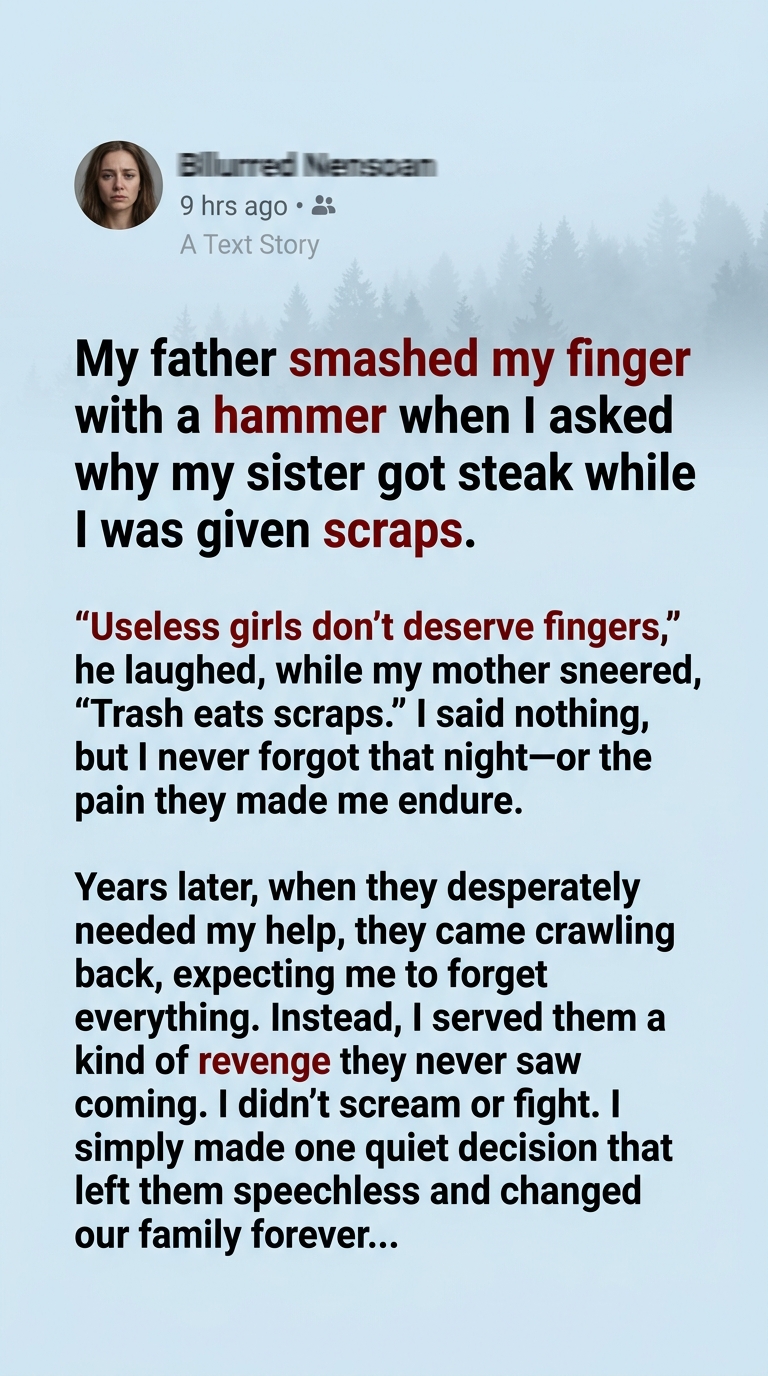
The night my father smashed my finger with a hammer, I was seventeen years old.
My sister, Rachel, sat across the table eating a thick, juicy steak with roasted potatoes. My father had bought it especially for her because she had earned good grades that week.
I sat beside the kitchen sink with a plate of cold scraps.
There was barely enough food to fill my stomach.
I had spent the entire afternoon cleaning the house, washing clothes, and preparing dinner. Yet when I asked why Rachel received a proper meal while I was given leftovers, my father slowly put down his fork.
“What did you say?”
I swallowed hard.
“I just wanted to know why she gets steak and I get scraps.”
My mother looked up from her plate and sneered.
“Trash eats scraps.”
Rachel giggled.
I should have stayed quiet. I knew better than to question my father. But after years of being treated like an unwanted burden in my own home, something inside me finally broke.
“That isn’t fair,” I whispered.
My father’s chair scraped against the floor.
He walked toward me, picked up a hammer he had been using to repair a cabinet, and ordered me to hold out my hand.
I froze.
“Dad, please—”
The hammer came down.
Pain exploded through my finger. I screamed and stumbled backward, clutching my hand against my chest.
My father laughed.
“Useless girls don’t deserve fingers.”
My mother didn’t call an ambulance. She didn’t even stand up.
“Maybe next time you’ll learn to be grateful for what you’re given,” she said.
Rachel went back to eating.
I spent that night holding my injured hand against my body, biting a towel to keep from crying loudly enough to anger my father again.
The next morning, my finger was swollen and dark. It hurt so badly that I could barely move it.
When I asked my mother to take me to a doctor, she refused.
“We don’t have money to waste on your drama.”
I eventually went to a clinic by myself using money I had secretly saved from small jobs. The doctor examined my hand, treated the injury, and explained that the damage might affect movement if I didn’t follow the treatment instructions.
I was terrified.
But I was even more terrified of going home.
That was the first time I understood something no child should have to learn: the people who were supposed to protect me were the people I needed protection from.
I finished school while working evenings at a small grocery store. I hid money in an old pencil case and quietly made plans to leave.
On my eighteenth birthday, I packed two bags.
My mother stood in the doorway, watching me.
“Where do you think you’re going?”
“Somewhere I can live without being afraid.”
My father laughed from the living room.
“You’ll be crawling back before the month is over.”
I looked at him one last time.
I wanted to tell him how much I hated him. I wanted to make him understand what he had done.
Instead, I picked up my bags and walked out.
I never asked them for money.
I worked two jobs, rented a tiny room, and enrolled in evening classes to study accounting. Some nights, I ate instant noodles for dinner. Other nights, I fell asleep over my textbooks.
But nobody hit me.
Nobody called me trash.
And nobody decided whether I deserved to eat.
For the first time, my life belonged to me.
Years passed.
I graduated, found a job at a regional accounting firm, and worked my way into a senior position. Eventually, I started my own bookkeeping and financial consulting business.
It wasn’t glamorous. I didn’t become rich overnight. I simply learned to save, invest carefully, and build something stable.
The little girl who had once been denied a proper dinner became a woman who could pay her bills, choose her own home, and sleep peacefully at night.
I also learned to set boundaries.
I didn’t contact my parents. They didn’t contact me either, except for the occasional message from my mother complaining that I had forgotten my family.
I had not forgotten.
I remembered every word.
Every bruise.
Every night I went to bed hungry while Rachel received whatever she wanted.
And I remembered the hammer.
Then, nearly fifteen years after I left home, my phone rang.
It was Rachel.
Her voice sounded different—strained and frightened.
“Please don’t hang up,” she said. “Dad is in the hospital.”
I said nothing.
“He had a serious health problem. The doctors say he needs further treatment, and the bills are more than we can manage. Mom has been trying to borrow money, but nobody will lend us enough.”
I closed my eyes.
For years, I had imagined what I would do if they ever needed me.
Part of me wanted to laugh. Part of me wanted to ask whether my father remembered the night he decided I wasn’t worth protecting.
Instead, I asked one question.
“Why are you calling me?”
Rachel began to cry.
“Because you’re the only one we know who might be able to help.”
There it was.
Not an apology.
Not an acknowledgment of what had happened.
A request.
I agreed to meet them at the hospital the following afternoon.
When I entered the room, my father looked smaller than I remembered. His hair had turned gray, and his face was drawn with exhaustion.
My mother sat beside him, clutching a folder of medical bills.
The moment she saw me, she stood up.
“Oh, thank goodness. We knew you’d come.”
She hugged me before I could react.
I stiffened.
My father looked at me from the bed.
“You’ve done well for yourself,” he said. “Rachel tells me you own a business now.”
“Yes.”
“Then you understand. Family has to help family.”
I stared at him.
For fifteen years, he had never wondered whether I had enough money to eat. He had never asked whether I was safe, whether I was struggling, or whether I needed help building my future.
Now he wanted to talk about family.
My mother opened the folder and pushed it toward me.
“We need you to cover the treatment costs. Your father worked hard his whole life. He deserves this.”
I looked through the paperwork. There were genuine medical expenses, but there were also other debts and household costs mixed in.
“How much of this is for his medical care?” I asked.
My mother frowned.
“What difference does that make? We need help.”
“It makes a difference to me.”
My father shifted impatiently.
“Don’t turn this into a business meeting. I’m your father.”
I looked at the hand resting on his blanket.
I could still feel the old injury in my own finger whenever the weather changed.
“I remember,” I said quietly.
He stared at me.
“Remember what?”
“The night you broke my finger because I asked why Rachel got steak and I got scraps.”
The room went silent.
My mother looked away.
My father’s expression changed, but only for a moment.
“That was a long time ago,” he muttered. “You were a difficult child.”
I almost smiled at the familiar excuse.
“You were an adult with a hammer.”
Rachel covered her mouth.
My mother quickly interrupted.
“We didn’t come here to argue about the past. Whatever happened, we’re still your family.”
I took a breath.
Then I made the decision that would change everything.
“I won’t give you money to do whatever you want with it,” I said. “But I’ll help with verified medical expenses directly, provided the doctors confirm the treatment plan and the hospital can explain the costs. I’ll also help you speak with the hospital’s financial assistance office and review any available payment options.”
My mother blinked.
“You’ll pay?”
“I said I’ll consider covering specific, verified treatment costs directly. I’m not paying unrelated debts, and I’m not handing over cash without knowing where it goes.”
My father looked offended.
“You think I’m going to steal from my own daughter?”
“No,” I replied. “I think trust has to be earned.”
His face flushed.
“After everything I’ve done for you—”
I stood up.
“Don’t.”
My voice was quiet, but it stopped him.
“You don’t get to use the word family as a weapon. I came because I decided to come. I am willing to help with a medical need because I don’t want to become cruel just because someone was cruel to me.”
I looked at my mother.
“But helping you doesn’t mean pretending nothing happened.”
For the first time, neither of my parents had an answer.
I left the hospital after arranging to speak with the billing office. Over the next few days, I reviewed the treatment estimates, confirmed the charges, and helped the family understand which expenses were urgent and which could be handled through a payment plan.
I paid a portion of the verified medical costs directly to the hospital. I did not pay their unrelated debts, and I did not agree to become their permanent financial safety net.
My father received treatment.
His recovery was slow, but he eventually returned home.
I didn’t visit immediately. I needed time to understand what I had done and what I expected from them.
A few weeks later, Rachel called again.
“Dad wants to see you,” she said.
“Why?”
“He says he needs to tell you something.”
I almost refused, but I agreed to one short visit.
When I arrived, my father was sitting in the living room. My mother stood behind him, unusually quiet.
He looked at my hands.
“Your finger,” he said. “Does it still hurt?”
“Sometimes.”
He swallowed.
“I remember that night.”
I waited.
“I told myself you were being disrespectful. I told myself I had to make you obey. But that doesn’t excuse what I did.”
It was the closest thing to an honest admission I had ever heard from him.
Then he said the words I had waited fifteen years to hear.
“I was wrong to hurt you. You were a child, and I was supposed to protect you. I’m sorry.”
My eyes burned, but I refused to confuse the apology with the return of the childhood I had lost.
“Thank you for saying that,” I replied. “But an apology doesn’t erase what happened.”
“I know.”
My mother stepped forward.
“I should have helped you that night,” she whispered. “I should have taken you to a doctor. I was wrong, too.”
For a moment, I saw the frightened girl I had once been, waiting for her mother to stand up for her.
She never had.
I could not change that now.
“I hope you mean what you’re saying,” I told them. “But if we’re going to have any relationship, things must be different. No insults. No threats. No demands for money. And I will not accept being treated as less important than Rachel.”
My father nodded slowly.
“I understand.”
I didn’t rush to forgive them. I didn’t move back into their lives as though fifteen years of pain could disappear in one conversation.
Instead, I let their actions speak.
Over the following months, Rachel and I began talking more honestly. She admitted that she had grown up believing she deserved better treatment because our parents had always told her so. She also admitted that she had watched me suffer without questioning it because being the favored child was easier.
Her confession hurt, but it was honest.
We began rebuilding our relationship slowly. I made it clear that I would love her without funding every problem in her life, and she learned to ask rather than demand.
My parents’ progress was less predictable. Sometimes my father slipped into old habits. When he did, I ended the conversation and left. Gradually, he learned that being my father no longer gave him unlimited access to my life.
The revenge I had imagined for years never came.
I didn’t humiliate them in public. I didn’t leave them helpless when they needed treatment. I didn’t use their suffering to make them feel the pain they had once caused me.
My revenge was quieter.
I became someone they could no longer control.
I built a life they could not take away. I helped on my own terms, not because they ordered me to, but because I chose to. And I refused to let their cruelty decide the kind of person I would become.
One evening, I looked down at my injured finger while preparing dinner in my own kitchen.
The scar was faint now.
I used to believe that if I ever became successful, my parents would finally realize I had been worth something all along.
I was wrong.
I had been worth something before I earned my first paycheck, before I graduated, and before I built my business.
I had been worth protecting when I was seventeen and hungry at their kitchen table.
My father had failed to see that.
But I no longer needed him to understand my worth.
They came back expecting the daughter they had once controlled. Instead, they found a woman who could help them without surrendering herself—and who finally understood that forgiveness, if it ever came, would be her choice.