My 19-Year-Old Daughter Got Pregnant, Quit College, and Demanded I Help Raise Her Baby. Then She Asked Me for Something I Never Expected.
My daughter Rose had always been the kind of girl parents bragged about.
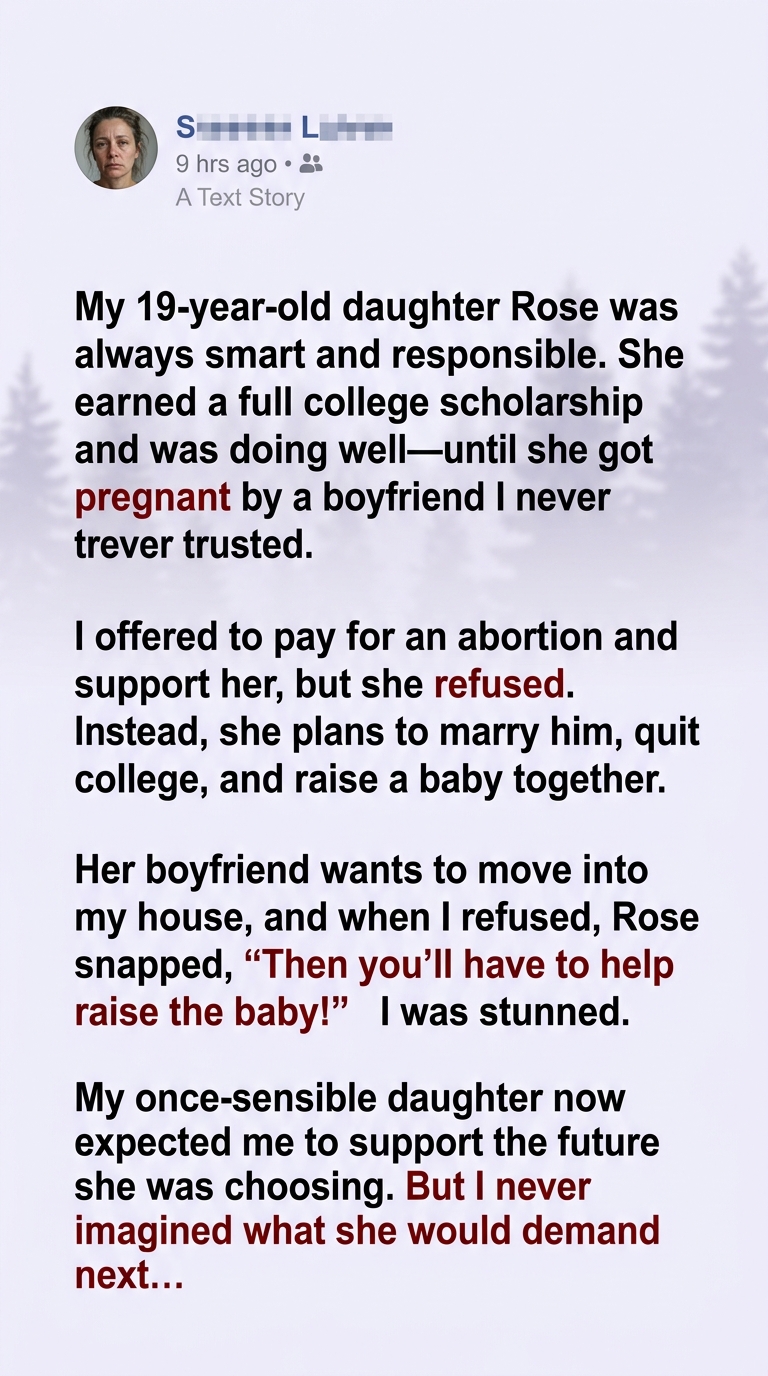
At nineteen, she had earned a full college scholarship, maintained excellent grades, and built a future that seemed brighter than anything I could have imagined for her. She was organized, ambitious, and responsible.
Then she got pregnant by a boy I had never trusted.
His name was Tyler, and from the moment I met him, something felt wrong. He talked endlessly about his plans but never seemed to follow through. He borrowed money and forgot to repay it. He had a new excuse every time someone asked him about work.
Still, Rose loved him.
When she told me she was pregnant, I sat beside her at the kitchen table and tried to keep my voice calm.
“You have options, sweetheart,” I told her. “Whatever you decide, I will help you get through this. If you choose an abortion, I’ll pay for it. If you decide to continue the pregnancy, we’ll talk about what support you need.”
Rose stared at the table.
“I’m keeping the baby.”
I nodded slowly. “Then we need to make a plan. You can still finish college. Let’s talk to your scholarship office and find out what options you have.”
She shook her head.
“I’m not going back.”
I thought I had misunderstood.
“What do you mean?”
“I’m quitting college. Tyler and I are getting married. We’re going to raise our baby together.”
My stomach tightened.
“Rose, you’re nineteen. You have a scholarship that could change your life. Why are you giving it up before you’ve even explored your options?”
“Because I want to be a mother!”
“I know you do. But being a mother doesn’t mean you have to abandon every other part of your future.”
Her eyes filled with tears.
“You just don’t want me to have this baby.”
“That isn’t true. I want you to have a safe, stable life. I want you to understand what you’re choosing.”
She pushed her chair back.
“Tyler says we can move in here until we get on our feet.”
I stared at her.
“No.”
Her expression changed instantly.
“What do you mean, no?”
“I mean Tyler cannot move into my house. You’re welcome to talk with me about your future, but I’m not agreeing to support both of you indefinitely.”
Rose stood up.
“Then you’ll have to help raise the baby!”
I was so stunned that I couldn’t speak for several seconds.
She looked at me as though she had just delivered a perfectly reasonable solution.
“You’re my mother,” she continued. “You’ll have to babysit while we work. You’ll help with expenses. That’s what grandparents do.”
“Grandparents help when they choose to. They don’t automatically become the parents.”
Rose’s face turned red.
“So you’re going to abandon your own grandchild?”
“No. I’m telling you that loving a child and taking responsibility for that child’s parents are two different things.”
She stormed out of the kitchen.
I thought that was the worst of it.
I was wrong.
Three days later, Rose came home carrying a folder. Tyler followed her, looking unusually confident.
“We need to talk,” she announced.
I put down my coffee.
“About what?”
Rose placed the folder on the table.
Inside were printouts of apartment listings, estimates for baby furniture, and a handwritten monthly budget. The numbers were frightening.
Rent. Utilities. Food. Insurance. Medical appointments. Baby supplies.
Their projected income barely covered the rent.
I looked up.
“How much does Tyler earn?”
“He’s looking for a better job,” Rose replied.
“That’s not an amount.”
“He has interviews.”
I turned to Tyler.
“Do you have a job right now?”
He shifted in his chair.
“I do some delivery work. But once the baby comes, things will be different.”
“Different how?”
“We’ll figure it out.”
I had heard those words too many times.
I closed the folder.
“You need a budget based on money you actually earn, not money you hope to earn.”
Rose’s eyes narrowed.
“This is exactly why I brought the papers. I knew you’d criticize everything.”
“I’m asking basic questions because a baby needs more than optimism.”
Tyler leaned forward.
“With all due respect, you’re making this harder than it needs to be. You have a house. You have a good job. Why can’t we stay here for a year? It would give us time to save.”
“Because I want my home to remain my home.”
Rose looked at me with a coldness I had never seen in her before.
“Fine. Then we’ll need you to pay our rent.”
I blinked.
“What?”
She tapped the budget.
“If you won’t let us move in, you should help us get our own place. We found an apartment near the hospital. You can cover the rent for the first year, and we’ll handle the other expenses.”
I stared at her.
“You’re asking me to pay the rent on an apartment for you and Tyler?”
“It’s for your grandchild.”
“And what happens after the first year?”
“We’ll be working by then.”
“Both of you?”
Rose hesitated.
Tyler looked at the floor.
I pushed the folder back toward her.
“No.”
Her mouth fell open.
“You haven’t even thought about it!”
“I have. And my answer is no.”
Then she delivered the demand that finally made me understand how far this had gone.
“Grandpa left you money when he died. I know you have savings. If you really cared about this baby, you’d give us enough to buy a house. Then we’d never have to ask you for anything again.”
I felt as though the air had been knocked out of me.
Rose knew about the inheritance. She knew I had spent years saving for retirement and repairing my home. But she had never asked how much money I had, how hard I had worked, or what I might need in the future.
She had simply decided that my resources were part of her plan.
“Rose,” I said quietly, “that money is not yours.”
Her eyes flashed.
“So you’re choosing money over your daughter?”
“No. I’m refusing to let you make financial commitments on my behalf.”
Tyler stood up.
“This conversation is pointless.”
He grabbed the folder.
“Come on, Rose. We don’t need her.”
Rose followed him toward the door, then turned back.
“When the baby comes, don’t expect us to bring her around if you’re not going to support us.”
The door slammed.
I sat at the table long after they left.
I was angry, frightened, and heartbroken. I worried about Rose. I worried about the baby. And beneath all of that, I was grieving the daughter I thought I knew.
But I also knew that if I gave in to every demand because I feared losing her, I would be teaching her that pressure was the same thing as responsibility.
So I made a decision of my own.
I called a family counselor and arranged an appointment for myself. I also gathered information about college deferrals, financial aid, childcare assistance, and local services for young parents. I wanted to offer Rose practical options without making promises I couldn’t sustain.
A week later, I invited her to meet me for lunch.
She arrived alone.
“I thought you were going to apologize,” she said as she sat down.
“I am sorry.”
Her expression softened slightly.
“Really?”
“I’m sorry that you’re scared and that I haven’t found a way to make this easier. I’m sorry that we keep hurting each other when we talk about the future.”
She looked down.
“But I’m not sorry for saying no to buying you a house,” I continued. “And I’m not going to pay your rent indefinitely.”
Her face hardened again.
“Then why did you ask me here?”
“Because I love you, and I don’t want this argument to destroy our relationship.”
I slid a piece of paper across the table.
It listed several things I was willing to do.
I would help Rose contact her college and learn whether she could take a temporary leave rather than permanently give up her scholarship. I would attend a prenatal appointment with her if she wanted me there. I would help her create a realistic budget based on actual income. I would also be willing to discuss occasional babysitting, with advance notice and clear limits, once the baby arrived.
But I would not give Tyler unrestricted access to my home, pay for a house, or become responsible for all their living expenses.
Rose read the list twice.
“So you want to control everything.”
“No. I want us to agree on what help looks like before resentment takes over.”
She folded the paper.
“Tyler says you’re trying to separate us.”
“I’m not asking you to leave him. I’m asking you to look carefully at the life you’re building with him.”
“He loves me.”
“I hope he does.”
“He says we’ll get married next month.”
“Have you discussed how you’ll pay your bills? Who will care for the baby? What happens if one of you loses a job? What happens if you want to return to college?”
Rose looked away.
“We’ll figure it out.”
I reached across the table, but I didn’t touch her hand.
“Sweetheart, I want you to have a partner who figures it out with you, not someone who leaves you carrying every question alone.”
She stood up abruptly.
“I knew you wouldn’t understand.”
She left before I could say anything else.
For several weeks, we barely spoke.
Then, one evening, Rose called me at nearly midnight.
Her voice was shaking.
“Mom, can I come over?”
“Of course.”
She arrived twenty minutes later, carrying a backpack. Her eyes were swollen from crying.
Tyler had lost his delivery work. The apartment they had hoped to rent was no longer available. He had been arguing with her about money and telling her she needed to convince me to help them.
That night, he had told her that if she couldn’t get money from me, she would have to find another way to provide for the baby.
“I thought he would be excited,” she whispered. “I thought we’d be doing this together.”
I sat beside her.
“What do you want to do now?”
“I don’t know.”
For the first time since announcing her pregnancy, Rose wasn’t defending a plan. She was admitting that she was frightened.
I didn’t tell her I had warned her.
I didn’t say, “I told you so.”
I made her tea, found her a blanket, and let her cry.
The next morning, we sat at the kitchen table and talked about practical steps. Rose agreed to contact her college. She also made an appointment with a prenatal care provider to discuss her health and her options for continuing her education while preparing for the baby.
I reminded her that she didn’t have to marry Tyler simply because she was pregnant. If she chose to marry him, it needed to be because she genuinely wanted that commitment—not because she was afraid of raising a child without him.
She listened quietly.
A few days later, she told Tyler she wouldn’t marry him next month. She wanted time to see whether they could build a stable relationship and share responsibility for their child.
He was furious.
He accused her of listening to me and threatened to leave.
Rose cried after the call, but she didn’t change her mind.
It wasn’t an easy decision. She still loved him. She still wanted her child to have two parents who loved each other. But she had begun to understand that a wedding couldn’t guarantee any of those things.
Over the following months, she continued her pregnancy and worked with her college to explore options for preserving her scholarship. The school couldn’t promise that every arrangement would be possible, but she learned that she had more choices than she had originally believed.
Tyler’s involvement became inconsistent. Sometimes he attended appointments and spoke excitedly about the baby. Other times, he disappeared for days.
Rose stopped building her future around his promises.
When her daughter was born, I was in the hospital room holding Rose’s hand.
She was exhausted, frightened, and overwhelmed. But when the nurse placed the tiny baby in her arms, Rose looked at her daughter with a tenderness that brought tears to my eyes.
“She’s so small,” Rose whispered.
I sat beside her.
“She is.”
Rose began crying.
“Mom, I’m scared I won’t know how to do this.”
I brushed the hair from her forehead.
“None of us knows everything before we begin. We’ll take it one day at a time.”
She looked at me.
“Are you still angry with me?”
I thought carefully before answering.
“I was hurt by some of the things you said. But I love you. And I want to help you build a life where you and your daughter can be safe and independent.”
She swallowed.
“I shouldn’t have demanded that you buy us a house.”
“No, you shouldn’t have.”
“And I shouldn’t have told you that you couldn’t see your grandchild.”
“No.”
She looked down at the baby.
“I’m sorry.”
I took her hand.
“Thank you.”
Our relationship didn’t magically become perfect after that conversation. We still disagreed. Rose still had to learn how to budget, make difficult decisions, and ask for help without assuming that help was owed to her.
I had to learn something, too: I could support my daughter without rescuing her from every consequence, and I could love my grandchild without becoming the third parent by default.
I began helping with occasional childcare while Rose worked toward returning to her studies. We established a schedule that respected both her responsibilities and my own life. I helped her research childcare options and plan for expenses, but she remained responsible for her choices.
Tyler eventually became more involved for a period, though Rose continued to make decisions based on his actions rather than his promises. She understood that her daughter’s future could not depend on whether he happened to keep his word.
Months later, Rose brought the baby to my house on a quiet Sunday afternoon.
She watched me rock her daughter in the living room.
“Mom,” she said, “I thought you were refusing to help because you didn’t care.”
I looked at her.
“I was refusing to promise things I couldn’t responsibly give. There is a difference.”
She nodded slowly.
“I understand that now.”
I kissed the baby’s forehead.
I still wished Rose had finished college before becoming a mother. I still worried about the road ahead. But I no longer saw her as the sensible girl I had lost.
She was a young woman learning how to become responsible for another human being.
And I was a mother learning that sometimes the most loving answer is not an unconditional yes.
I would always be there for Rose and her daughter. But I would never again confuse loving my child with surrendering my entire future to the choices she made.