My Brother Had Three Women Pregnant and Kept Asking Me for Money—Until One Sentence Changed Everything
My brother Michael had always been irresponsible with money, but nothing prepared me for the day he called asking for help with his third child.
“Please, I just need $2,000,” he said. “The baby is coming soon, and I have hospital bills, rent, and everything else to worry about.”
I closed my eyes and rubbed my forehead.
“Michael, are you serious right now?”
“What?”
“You already have children with two other women. Now there’s a third? How many times am I supposed to bail you out?”
He sighed.
“I wouldn’t ask if I had another option.”
That was exactly what he had said the last time. And the time before that.
For years, I had watched him make one reckless decision after another. He borrowed money, promised to repay it, and disappeared until the next emergency. Meanwhile, I worked overtime, paid my bills, and tried to build a stable life.
I loved my brother, but I was exhausted from being his emergency fund.
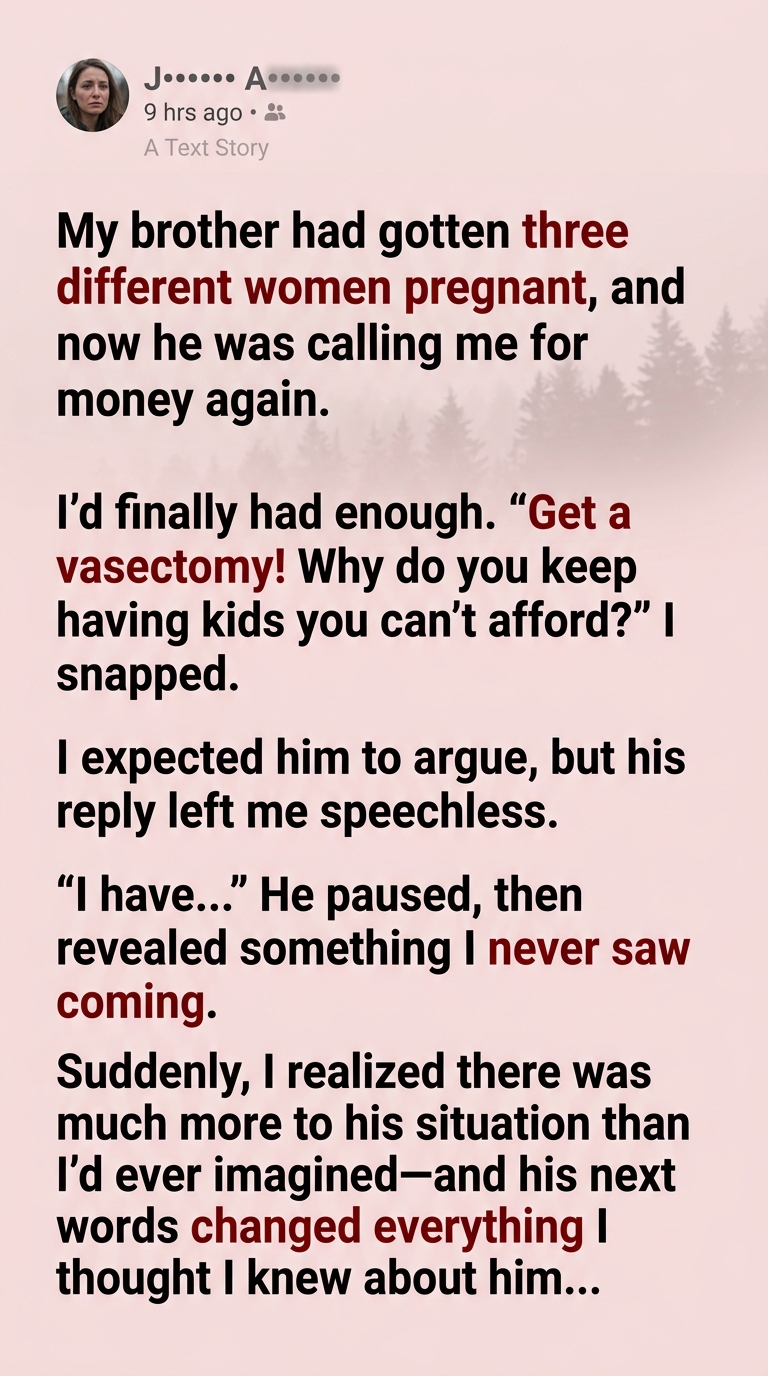
“Get a vasectomy!” I finally snapped. “Why do you keep having kids you can’t afford?”
Silence.
I expected him to yell at me. I expected him to call me heartless or remind me that family was supposed to help family.
Instead, he whispered, “I have.”
I froze.
“What did you say?”
“I had a vasectomy two years ago.”
I stared at my phone.
“That doesn’t make any sense. You told me this woman is having your baby.”
“She believes it’s mine.”
My anger suddenly gave way to confusion.
“Michael, what exactly are you telling me?”
He took a shaky breath.
“I’m telling you that I haven’t been able to have biological children since the procedure. I had the follow-up testing, and the doctor confirmed it worked. But when I told you I was having another baby, I didn’t know how to explain everything else.”
I sat down.
For the first time in years, my brother sounded genuinely frightened.
“Then why are you asking me for money?”
“Because I’m trying to help the baby,” he said. “And because I made promises I shouldn’t have made.”
He told me that the woman, Vanessa, had known about his two older children. She had told him she was pregnant and believed he was the father. Michael had admitted to me that he had been careless, but he had never told me about the vasectomy.
He explained that he had undergone the procedure after realizing he couldn’t responsibly raise more children. He had kept the decision private because he was embarrassed by how his life had turned out and didn’t want our family judging him.
But his explanation didn’t erase the obvious question.
“If you knew you couldn’t father another child, why didn’t you tell Vanessa?”
He went quiet.
“Because I was afraid she’d leave.”
I felt a fresh wave of anger.
“So you let her believe something that might not be true?”
“I know. I know how it sounds.”
“It sounds like you lied to someone who deserved the truth.”
He didn’t argue.
Then he said something I wasn’t expecting.
“I’m not asking you to help me hide anything. I’m asking for help because I don’t want another child to suffer because of my mistakes.”
I wanted to believe him, but I had heard too many promises.
“Michael, I can’t keep sending money every time your life falls apart. And I won’t help you mislead Vanessa.”
“I understand.”
“If you want my help, you need to be honest with her, and you need to get medical advice about what your vasectomy means. You also need to stop making promises you can’t keep.”
He began to cry.
“I know,” he whispered. “I just don’t know how to fix everything.”
For the first time, I heard something beneath his excuses: shame.
That didn’t make his behavior acceptable, but it made me realize that shouting at him wasn’t going to solve the problem either.
I told him I would meet him the following afternoon. We would go through his expenses, work out what he could realistically afford, and figure out what needed to happen next.
But I made one condition clear.
“No more lies. Not to me, and not to Vanessa.”
The next day, Michael arrived at my house looking as though he hadn’t slept. He brought a folder filled with medical paperwork, bills, and letters about unpaid rent.
I had expected excuses.
Instead, he placed the documents on the table and said, “I need help getting my life under control.”
We went through everything. His income was inconsistent. He had debts he had ignored for months. He had been paying support for his older children, but he had also made financial promises to the mothers of his children that he couldn’t keep.
Then we discussed the vasectomy.
I told him that a vasectomy is highly effective but not absolutely infallible, and that only a qualified clinician could properly explain his individual results. He agreed to arrange a medical appointment and obtain the relevant records.
He also agreed to speak honestly with Vanessa rather than assume he knew what had happened.
A few days later, he called me.
“I told her,” he said.
“And?”
“She was furious. She said she felt betrayed because I hadn’t told her about the procedure.”
I wasn’t surprised.
“She has every right to be upset,” I replied.
“I know. I apologized. I told her I should have been honest from the beginning.”
He explained that Vanessa had decided to discuss the situation with her healthcare provider and pursue appropriate medical testing. They would have to deal with the facts rather than make assumptions about paternity.
For once, Michael didn’t ask me to pay for the consequences of a lie.
Instead, he asked me to help him create a budget and find steadier work.
Over the following months, he began making changes. He took additional shifts, arranged a realistic repayment plan for his debts, and worked toward becoming more consistent with his existing responsibilities as a father.
He still struggled. There were setbacks, difficult conversations, and moments when his old habits resurfaced. But this time, I stopped rescuing him from every consequence and focused on encouraging the changes he could make himself.
Eventually, the question of the pregnancy was resolved through appropriate medical testing and conversations between the people involved. I won’t pretend that every relationship healed or that one difficult conversation erased years of mistakes.
But something changed between my brother and me.
One evening, several months later, Michael came over for dinner. After we ate, he helped me clear the table.
“I’ve been thinking about what you said,” he told me.
“Which part?”
“That you couldn’t keep being my emergency fund.”
I smiled faintly.
“I meant it.”
“I know. At the time, I thought you were giving up on me.”
He looked down at his hands.
“But you weren’t. You were telling me that I had to take responsibility for my own life.”
I didn’t know what to say.
He continued, “I kept asking you for money because it was easier than admitting how badly I’d messed things up. I thought if I could get through one more crisis, everything would somehow work out.”
“And now?”
“Now I know that every time I avoid a problem, I make the next one worse.”
He gave a small, embarrassed laugh.
“I should have listened to you years ago.”
I reached across the table and squeezed his hand.
“I love you, Michael. But loving you doesn’t mean pretending your choices don’t hurt people.”
He nodded.
“I understand that now.”
For years, I had believed my brother’s biggest problem was that he kept having children he couldn’t afford. I thought he simply refused to learn.
The truth was more complicated. He had made serious mistakes, hidden uncomfortable facts, and hurt people who trusted him. But beneath all of it was a man so ashamed of his own failures that he kept trying to escape them instead of facing them.
Understanding that didn’t excuse him.
It simply helped me see what needed to change.
I still wouldn’t hand him money whenever he called. I still expected him to keep his promises and take responsibility for his children.
But I no longer believed that the only choices were to rescue him or abandon him.
Sometimes, helping someone means refusing to make their mistakes easier to repeat.
And sometimes, the hardest sentence a person can hear is the one that finally forces them to change.
My brother’s words that day—“I have”—didn’t solve his problems.
They opened the door to a conversation we should have had years earlier.
And for the first time, we both walked through it honestly.