My Daughter-in-Law Kept Me Away From My Grandson for Two Months—Then I Finally Saw the Truth
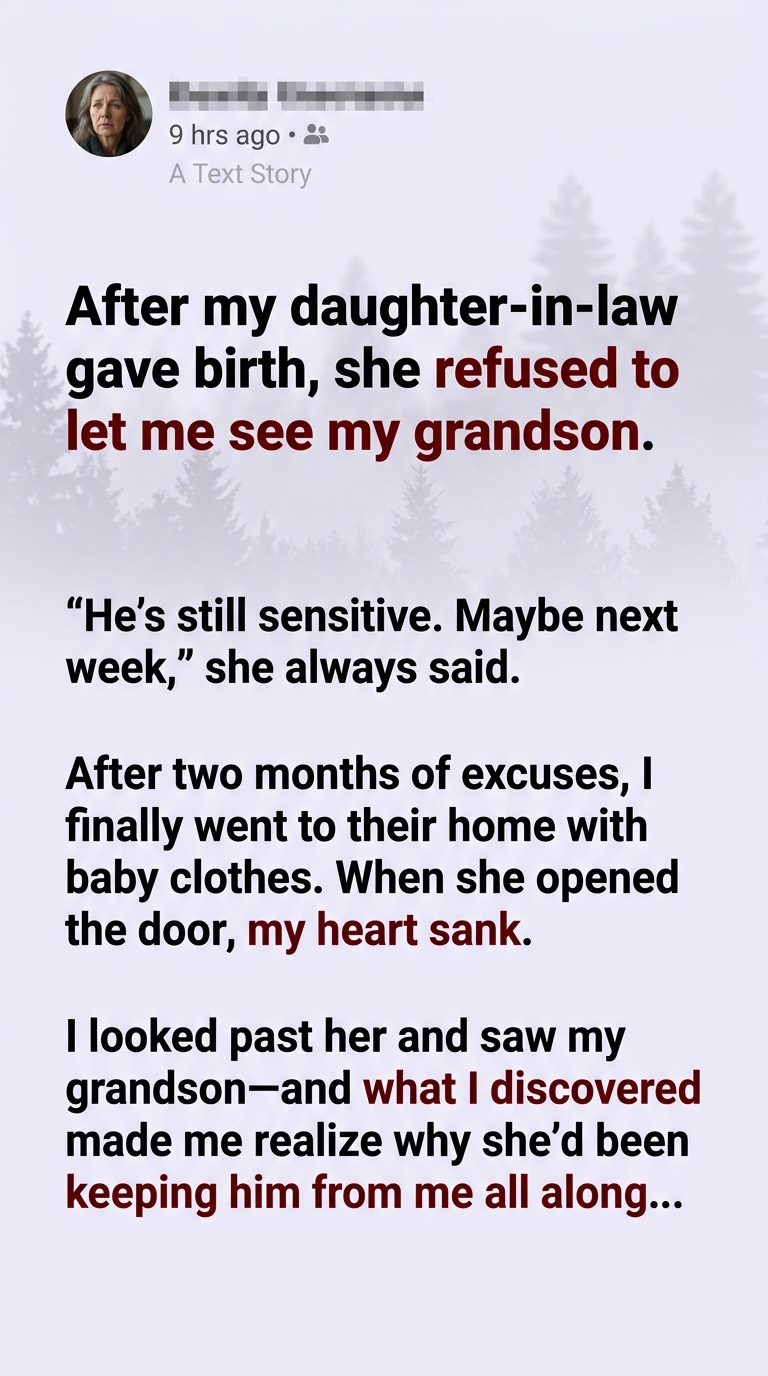
When my son Daniel called to tell me his wife had given birth to a beautiful baby boy, I cried with happiness.
After years of imagining what it would feel like to become a grandmother, the moment had finally arrived. I immediately bought tiny blue pajamas, knitted blankets, soft stuffed animals, and a pair of little socks so small they barely covered my palm.
But when I asked Daniel when I could visit, his wife, Emily, answered instead.
“He’s still sensitive,” she said. “Maybe next week.”
I understood. Newborns need rest, and new parents need time to adjust. I didn’t want to be the pushy mother-in-law who showed up uninvited or demanded attention.
So I waited.
A week passed. Then another.
Every time I called, Emily had a reason I couldn’t come.
“He’s been fussy all day.”
“We’re trying to establish a routine.”
“The pediatrician says we should limit visitors.”
“I’ll let you know when we’re ready.”
I offered to bring dinner, wash clothes, or simply sit quietly while they rested. She refused every offer.
Daniel always sounded uncomfortable when I asked him about visiting.
“Mom, please be patient,” he would say. “Emily’s going through a lot.”
I tried to be understanding. I remembered how exhausting those first weeks of motherhood could be, and I didn’t want to add to her stress.
Still, something hurt more with every passing day.
I had sent flowers to the hospital, but Emily said they arrived when she was asleep. I mailed a card congratulating them, but neither of them mentioned it. I sent a message asking for a photograph of the baby, and Emily replied that she would send one later.
She never did.
Two months passed without my holding my grandson even once.
Then, one Saturday morning, I decided I couldn’t spend another day waiting for permission to find out how my family was doing.
I packed a bag of baby clothes, a soft blanket, and a small stuffed elephant. I didn’t intend to argue. I simply wanted to see my grandson and make sure everyone was okay.
When I arrived at their house, I knocked.
Emily opened the door only a few inches.
Her expression changed when she saw me.
“Mom? What are you doing here?”
“I brought some things for the baby,” I said gently. “I was hoping I could finally meet my grandson.”
She looked over her shoulder.
“Now isn’t a good time.”
“Emily, it’s been two months.”
“I know, but—”
Before she could finish, I heard a tiny cry from somewhere inside the house.
My heart leaped.
“Is that him?” I asked.
Emily’s face tightened.
“Please don’t do this.”
I wasn’t trying to start a fight. I simply wanted to see the child my son had welcomed into the world.
Then the door opened a little wider, and I caught sight of the living room.
A baby lay in a bassinet near the sofa.
I took one step forward, and my smile disappeared.
My grandson was wearing a thin, oversized shirt. A bottle sat on the table beside him, and a pile of laundry covered one corner of the room. He was crying, his little fists moving restlessly beside his face.
But what caught my attention wasn’t the messy room or his clothes.
It was the small white medical band around his wrist.
I couldn’t read all the writing from the doorway, but I recognized the hospital logo.
“Why is he wearing that?” I whispered.
Emily immediately moved between me and the bassinet.
“He’s fine.”
“Then why does he still have a hospital band on?”
She looked down.
For the first time since I’d arrived, she seemed unable to find an answer.
I set the bag of clothes on the floor.
“Emily, I’m not here to judge you. But something is wrong, isn’t it?”
Her eyes filled with tears.
Then she stepped aside and began to cry.
“He hasn’t been home for two months,” she whispered.
I felt the world tilt beneath my feet.
She explained that my grandson, Noah, had been born prematurely and spent the first several weeks in the neonatal intensive care unit. He had finally been discharged, but his doctors had given his parents a strict care plan and scheduled follow-up appointments.
Daniel had been trying to keep everything together while working. Emily had been sleeping in short stretches, struggling with anxiety and feeling terrified that she might do something wrong.
She had become convinced that if anyone saw how difficult things were, they would think she was a bad mother.
So she kept everyone away.
She told Daniel that she didn’t want visitors, but she never explained how frightened and overwhelmed she felt. Daniel, believing she simply needed privacy, had stopped asking questions.
And because I had trusted their explanations, I hadn’t realized how isolated they had become.
I looked at the baby again.
“Where is Daniel?” I asked.
“At work,” Emily whispered. “He thinks I’m managing everything.”
She covered her face.
“I know you must hate me. I kept making excuses because I was ashamed. I thought if I could just get through one more week, I’d feel better. But every week, I felt worse.”
I wanted to be angry. I had spent two months feeling rejected, wondering what I had done to make her keep me away.
But standing in that doorway, watching a frightened young mother fall apart, I realized that the truth was more complicated than I had imagined.
I stepped closer, but I didn’t reach for Noah.
“Emily, may I come in?”
She nodded.
I sat beside her while she explained the feeding schedule, the medical appointments, and the fears she hadn’t shared with anyone. I listened without interrupting.
When she finished, I took her hand.
“I wish you had told me,” I said. “I was hurt, but I don’t want you to feel you have to hide when you’re struggling.”
She began to cry again.
“I didn’t know how to ask for help.”
“Then let’s start there,” I told her. “You don’t have to handle everything alone.”
I asked whether Noah had eaten and whether she had someone helping her follow his medical care plan. She showed me the written instructions his doctors had provided, and we discussed what support she needed that day.
I offered to prepare a meal, help with laundry, and sit with her while she called Daniel. I also encouraged her to tell her healthcare provider how overwhelmed and anxious she had been feeling.
When Daniel arrived home, he was shocked to find me there.
At first, he looked at Emily as if he expected her to explain why I had come without permission.
Then he saw her tear-stained face.
He sat beside her, and for the first time, she told him everything.
He looked devastated.
“Why didn’t you tell me you were struggling this much?” he asked.
“Because I thought I had to be able to do it all,” she replied.
He took her hand.
“You don’t.”
That evening, we agreed on a plan. Daniel would speak with his employer about adjusting his schedule temporarily. Emily would contact her healthcare provider and discuss her anxiety and the support available to her. We would follow Noah’s medical instructions carefully, and family visits would happen only when she felt comfortable and his care needs allowed.
Before I left, Emily asked whether I still wanted to hold Noah.
I felt tears rise in my eyes.
“More than anything,” I whispered. “But only when you’re ready.”
She carefully lifted him from the bassinet and placed him in my arms.
He was so tiny that I barely dared to move. His fingers curled around one of mine, and for a moment, the two months of hurt faded into the background.
I kissed his forehead.
“Hello, sweetheart,” I whispered. “Grandma’s here.”
Emily sat beside me, watching us with tired eyes.
“I am sorry,” she said.
I looked at her.
“I was hurt because I thought you didn’t want me in his life. I wish you had trusted me enough to tell me the truth. But I don’t want us to spend the next few years punishing each other for what happened.”
She nodded, wiping her cheeks.
We didn’t become perfectly close overnight. Trust takes time, and the exhaustion and anxiety didn’t disappear after one conversation. But we began talking honestly, asking for help when we needed it, and respecting each other’s boundaries.
Over the following weeks, I visited when invited, brought meals, and helped with practical tasks without taking over. Daniel became more involved in Noah’s daily care, and Emily gradually felt less alone.
Months later, I watched my grandson sleep in his crib while Emily sat beside me with a cup of tea.
“I thought keeping everyone away would make me a better mother,” she said quietly. “I was so afraid of being judged that I made everything harder.”
I squeezed her hand.
“Being a good mother doesn’t mean never needing help.”
She smiled sadly.
“And being a grandmother doesn’t mean I get to decide when I’m invited.”
I smiled back.
“Exactly.”
We both laughed softly.
I had gone to their home expecting to discover why my daughter-in-law didn’t want me near my grandson. I thought I would find rejection, resentment, or some secret she had deliberately kept from me.
Instead, I found a family that had become trapped in silence.
The truth was not that Emily wanted to take my grandson away from me. She was frightened, exhausted, and ashamed to admit she needed help.
I couldn’t erase the two months I had spent feeling shut out. But I could choose what happened next.
And that day, I learned that sometimes the door someone keeps closed isn’t a sign that they don’t love you.
Sometimes, it’s a sign that they are struggling behind it—and don’t know how to ask you to come in.