I Thought a Man Was Following Me in the Mall—Then I Remembered One Piece of Advice
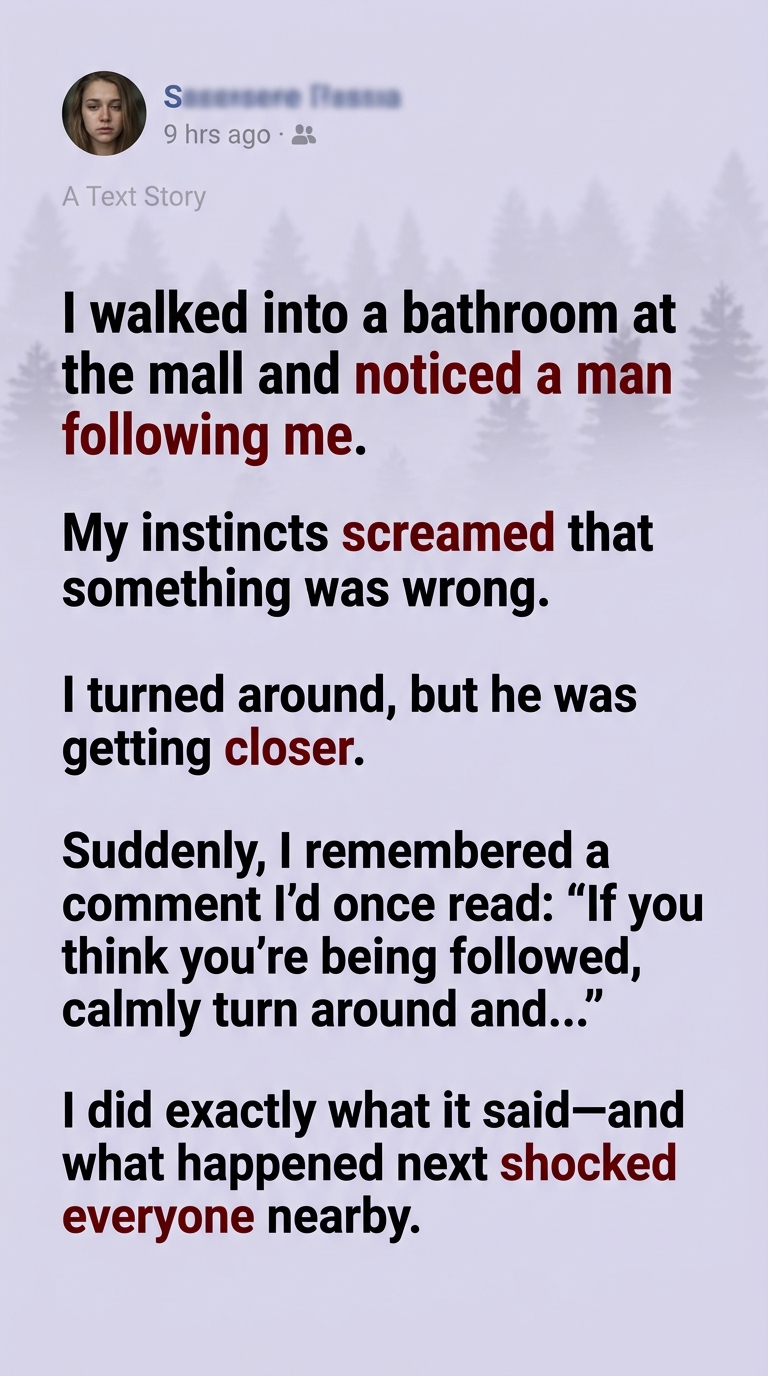
I walked into a bathroom at the mall and noticed a man following me.
At first, I told myself I was imagining things. The mall was crowded, and people crossed paths constantly. Maybe he was simply heading in the same direction.
But when I glanced over my shoulder, he was still there.
I slowed down.
He slowed down, too.
My stomach tightened.
I turned toward the sinks, pretending to check my phone. In the mirror, I watched him approach the entrance. He paused, looked around, and then took another step toward me.
My instincts screamed that something was wrong.
I remembered a comment I’d once read online: “If you think you’re being followed, calmly turn around, make eye contact, and loudly ask the person if you know them. Then move toward other people and ask for help.”
I had never expected to use that advice.
But now, with my heart pounding, I decided to try it.
I turned around, faced the man, and spoke loudly enough for everyone nearby to hear.
“Excuse me. Do I know you? Why have you been following me?”
The man froze.
A woman washing her hands looked up. Two other shoppers stopped talking.
“I’m not following you,” he muttered.
“Then why have you walked behind me from the food court to this bathroom?” I asked.
His eyes darted toward the exit.
That was when I noticed something strange: he wasn’t carrying a phone, a bag, or anything that might explain why he had been lingering in the area.
I took a step toward the bathroom entrance, where several people were passing by.
“I’d like mall security here, please,” I said to the woman beside me.
She immediately nodded and stepped closer.
The man suddenly raised his hands.
“Wait! Please don’t call security. I can explain.”
Nobody moved.
Then he reached into his jacket.
My blood ran cold.
“Don’t reach into your pocket!” a woman shouted.
He stopped instantly.
For one terrifying second, everyone stared at him.
Then he slowly pulled out a small identification badge and held it where we could see it.
“I’m security,” he said. “I’m working undercover.”
The room fell silent.
He explained that mall management had received reports of a man harassing women near the public restrooms. He had been asked to monitor the area, but he admitted he should have identified himself or contacted a uniformed guard instead of approaching me without explanation.
He showed his identification to the woman who had offered to help, then contacted the mall’s security office to verify his assignment.
A uniformed guard arrived a few minutes later and confirmed that the man was part of the security team.
I felt my knees weaken with relief.
“I understand that you were doing your job,” I told him, “but you scared me. I had no way of knowing who you were.”
He lowered his eyes.
“You’re right,” he said. “I should have handled it differently. I’m sorry.”
The guard offered to escort me to the customer service desk, where I could speak with the security supervisor if I wished. I accepted.
As we walked through the mall, several shoppers who had witnessed the confrontation approached us. One woman admitted that she had noticed the same man earlier and had also felt uncomfortable.
The supervisor listened carefully to what happened and promised to review the team’s procedures for monitoring public areas.
Before I left, the woman who had stood beside me touched my arm.
“You did the right thing,” she said. “You didn’t ignore your instincts, but you also didn’t try to handle it alone.”
Her words stayed with me.
I had once thought that being brave meant facing danger without showing fear. That afternoon taught me something different.
Bravery can mean speaking up when something feels wrong. It can mean drawing attention to yourself, asking strangers for help, and moving toward a safer place instead of trying to prove you can handle everything alone.
And one thing became especially clear: I couldn’t know whether the man was dangerous simply by looking at him. What mattered was that I felt unsafe, and I had every right to seek help.
I never found out whether the security team changed its procedures, but I hoped they did.
From that day forward, I promised myself that if I ever felt unsafe again, I wouldn’t dismiss my instincts just to avoid embarrassing someone.
I would stay aware, get to a public place, and ask for help.
Because sometimes, the most important decision you make isn’t about figuring out another person’s intentions.
It’s about making sure you get home safely.