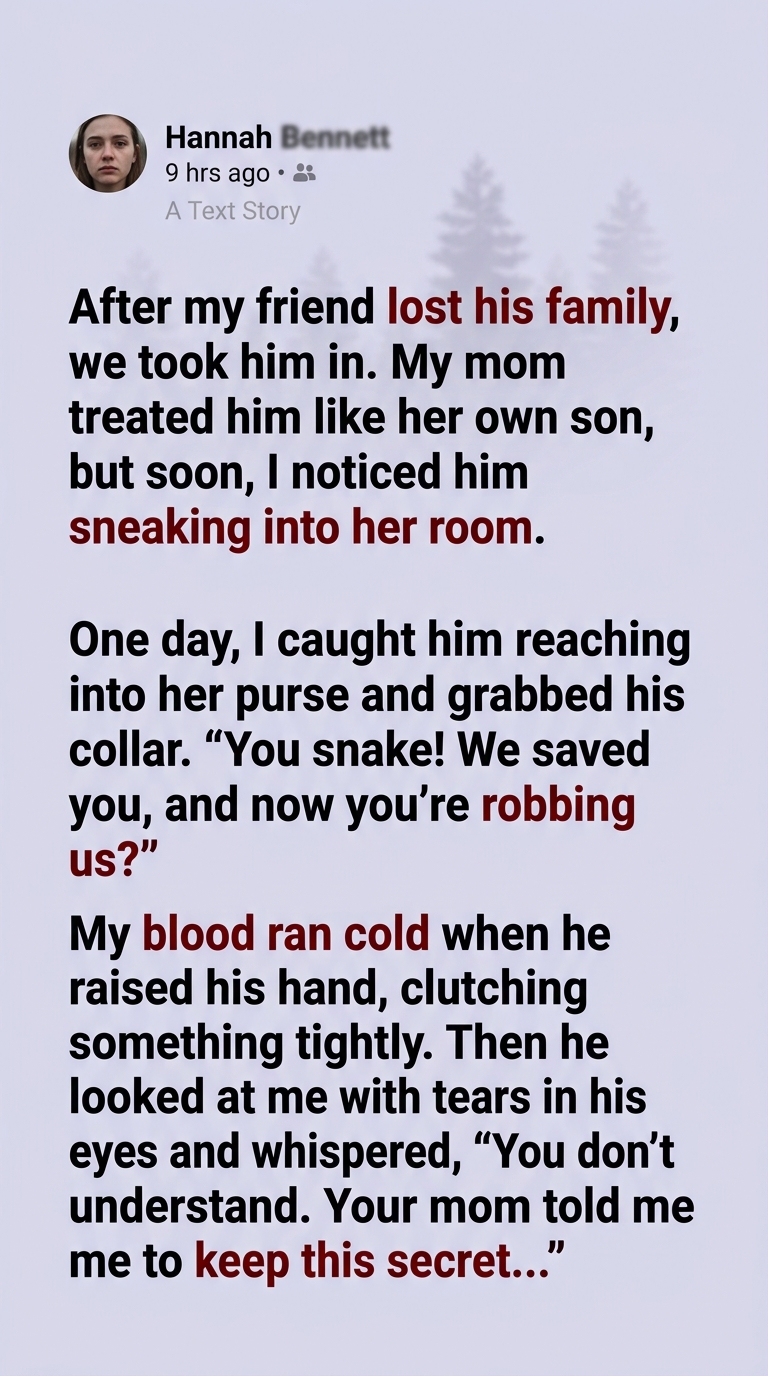
When my best friend lost his entire family, my mother was the first person who opened our door to him.
His name was Daniel. We had grown up together, shared school lunches, played football in the street, and spent countless weekends at one another’s houses. His parents had always been warm and welcoming, and I had practically lived at their home during the summer holidays.
Then, one rainy night, a car accident took both of his parents and his younger sister.
Daniel survived because he had stayed home that evening with a fever.
When I visited him at the hospital, he sat on the edge of the bed staring at the wall. He hadn’t cried. He hadn’t spoken much, either. He looked like someone who had been left behind in a world that no longer made sense.
I didn’t know what to say, so I sat beside him and put a hand on his shoulder.
“You can stay with us,” I told him. “As long as you need.”
My mother agreed before I had even finished explaining.
“Of course he can,” she said. “He’s family.”
She prepared his favorite meals, made up the spare bedroom, and gently reminded him to eat when he spent entire days without touching his food. She never pressured him to talk about the accident. She simply made sure he knew he wasn’t alone.
For the first few months, Daniel barely left his room.
Then, little by little, he began to return to life. He started helping my mother in the kitchen, accompanied me to work on weekends, and occasionally laughed at something on television.
Mom seemed especially happy when she heard him laugh.
“He’s had enough sadness for one lifetime,” she told me one evening. “If we can give him a little peace, we should.”
I agreed with her.
I truly did.
But about six months after Daniel moved in, I began noticing things that didn’t make sense.
He would disappear into my mother’s bedroom when she wasn’t home.
Sometimes I heard the floorboards creak outside her room late at night. Other times, I’d walk down the hallway and find him coming out, looking startled when he saw me.
At first, I thought he was borrowing something.
Then I noticed that he always seemed to be near my mother’s handbag.
One afternoon, I came home early and heard a drawer sliding shut.
I followed the sound.
Daniel was standing beside my mother’s dresser, his hand inside her open purse.
For a moment, I couldn’t believe what I was seeing.
“What are you doing?”
He spun around.
His face went pale.
“Nothing.”
“Nothing?” I repeated. “Your hand is inside my mother’s purse!”
He tried to close it, but I grabbed his wrist.
“Have you been stealing from us?”
“Please,” he said. “Just let me explain.”
Something inside me snapped.
I grabbed the front of his shirt and shoved him back against the dresser.
“You snake! We took you in when you had nowhere to go. My mother has treated you like her own son, and this is how you repay us? You’re robbing us?”
Daniel didn’t fight back. He didn’t even try to push me away.
He just stared at me with wide, devastated eyes.
Then he slowly raised his hand.
He was clutching something tightly in his fist.
My blood ran cold.
It was a small, folded piece of paper, yellowed at the edges. I could see my mother’s handwriting on the outside.
Daniel looked at me, and tears began rolling down his cheeks.
“You don’t understand,” he whispered. “Your mom told me to keep this secret…”
I released his shirt.
“What secret?”
He looked toward the bedroom door, as if he expected my mother to appear at any moment.
Then he opened his hand.
Inside was a tiny brass key, a photograph, and a note with my name written across the front.
I recognized the handwriting immediately.
It belonged to my mother.
I snatched the note from his hand and unfolded it.
There were only a few words.
If the time comes, let him tell you the truth.
I looked up at Daniel.
“What truth?”
He sank onto the edge of the bed.
“Your mother made me promise not to tell you until she was ready,” he said. “But she isn’t getting any better, and I don’t know how much time we have left.”
My stomach dropped.
My mother had been struggling with a heart condition for several years. She had always insisted she was managing it, and whenever I asked whether she needed help, she told me not to worry.
I had believed her.
“What does this have to do with your sneaking into her room?”
Daniel wiped his face with his sleeve.
“Everything.”
He held out the photograph.
It showed my mother standing beside a young woman I had never seen before. The woman was holding a baby wrapped in a white blanket. On the back, my mother had written a date from nearly thirty years earlier.
Below it were three words.
The day we met.
I stared at the picture, completely confused.
“Who are these people?”
Daniel took a shaky breath.
“Your mother told me the story after I moved in. She said she had kept it to herself for years because she didn’t know how to tell you.”
He paused.
“Before my parents died, your mother had been helping them with something. Something connected to that woman in the photograph.”
My mind raced.
“What does your family have to do with this?”
Daniel looked down at the key in his palm.
“My parents knew your mother long before you and I became friends. They had promised to help her protect someone. When they died, I found a letter among my father’s things. I brought it to your mother because I didn’t know what else to do.”
“And you’ve been sneaking into her room to look for it?”
He shook his head.
“No. Your mother gave me the key. She asked me to retrieve a small box from the back of her wardrobe when she was ready. She said you needed to know what was inside, but she wanted to tell you herself.”
My anger began to give way to something much worse.
Fear.
I looked at the note again.
“Where’s the box?”
Daniel stood and walked to the wardrobe. He reached behind a stack of folded blankets and pulled out a small wooden box, no bigger than a book.
The brass key fitted the lock.
Inside were several documents, a bundle of letters, and another photograph.
This one showed my mother holding a newborn baby in a hospital room.
The date was almost a year before I was born.
I felt dizzy.
“Daniel,” I whispered, “what am I looking at?”
He didn’t answer immediately.
Instead, he took a letter from the box and placed it in my hands.
“Your mother told me that you deserved to hear this from her. But she also made me promise that if she couldn’t explain it herself, I would help you understand.”
I unfolded the letter.
And as I read the first sentence, I felt the world I thought I knew begin to crack open.
My dearest son,
There is something about our family that I should have told you a long time ago.
I looked at Daniel.
He was crying openly now.
“Keep reading,” he whispered.
I lowered my eyes to the page.
The woman in the photograph is your biological mother.
I stopped breathing.
For a long moment, I couldn’t move.
My mother—the woman who had raised me, comforted me when I was sick, attended every school event, and stayed awake waiting for me to come home—had just revealed that she wasn’t the woman who gave birth to me.
I read the sentence again.
Then again.
It didn’t change.
I looked at Daniel, hoping he would tell me there had been a mistake.
He shook his head slowly.
“Your mother didn’t give birth to you,” he said. “But she chose you. And she has loved you every day of your life.”
I stumbled backward and sat on the bed.
“Why didn’t she tell me?”
Daniel lowered his eyes.
“Because she was afraid of losing you.”
He explained that my biological mother, Rachel, had been a young woman facing circumstances she couldn’t manage alone. My mother had known her through a family friend. When Rachel became unable to care for me safely, a private family arrangement had been made, followed by the legal adoption that allowed me to become my mother’s son.
The documents in the box recorded the arrangement and the legal steps that followed. The letters described the fear and uncertainty surrounding those first months.
My mother had not hidden the truth because she was ashamed of me.
She had hidden it because she had been terrified that one day I would look at her and see a stranger instead of the woman who had raised me.
Daniel’s father had helped keep the documents safe. Before the accident, he had told Daniel that if anything happened to him, he should bring the old letters to my mother.
When Daniel found them after the accident, he had done exactly that.
My mother had then asked him to help her retrieve the box when she felt ready to tell me.
“And the purse?” I asked, my voice barely audible.
Daniel looked miserable.
“Your mother kept the small key in her purse. She asked me to get it because she was too weak to reach into the wardrobe herself. I was trying to take it without waking you. I knew how strange it looked, but she made me promise not to tell you until she was ready.”
I covered my face with both hands.
I had accused my best friend of stealing from the woman who had raised me, when he had been trying to honor her trust.
I had grabbed him, called him a snake, and treated him like a criminal.
And all the while, he had been carrying a secret that was not his to reveal.
“I am so sorry,” I whispered.
Daniel shook his head.
“You didn’t know.”
“But I should have trusted you.”
He sat beside me.
“I understand why you were angry. I would have thought the same thing if I’d walked in and seen what you saw.”
We sat in silence, surrounded by the contents of the box.
Finally, I picked up the photograph of my mother holding me as a newborn.
On the back, she had written:
The first day I got to hold my son.
I pressed the photograph to my chest.
I had spent my entire life believing that family was something you were born into. Now I was learning that the woman who had packed my lunches, taught me to ride a bicycle, and held me through every childhood nightmare had made a choice that changed both our lives.
She had chosen to be my mother.
And she had never once made me feel that I was anything less than her own.
I found her in the living room that evening, sitting by the window with a blanket across her knees.
When she saw the box in my hands, her eyes filled with tears.
“Oh, sweetheart,” she whispered.
I sat beside her.
“Why didn’t you tell me?”
She looked down at her hands.
“Because I was afraid.”
“Afraid of what?”
“That you would think I had lied to you about everything. That you would wonder whether I loved you because I raised you or because I felt I had to. That you would go looking for Rachel and decide there was no room for me anymore.”
I took her hand.
“Mom, you’ve been my mother my whole life.”
She began to cry.
“I know I should have told you sooner. I wanted to find the right time, and then years passed. Every year it became harder to begin the conversation.”
I leaned forward and rested my forehead against hers.
“I wish you’d trusted me with the truth.”
“So do I,” she whispered.
We talked for hours.
She told me about Rachel, about the difficult circumstances surrounding my birth, and about the years of uncertainty before the adoption became permanent. She explained that she had kept some of the letters because they contained information about my early life that she thought I might want someday.
She had never intended to erase Rachel from my story.
She had simply been afraid that telling me would somehow erase her.
I hugged her and told her that it didn’t have to be one or the other.
I could want to understand where I came from without loving the woman who raised me any less.
And I could be grateful to my mother without pretending that every decision she had made was right.
The next morning, I apologized to Daniel properly.
Not with a quick handshake or a joke to make the awkwardness disappear, but with the honesty he deserved.
“I accused you of betraying us when you were trying to keep a promise to my mother,” I told him. “I was wrong. You were my friend before you came to live here, and I should have remembered that.”
Daniel hugged me.
“You were scared. I get it.”
But I knew fear wasn’t an excuse for treating someone unfairly.
From then on, I stopped seeing Daniel as a grieving friend we had rescued. He was family, not because my mother had given him a place to stay, but because he had continued to show up for us even when he was carrying his own grief.
As for the secret, my mother and I took our time.
We reviewed the documents together and spoke with a qualified professional about the adoption records and what could responsibly be shared. I learned that Rachel had moved away years earlier, and there were still questions about her life that the papers couldn’t answer.
I didn’t rush to find her, and my mother didn’t ask me not to.
For the first time, we could talk about the truth without treating it as a threat.
A few months later, I sat beside my mother in the garden while Daniel helped prepare dinner inside.
She reached for my hand.
“Do you think you’ll ever want to meet Rachel?”
“I don’t know,” I said honestly. “Maybe one day.”
She nodded, though I could see the fear in her eyes.
“But Mom,” I continued, “I don’t need to meet her to know who raised me.”
She squeezed my hand.
And for the first time, I saw relief settle across her face.
The secret had not destroyed our family.
It had given us the chance to stop living in fear of the truth.
I still think about the day I caught Daniel reaching into her purse. I remember the fury in my chest and the way I grabbed his collar before I gave him a chance to speak.
I thought I was defending my mother.
Instead, I nearly hurt the person who had been helping her protect a secret she was finally ready to share.
Now I understand that love isn’t always a simple story, and family isn’t always defined by blood. Sometimes it is defined by the people who stay, the promises they keep, and the courage it takes to tell the truth.
My mother had given me a home.
Daniel had helped her protect a part of my story.
And in the end, the secret they had kept from me wasn’t proof that they didn’t trust me.
It was proof that they had both been afraid of losing someone they loved.
I only wish we had learned sooner that the truth, spoken with care, could bring us closer instead of tearing us apart.