I Demanded a Paternity Test After My Son Was Born. The Results Said He Wasn’t Mine, So I Walked Away. Three Years Later, a Hospital Worker Revealed a Secret That Destroyed My Life.
The day my son was born was supposed to be the happiest day of my life.
I still remember standing outside the delivery room, pacing the hallway and checking my phone every thirty seconds. When the nurse finally came out and told me I had a healthy baby boy, I nearly cried.
My wife, Claire, had always wanted to be a mother. We’d spent years talking about names, decorating a nursery, and imagining what our future family would look like.
I thought our lives were finally beginning.
Then I held my son for the first time.
Something felt wrong.
I couldn’t explain it. It wasn’t a single feature or a particular expression. It was an uncomfortable feeling I couldn’t shake, and instead of questioning myself, I allowed suspicion to grow.
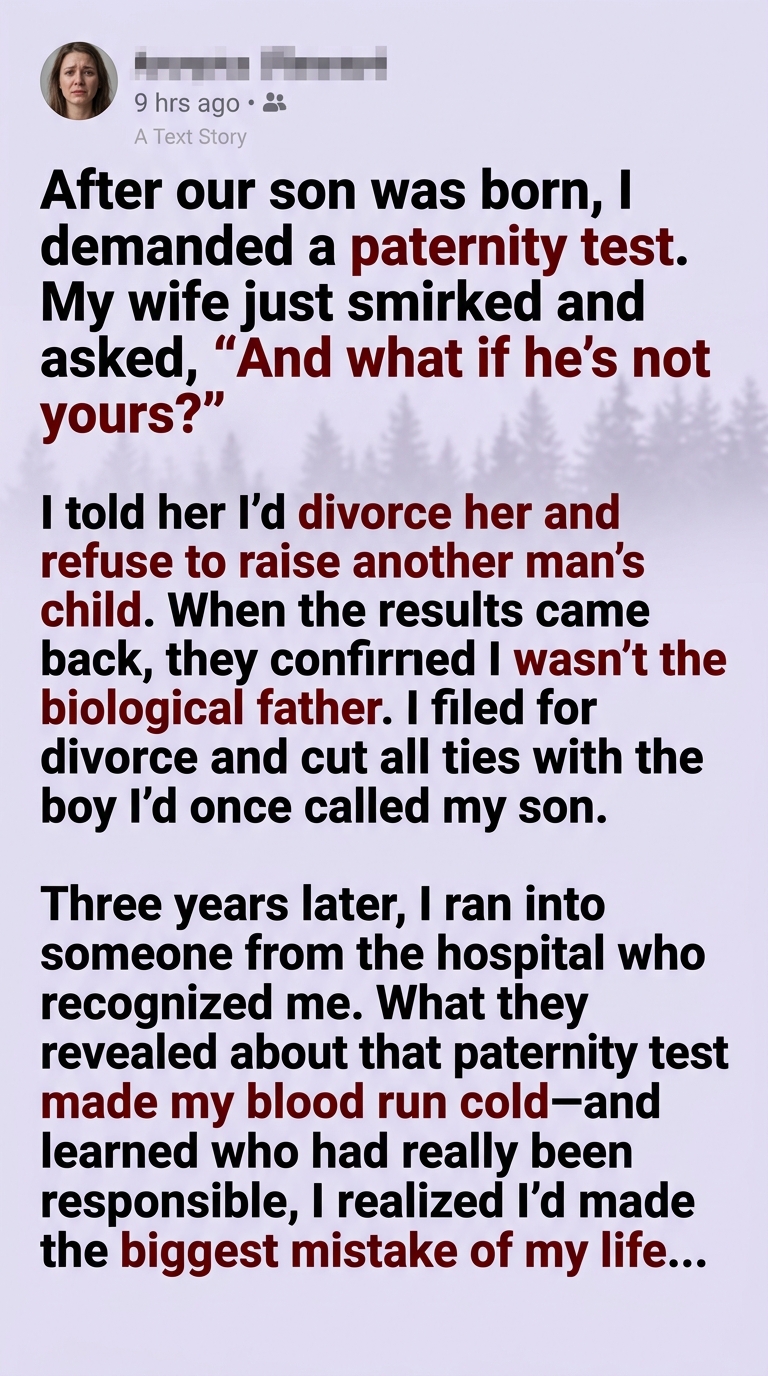
A few days later, I told Claire I wanted a paternity test.
She was sitting on the sofa, holding our newborn against her chest, when I said it.
For a moment, she simply stared at me.
Then she smirked.
“And what if he’s not yours?”
Her answer infuriated me.
“Then I’ll divorce you,” I said. “And I won’t spend the rest of my life raising another man’s child.”
Claire’s expression changed.
She looked down at the baby, then back at me.
“Be careful what you ask for,” she whispered.
I interpreted her words as a confession.
I convinced myself that a faithful wife would have been horrified by my accusation. Her reaction, I decided, was proof that she had something to hide.
I ordered the test.
Claire didn’t try to stop me. She didn’t beg or argue. She simply signed the paperwork and went about caring for our son.
That silence made me even more suspicious.
When the results arrived, I opened the envelope alone at the kitchen table.
I read the report once.
Then again.
The conclusion stated that I was excluded as the biological father.
I felt as if someone had punched me in the chest.
I called Claire into the room and threw the report onto the table.
“You lied to me.”
She looked at the paper for a long time.
Then she began to cry.
“Please,” she whispered. “You don’t understand.”
“There’s nothing to understand! You had another man’s child and let me believe he was mine!”
She tried to explain, but I refused to listen.
I packed a suitcase that night and left.
Within weeks, I filed for divorce. I demanded that my name be removed from the child’s legal records wherever legally possible, and I cut contact with Claire and the little boy I’d once proudly introduced as my son.
His name was Noah.
For months, I had imagined teaching him to ride a bicycle, taking him fishing, and watching him grow into a man.
After the test, I couldn’t even look at his photographs.
I told myself I was protecting my dignity.
I told everyone that Claire had betrayed me and that I had done what any self-respecting man would do.
Some friends supported me. Others told me I should at least consider that the test might not tell the whole story.
I ignored them.
I moved to another city, changed jobs, and rebuilt my life around the idea that I had escaped a terrible deception.
Claire never publicly fought me. She moved away with Noah and stopped contacting me except for the occasional legal matter.
I convinced myself that her silence meant guilt.
Three years passed.
By then, I rarely thought about my former family. I dated occasionally, worked long hours, and tried to pretend the experience had made me stronger.
Then, on an ordinary Tuesday morning, I returned to the hospital where Noah had been born.
My father needed a follow-up appointment, and I had offered to drive him.
While waiting near the reception desk, a woman in her late fifties approached me.
She studied my face carefully.
“Excuse me,” she said. “Are you Daniel?”
I was surprised.
“Yes. Do I know you?”
Her expression changed.
“I used to work in the maternity department here. I remember you. Your wife had a baby boy three years ago.”
My stomach tightened.
“I remember,” I said coldly.
The woman hesitated.
“I’ve wanted to speak to you for a long time, but I wasn’t sure how to find you.”
“Why?”
She glanced around before lowering her voice.
“Because I don’t think the paternity test you received told you the truth.”
For a moment, I couldn’t understand the words.
“What did you just say?”
She introduced herself as Margaret, a former hospital laboratory technician. She explained that shortly after Noah’s birth, the hospital had investigated an administrative error involving several patient samples and laboratory records.
She had recently been reviewing documentation connected to the old incident as part of a records audit.
One case had stayed in her memory.
Mine.
“I can’t tell you everything from memory,” she said. “But I remember there was a discrepancy involving your test. The records weren’t consistent.”
My hands began to tremble.
“Are you saying the results were wrong?”
“I’m saying the result you were given needs to be independently verified. The paperwork I remember didn’t line up properly, and there were questions about whether the correct samples had been matched.”
I stared at her.
For three years, I had treated that report as unquestionable proof.
Now someone was telling me the foundation of my divorce might have been a mistake.
“Why didn’t anyone tell me?”
Margaret looked distressed.
“I don’t know whether the investigation ever reached you. I left the hospital not long afterward. I should have made sure the concern was followed up, but I can’t change that now.”
I felt dizzy.
“Who was responsible?”
She shook her head.
“I don’t want to accuse anyone without evidence. There was a record-handling problem. You need to request the original laboratory documentation and speak to the hospital’s patient-safety team.”
I left my father in the waiting area and went straight to the records office.
The staff initially told me that the matter was too old to investigate casually. I explained what Margaret had said and requested the complete records associated with the paternity test, including the sample identifiers, chain-of-custody documentation, and any incident reports.
Several days later, I received a call from the hospital.
They had located records showing that the laboratory had investigated a sample-identification discrepancy around the time my test was processed.
The original documentation was incomplete, and the hospital could not reliably establish that the result I had received was based on the correct samples.
They recommended a new, independently supervised test if the relevant parties consented.
I sat in my car after the call, unable to move.
I had spent three years telling myself that Claire had destroyed our family.
But what if I had destroyed it myself?
I contacted Claire.
She didn’t answer my first call.
Or the second.
On the third attempt, she finally picked up.
When she heard my voice, she went silent.
“Claire,” I said, struggling to speak, “I need to ask you something about Noah’s paternity test.”
Her voice became cold.
“Why? You got your answer three years ago.”
“The hospital has found evidence of a sample-identification problem. They can’t confirm that the original result was reliable.”
There was a long silence.
Then she said, “You don’t get to call me now and expect me to comfort you.”
“I know.”
“No, Daniel. You don’t know. I begged you to listen to me. I begged you to wait until we could understand what happened. You wouldn’t even look at your own son.”
Her words cut deeper than any accusation could.
I swallowed hard.
“Was Noah mine?”
She began crying.
“I always believed he was. I never had an affair. I told you that from the beginning.”
I closed my eyes.
I remembered her face in the hospital room. Her shock when I demanded the test. Her quiet warning when I threatened to leave.
“Be careful what you ask for.”
I’d treated that sentence as proof of guilt.
Now I wondered whether it had been the last thing she could say before realizing she had already lost me.
Claire agreed to consider a new test, but only after speaking with her lawyer and making sure Noah would be protected from further harm.
The process took several weeks.
We met at an independent laboratory. Claire brought Noah, who was now three years old, with bright eyes and a shy smile.
He didn’t recognize me.
Why would he?
To him, I was simply a stranger standing in a room with his mother.
He held her hand and peeked at me from behind her leg.
“Who’s that?” he whispered.
Claire knelt beside him.
“Someone Mommy used to know.”
I had to turn away.
The sample collection was supervised, documented, and handled by an independent laboratory.
Then we waited.
Those days were the longest of my life.
I replayed every memory of Noah’s infancy. The first time he wrapped his tiny hand around my finger. The night I had held him against my chest and promised that I would always protect him.
I had once believed those memories were meaningless because we might not share DNA.
Now I understood how little I had truly understood about fatherhood.
When the report arrived, Claire asked me to meet her at a lawyer’s office.
She placed the sealed envelope on the table between us.
“Whatever it says,” she told me, “you need to understand that you don’t get to erase what happened.”
I nodded.
My hands shook as I opened it.
The results confirmed that I was Noah’s biological father.
I read the conclusion over and over, waiting for the words to change.
They didn’t.
I was his father.
My son had been mine all along.
The first emotion I felt was relief.
The second was shame so overwhelming that I couldn’t look Claire in the eye.
“How?” I whispered. “How could the first test have been wrong?”
The hospital’s formal review later established that a sample-identification error had occurred during the original testing process. The documentation showed that the laboratory had failed to maintain a reliable chain of custody, and the original result could not be trusted.
The hospital apologized and reviewed its procedures. It also referred the matter for further professional review.
There was no evidence that Claire had caused the error or that she had ever been unfaithful.
The person responsible was not a secret lover or a jealous relative, as I had begun to imagine in my darkest moments.
It was a breakdown in the laboratory’s sample-handling process—and my own certainty had turned that failure into a catastrophe for my family.
I looked at Claire.
“I am so sorry.”
She wiped her eyes.
“You didn’t leave because the test was wrong, Daniel. You left because you decided I was guilty before you had all the facts.”
I had no defense.
“I know.”
“You told everyone I cheated. You refused to hold Noah. You walked away from your own child without waiting for a second opinion.”
“I know,” I repeated, my voice breaking.
“I can’t give you back the years you missed.”
“I know.”
She stood up.
“I agreed to this test because Noah deserves the truth. Not because I’m promising to take you back.”
Then she left.
And I remained at that table with a piece of paper that proved I was a father—and a thousand memories of the father I had chosen not to be.
Over the following months, I apologized publicly to the people I had told about Claire. I corrected the story I had repeated for years and accepted that some people would never forgive me.
I also began working with a family counselor to understand how I could approach Noah without causing him further confusion.
Claire allowed supervised visits after consulting her lawyer and Noah’s counselor. I didn’t demand to be called Dad. I didn’t expect him to love me. I showed up when I said I would, brought books he liked, listened when he spoke, and tried to become someone he could gradually trust.
The first time he reached for my hand, I had to fight back tears.
He didn’t know that I had once held that same hand as a newborn and then walked away from him.
He only knew that I was the man who came to read him stories.
I couldn’t change the past, but I could stop making excuses for it.
Claire and I never reunited romantically. The hurt between us was too deep, and she had every right to build a life without me.
Over time, though, we learned to communicate about Noah with patience and respect.
I no longer called myself the victim of a terrible betrayal.
I had been given a flawed test result, but the decision to abandon my family had been mine.
The hospital’s error explained how the tragedy began. It didn’t erase what I had done afterward.
Today, I see Noah regularly, and our relationship continues to grow one small moment at a time. He knows I love him. As he gets older, he will learn more about the circumstances that separated us, in an age-appropriate way that protects him from blame he never deserved.
Sometimes I still remember the man I was when I opened that first test result.
I thought a biological connection was the only thing that made someone a father.
I thought walking away would protect my pride.
Instead, I lost three years I can never recover.
If I could speak to that younger version of myself, I would tell him to pause. To ask questions. To verify the evidence. To remember that a child is not responsible for the fears or mistakes of adults.
And most importantly, I would tell him this:
A test can measure biology. It cannot measure love, loyalty, or the kind of father you choose to be.
I was right to want the truth.
I was wrong to believe I already had it.
And the greatest mistake of my life wasn’t discovering that the test was wrong.
It was allowing my pride to become more important than the little boy who had called me Dad before he could even speak.