Mom Texted “PLEASE DON’T COME TODAY.” When I Opened Her Door, I Finally Understood Why.
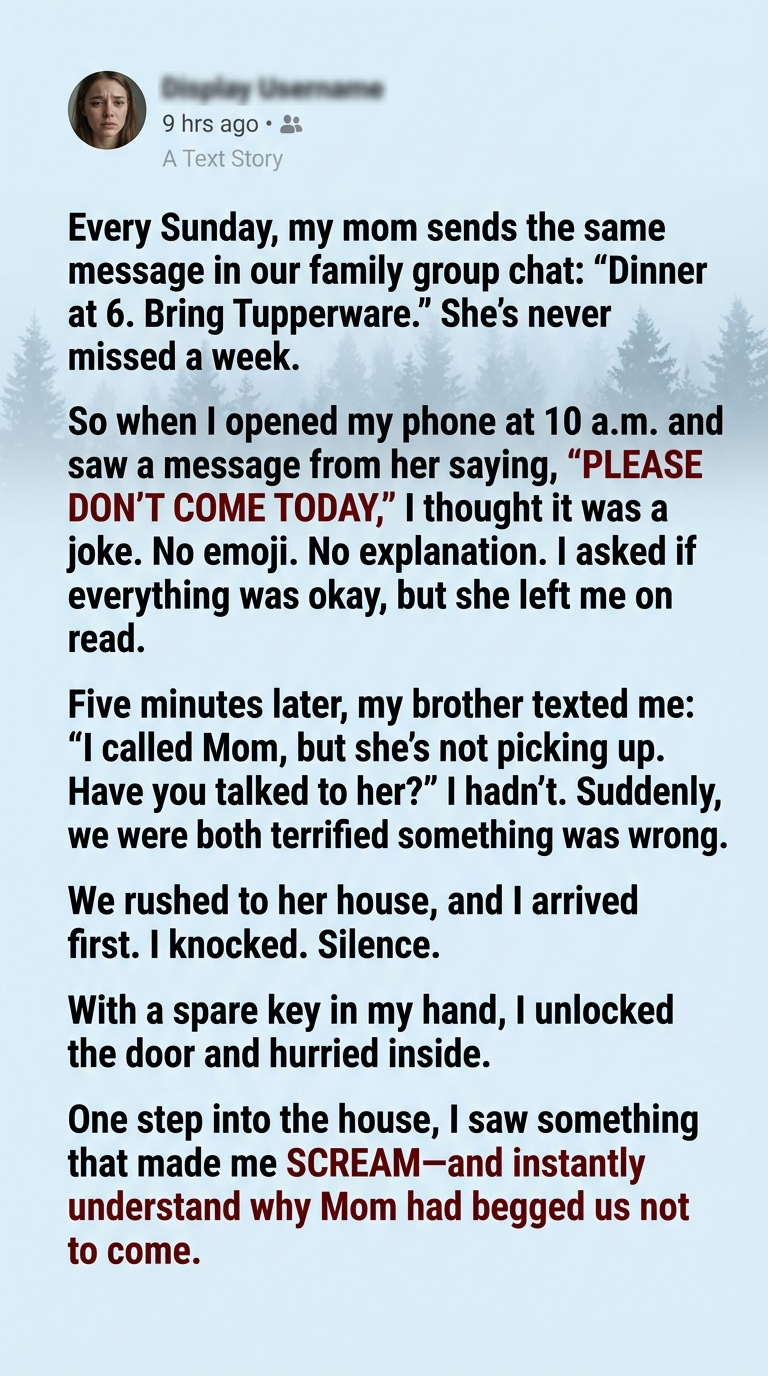
Every Sunday, my mom sent the same message to our family group chat.
“Dinner at 6. Bring Tupperware.”
She had been doing it for almost fifteen years. It didn’t matter if it was raining, if one of us was busy, or if she had spent the entire week complaining about her knees. Sunday dinner was sacred.
Mom cooked enough food for an army, insisted we take leftovers home, and packed extra containers for anyone who claimed they weren’t hungry.
It was her way of keeping us together.
So when I checked my phone at 10 a.m. that Sunday and saw a message from her, I immediately noticed something was wrong.
PLEASE DON’T COME TODAY.
No greeting. No explanation. No familiar reminder about bringing containers.
Just those four words.
I stared at the screen, waiting for another message.
Nothing came.
I typed, “Mom, is everything okay?”
She read it.
She didn’t reply.
Five minutes later, my brother, David, messaged me privately.
“Have you heard from Mom? I called twice, but she’s not answering.”
I told him about her message.
He called me immediately.
“That isn’t normal,” he said. “Did she sound upset yesterday?”
“No. She was talking about making her chicken casserole.”
“Then why would she suddenly tell us not to come?”
Neither of us had an answer.
We agreed to drive to her house.
I arrived first, pulled into her driveway, and noticed that her curtains were closed. Her car was parked outside, and the porch light was still on even though the sun was shining.
I knocked.
“Mom?”
Nothing.
I knocked harder.
Still nothing.
I called her phone. Somewhere inside the house, I heard it ringing.
My stomach tightened.
Mom had given both David and me spare keys years earlier, after Dad died. She had told us to use them only in an emergency.
I took mine from my purse.
“Please be okay,” I whispered as I unlocked the door.
The house was unusually quiet.
I stepped inside and called her name again.
Then I smelled something strange.
Not smoke. Not gas.
Something sweet and familiar, mixed with the unmistakable smell of vanilla frosting.
I turned toward the dining room.
And screamed.
There was a huge banner hanging across the wall.
SURPRISE! HAPPY 40TH BIRTHDAY, EMILY!
Balloons covered the ceiling. A giant cake sat in the center of the dining table. Photographs of me from childhood to adulthood were arranged around the room, including one of me wearing a terrible haircut in seventh grade.
And standing beside the table were nearly thirty people.
My cousins. My aunts. My uncles. Family friends I hadn’t seen in years.
Every single one of them shouted, “SURPRISE!”
I nearly dropped my keys.
Then I saw Mom.
She was standing behind the cake, holding a frosting-covered spatula. Her face went pale when she saw my expression.
“Oh, honey!” she cried. “You weren’t supposed to come yet!”
I stared at her.
“You told me not to come!”
“I know!”
“You didn’t answer my messages!”
“I couldn’t! I was decorating!”
“YOU LEFT ME ON READ WHILE I THOUGHT YOU WERE DEAD!”
The room went silent.
Then my uncle started laughing.
My cousin followed.
Within seconds, half the room was laughing so hard they had to sit down.
I wasn’t laughing.
Not yet.
I walked straight toward Mom, wrapped my arms around her, and held on tightly.
“Don’t ever do that to me again,” I whispered.
Her expression changed immediately.
“Oh, sweetheart.”
She hugged me back.
“I’m so sorry. I thought if I told you it was a surprise party, you’d know something was happening. I never imagined you’d think something terrible had happened.”
I pulled away and wiped my eyes.
“Your message looked like a final warning from a hostage.”
Mom winced.
“I panicked when your aunt called to say the decorations were taking longer than expected. I was trying to keep you and David away until everyone arrived.”
“By making us think you were missing?”
“I know,” she said softly. “I know. It was a terrible idea.”
Just then, David burst through the front door.
“WHERE IS SHE?”
Everyone shouted, “SURPRISE!”
David stopped so abruptly that he nearly tripped over the welcome mat.
He looked at the balloons, the guests, and the cake.
Then he looked at me.
“You knew?”
“I got here first.”
“You screamed?”
“Loudly.”
He pressed a hand to his chest.
“Mom, I thought you’d fallen down the stairs!”
Mom hurried over and hugged him, apologizing repeatedly.
For the next several minutes, we compared the increasingly frantic messages we’d sent each other while driving over.
David had even called a neighbor to ask whether she’d seen Mom that morning. The neighbor, apparently sworn to secrecy, had told him she hadn’t noticed anything unusual.
“She was probably standing behind the curtains watching me panic,” David muttered.
Mom looked guilty.
“I might have peeked once.”
That earned her a chorus of groans.
Eventually, the shock wore off, and the party began in earnest.
I discovered that Mom had been planning the celebration for three months. She had collected photographs from relatives, asked my friends to send stories, and secretly contacted people I hadn’t seen since college.
There was even a slideshow playing on the television.
It started with a picture of me as a newborn, wrapped in a yellow blanket, with Dad standing beside the hospital bed.
I stopped smiling.
Dad had died twelve years earlier, and birthdays had never felt quite the same without him.
Mom noticed my expression and took my hand.
“I wanted him to be part of today,” she said.
The next photograph showed Dad teaching me to ride a bicycle. Another captured him carrying me on his shoulders at a county fair. In one particularly embarrassing picture, I was wearing a homemade Halloween costume that looked suspiciously like a cardboard refrigerator.
Everyone laughed.
Then a short video appeared.
It was Dad, sitting in our old kitchen, speaking directly to the camera.
Emily, if you’re watching this, you’re probably older than I ever got to see you become. I hope you’re still laughing too loudly and making your mother worry too much.
The room became quiet.
He smiled at the camera.
“Remember something, sweetheart. Getting older isn’t about having everything figured out. It’s about knowing who loves you, showing up for them, and never being too proud to let them show up for you.”
I covered my mouth.
Mom squeezed my hand.
“I found that video on an old computer,” she whispered. “I wanted you to have it.”
For the first time that morning, I understood what the party really meant to her.
She hadn’t been trying to frighten us. She had been trying to give me a memory I would keep for the rest of my life.
Unfortunately, she’d managed to give me a mild heart attack along the way.
After the video ended, Mom brought out the cake.
The guests sang, I blew out the candles, and everyone applauded when I managed to cut a slice without destroying the frosting.
Then Mom handed me a small envelope.
“This one isn’t part of the party,” she said. “It’s just from me.”
Inside was a handwritten letter.
She explained that after Dad died, Sundays had become her way of keeping the family connected. Cooking for us made the house feel less empty. Packing leftovers gave her an excuse to send us home with something that reminded us of her.
She wrote that she knew we were adults now, with jobs, responsibilities, and lives that didn’t always leave room for family dinners.
But she hoped we would always know that there was a place for us at her table.
At the bottom, she had written:
You will never have to earn your place in this family. You already belong here.
I cried again.
David read over my shoulder and pretended he had something in his eye.
Mom hugged us both.
“Next Sunday,” she announced, “dinner at six. Bring Tupperware.”
Everyone groaned.
“Even after all this?” I asked.
“Especially after all this,” she replied. “I’ve got leftovers to get rid of.”
That evening, after the guests had left and David had loaded his car with enough food to feed a small neighborhood, I sat with Mom at the kitchen table.
The balloons were beginning to sag. Wrapping paper covered the floor, and the refrigerator was packed with containers.
I reached across the table and took her hand.
“Mom?”
“Yes, sweetheart?”
“If you ever text me ‘PLEASE DON’T COME TODAY’ again, I’m calling the police before I get in the car.”
She laughed.
“Fair enough.”
Then her expression softened.
“I really am sorry I scared you.”
“I know.”
We sat together for a while, listening to the refrigerator hum.
I had arrived at her house believing something terrible had happened.
Instead, I had found proof of something I sometimes forgot when life became busy: I was surrounded by people who loved me enough to plan, to gather, and to celebrate the person I had become.
The surprise wasn’t the balloons or the cake.
It wasn’t even Dad’s video.
It was realizing that Mom had spent three months trying to make me feel loved—and had accidentally made me fear the worst.
I kissed her cheek before leaving.
“Love you, Mom.”
“Love you more.”
As I walked toward my car, my phone buzzed.
A new message appeared in the family group chat.
Mom: Next Sunday, dinner at 6. Bring Tupperware.
David replied first.
David: I’ll come when you send a normal invitation.
I added:
Emily: And please confirm you’re alive.
Mom responded with a laughing emoji and a photograph of the leftover cake.
For the first time that day, all of us laughed without being frightened.
And I knew that no matter how old I became, no matter how far life took me, those Sunday messages would always mean the same thing.
There was still a seat for me at Mom’s table.
And there would always be someone waiting for me to come home.