My Son Gave Me a Spreadsheet of My Property Values on My 75th Birthday. Two Weeks Later, I Made One Phone Call He Never Expected.
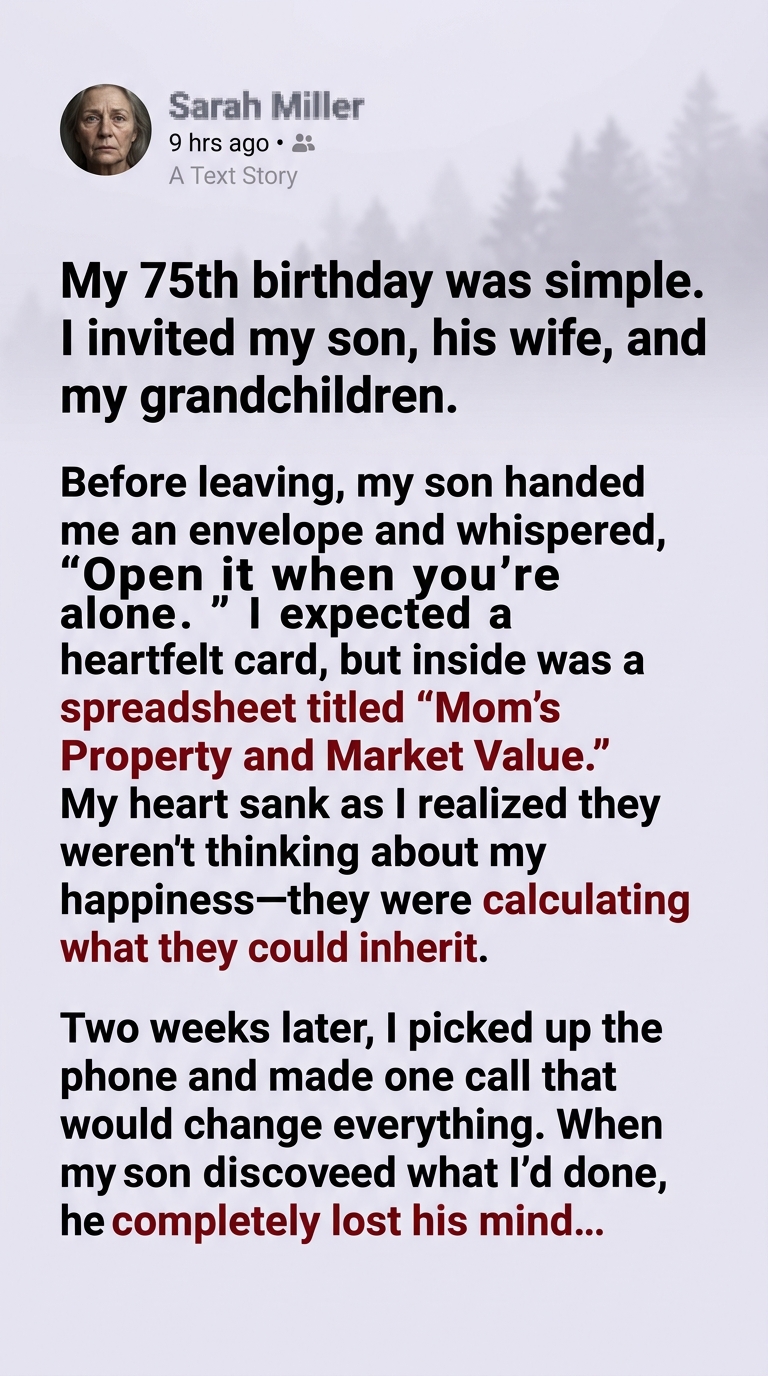
My seventy-fifth birthday was supposed to be a quiet celebration.
I didn’t want a fancy restaurant or expensive gifts. I only wanted my son, Daniel, his wife, Rebecca, and my two grandchildren around my dining table, laughing over cake the way we used to when Daniel was little.
I spent the morning cooking his favorite meal, setting out the good plates, and arranging flowers in the vase my late husband had given me years ago.
When they arrived, everyone seemed pleasant enough. The children hugged me, Rebecca complimented the food, and Daniel kissed my cheek.
“Happy birthday, Mom,” he said.
For a few hours, I let myself believe that nothing had changed.
After dinner, we cut the cake and took photographs. My grandchildren argued over who got the biggest slice, and I laughed so hard that tears gathered in my eyes.
It was the kind of evening I had wanted.
Then, as they prepared to leave, Daniel pulled a plain envelope from his jacket.
“Here, Mom,” he said quietly. “Open it when you’re alone.”
I smiled, thinking he had written me a heartfelt letter.
“Thank you, sweetheart.”
He hugged me quickly, then hurried outside to help his family into the car.
I watched their taillights disappear down the street before returning to the kitchen. The house felt painfully quiet.
I sat at the table, poured myself a cup of tea, and opened the envelope.
Inside was a printed spreadsheet.
At the top, in bold letters, were the words:
MOM’S PROPERTY AND MARKET VALUE
Beneath the heading were details about my house, my small rental apartment across town, my savings, and even the estimated value of my jewelry.
There were columns for current market value, potential sale price, outstanding expenses, and estimated inheritance.
At the bottom, someone had written:
Potential net estate: $1,284,000.
I read the number twice.
Then I noticed a second page.
It listed my monthly pension, estimated living expenses, and a projected number of years I might continue living independently.
One line had been highlighted in yellow:
Possible transition to assisted living: review within 3–5 years.
My hands began to tremble.
I was seventy-five, not a parcel of land waiting to be sold.
I had spent my life building that home. My husband and I had worked extra shifts, skipped holidays, and saved every spare dollar so our son could have opportunities we never had.
When my husband died, I paid the bills alone. I maintained the house, managed the rental apartment, and learned how to do things I had once relied on him to handle.
And now my own son had turned my life into a financial forecast.
I sat there for a long time, staring at the spreadsheet.
Perhaps Daniel would have an explanation. Perhaps he had convinced himself he was being practical.
But why hadn’t he spoken to me?
Why had he hidden it inside a birthday envelope?
The following morning, I called him.
“Daniel, I found the spreadsheet.”
There was a pause.
“Oh. You opened it.”
“You asked me to open it when I was alone. Why?”
“Mom, don’t get upset. It’s just planning.”
“Planning for what?”
“For the future. We need to know what everything is worth.”
“Who is we?”
Another pause.
“Rebecca and I have been talking about it. We want to make sure everything is organized before things become complicated.”
“Things like what?”
“You know what I mean. You’re getting older.”
I looked around my kitchen, at the clean counters and the groceries I had carried home myself the day before.
“Yes,” I said. “I’m getting older. But I’m still here.”
“Mom, we’re trying to help.”
“Then why didn’t you ask what I wanted?”
He sighed, the way he used to when I questioned him as a teenager.
“Can we not turn this into an argument? We have children to think about. We need to be responsible.”
I ended the call before I said something I would regret.
For the next two weeks, I barely slept.
I wasn’t frightened of dying. At seventy-five, I had learned that life was precious precisely because none of us could hold on to it forever.
What frightened me was the realization that the people I loved might already be planning a future in which my wishes no longer mattered.
I thought about my house, my little garden, and the neighbors who checked on me after storms. I thought about the rental apartment that paid for my unexpected expenses and allowed me to help my grandchildren with school supplies when they needed them.
I also thought about my husband.
Before he died, he had told me something I had never forgotten.
“Promise me you’ll never let anyone make you feel like you’re a guest in your own life.”
At the time, I thought he was talking about grief.
Now I understood.
Two weeks after my birthday, I picked up the phone and made one call.
I called Margaret Ellis, the attorney who had helped my husband and me prepare our wills years earlier.
“Margaret,” I said, “I need to review my estate plan. And I need you to tell me how to protect my independence while I’m still able to make my own decisions.”
Her voice softened.
“Of course. Is someone pressuring you?”
I hesitated.
“My son has started making plans for my property and my future without asking me.”
“Then let’s begin by separating what he wants from what you want.”
That sentence alone made me feel less alone.
At our meeting, Margaret reviewed my existing documents, explained my options, and asked questions no one else had thought to ask.
Where did I want to live?
What did I want my money to provide for me while I was alive?
Did I want to leave an inheritance? If so, under what conditions?
Who would I trust to make decisions if I eventually became unable to make them myself?
For the first time in weeks, someone was asking me about my future instead of calculating it.
I decided to make several changes.
I updated my will according to my wishes. I arranged for independent financial advice. I reviewed the ownership and beneficiary details of my accounts. I also documented my preferences for future care, making it clear that any major decision about my living arrangements should involve me for as long as I had the capacity to decide.
I didn’t cut Daniel out of my life.
I didn’t empty my accounts or give my property away out of spite.
I simply made sure my future belonged to me.
Then I made one more decision.
For years, I had considered leaving the house to Daniel outright because I assumed that was what a good mother was supposed to do. But after talking with Margaret, I realized I could make a thoughtful plan that balanced my needs, my values, and the future I wanted for my grandchildren.
I chose to preserve my financial independence first. I also set aside a modest education fund for each grandchild, with clear conditions and professional oversight.
The rest of my estate would be distributed according to the plan I had discussed privately with my attorney.
Everything was documented properly.
No one else made the decision for me.
Three days later, Daniel called.
“Mom, I spoke to a financial adviser,” he said. “We should probably start discussing the house.”
“We can discuss my wishes,” I replied. “But I won’t be making decisions based on a spreadsheet you prepared without me.”
He went quiet.
“What do you mean?”
“I’ve reviewed my estate plan with my attorney.”
“You changed your will?”
“Yes.”
His voice sharpened. “Without telling me?”
“It’s my will, Daniel.”
“But we’re your family!”
“I know. That’s why I had hoped you would speak to me before treating my life like an asset list.”
He began talking rapidly about fairness, responsibility, and how much he and Rebecca had already considered.
Then he said the words that broke my heart.
“So what are we supposed to get when you’re gone?”
I closed my eyes.
There it was.
Not How are you feeling, Mom?
Not Are you worried about the future?
Not even Can we talk about what upset you?
Just what they expected to receive.
“Daniel,” I said quietly, “I’m still alive.”
He went silent.
“I invited you to my birthday because I wanted to spend time with my family. I didn’t invite you to evaluate my house.”
“We weren’t trying to hurt you.”
“Maybe you weren’t. But you did.”
He started arguing again, insisting that I was overreacting and that parents were supposed to help their children.
I listened until he ran out of words.
Then I said, “I have helped you your entire life. I will always love you. But loving you does not mean surrendering control of my future.”
He hung up.
An hour later, Rebecca called.
She was furious.
“Do you realize what you’ve done? Daniel thought he could count on you. Now you’ve changed everything without considering how this affects our family.”
I took a slow breath.
“I considered my family for seventy-five years. Now I’m considering myself, too.”
She accused me of being selfish.
I didn’t argue.
I had spent too many years believing that being a good mother meant making everyone else comfortable, even when it cost me my peace.
I wasn’t going to spend the rest of my life defending my right to make my own decisions.
For several weeks, Daniel didn’t call.
I missed my grandchildren terribly. I missed their laughter, their messy drawings, and the way they always asked for an extra slice of cake.
Some evenings, I wondered whether I had gone too far.
Then I would remember that spreadsheet, especially the line about moving me into assisted living within three to five years—as if my wishes were a minor detail to be reviewed later.
I knew I had done the right thing.
Eventually, Daniel came to visit alone.
He looked tired. He sat at the kitchen table where we had eaten my birthday dinner and stared at his hands.
“I owe you an apology,” he said.
I didn’t rush to answer.
He swallowed.
“Rebecca and I have been under pressure. The mortgage, the children’s expenses, everything. We started talking about the future and got carried away with the numbers. I told myself we were being responsible.”
He looked up at me.
“I didn’t stop to think about what it would feel like for you to see that document.”
“No,” I said. “You didn’t.”
“I thought because you’re my mother, we could talk about these things whenever we needed to.”
“We can talk about them, Daniel. But a conversation isn’t the same as a decision made on my behalf.”
He nodded slowly.
“I know that now.”
I wanted to forgive him immediately. Mothers often want to make things better before anyone has finished admitting what went wrong.
But love doesn’t erase hurt in a single afternoon.
So I told him the truth.
“I don’t need you to pretend you don’t care about money. Everyone has financial worries. What I need is to know that you care about me as a person, not just as someone who might leave you something.”
His eyes filled with tears.
“I do care about you, Mom.”
“Then show me while I’m here.”
He reached across the table and took my hand.
“I will.”
Things didn’t become perfect overnight. Rebecca and I needed time to rebuild trust, and Daniel had to learn that an apology didn’t automatically restore the old arrangement.
But he began calling more often—not to ask about my property, but to ask what I was cooking, whether my garden was blooming, and if I wanted company on Sunday.
My grandchildren returned for dinner the following month.
They brought a cake they’d decorated themselves. The icing was uneven, and one corner had collapsed, but I thought it was beautiful.
As we sat around the table, my youngest grandson asked, “Grandma, can we come back next weekend?”
I smiled.
“Of course you can.”
After they left, I sat in my favorite chair and looked around the house.
The walls still held photographs of my husband. The garden still needed weeding. The little rental apartment still needed repairs from time to time.
And I was still the woman who had built a life here.
My birthday spreadsheet had taught me something I wish I had understood years earlier: an inheritance is not a promise that a parent owes a child. It is a gift a person may choose to leave after living their own life.
I still hoped to leave something meaningful to my family.
But I wanted to leave more than property.
I wanted my grandchildren to remember a grandmother who remained curious, independent, generous, and unafraid to speak up for herself.
I wanted my son to understand that love is not measured by what someone receives after you are gone.
It is measured by how they treat you while you are still here.
And at seventy-five, I finally gave myself permission to live by that truth.
My son had calculated the value of everything I owned. He had forgotten the value of the woman who owned it.