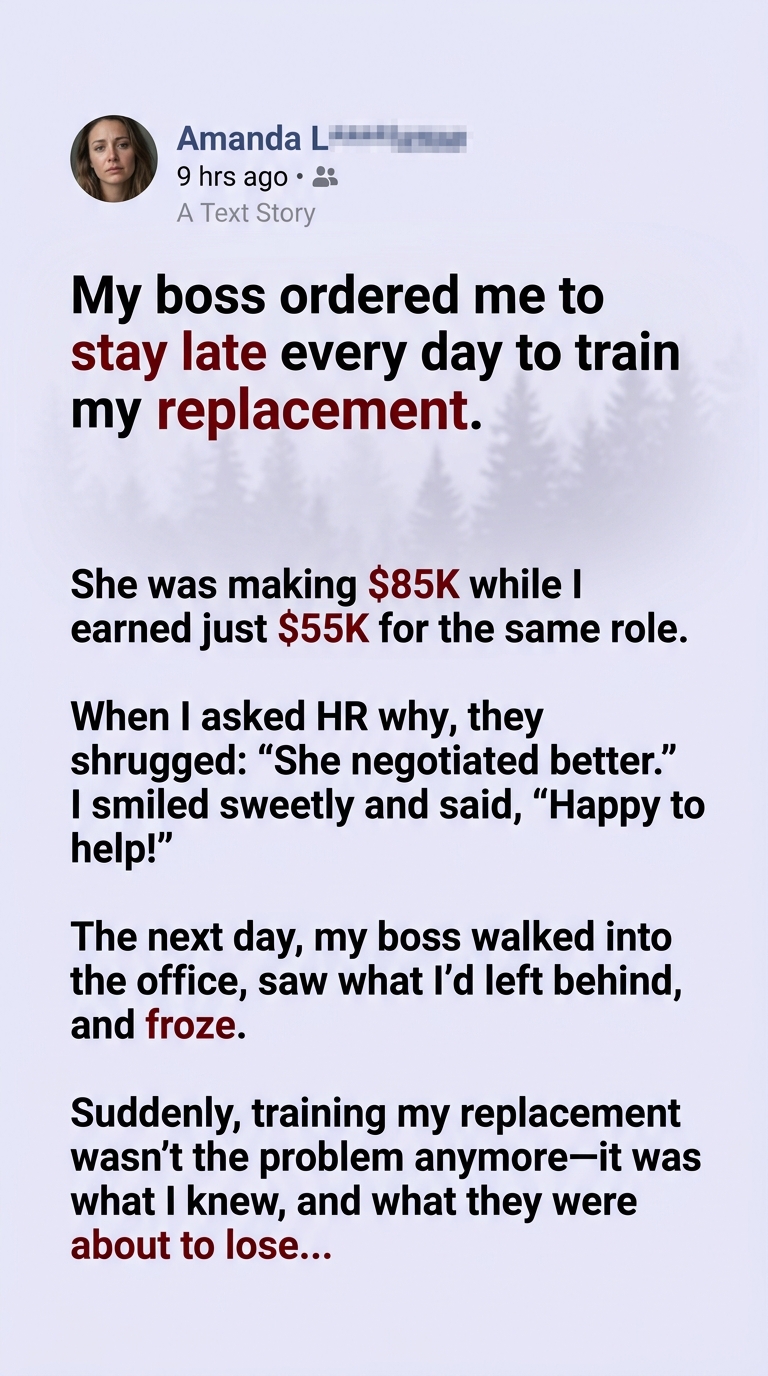
My Boss Made Me Train My $85K Replacement While I Earned $55K—So I Left Behind One Thing That Made Her Freeze
For seven years, I was the person everyone called when something went wrong.
A client’s account was broken? I fixed it. A deadline was impossible? I found a way. A new employee couldn’t figure out our systems? I stayed late to teach them.
I never complained. I believed hard work would eventually be rewarded.
Then, one Monday morning, my boss, Karen, called me into her office and introduced me to my replacement.
“This is Madison,” she said brightly. “She’ll be taking over your responsibilities over the next few weeks. I need you to train her thoroughly.”
I stared at her.
“My replacement?”
Karen folded her hands on the desk. “We’re restructuring the department. Your position is being eliminated, but Madison will help us move forward.”
I looked at Madison. She seemed uncomfortable, which told me she probably hadn’t known the whole story either.
“How much is she being paid?” I asked before I could stop myself.
Karen’s smile tightened. “That’s confidential.”
I didn’t learn the truth from Karen. I learned it from Madison herself.
During lunch, we sat together in the break room, and she casually mentioned her annual salary.
“Eighty-five thousand,” she said. “I was thrilled they accepted my number.”
My stomach dropped.
I earned $55,000.
We had the same job title. We were expected to handle the same clients, the same software, the same deadlines, and the same emergencies.
In fact, Madison had been hired to learn the job I had spent seven years mastering.
I took my concerns to HR.
The representative barely looked up from her computer.
“Madison negotiated better,” she said.
“That’s a $30,000 difference for essentially the same role.”
“Different candidates negotiate differently. Your compensation reflects the agreement you accepted.”
I waited for another explanation. A discussion about my performance. An offer to review my salary. Even an acknowledgment that the situation seemed unfair.
Nothing came.
“So,” I said slowly, “you’re eliminating my position but paying someone $30,000 more to do my work?”
“The company has made its decision.”
I nodded.
Then I smiled.
“Happy to help!”
HR looked relieved. They apparently interpreted my smile as acceptance.
They had no idea what I was about to do.
For the next two days, I trained Madison professionally. I showed her how to use our systems, explained the reporting process, and walked her through the standard procedures.
But I also began documenting everything.
Every process I had created. Every recurring issue I had solved. Every client exception I handled personally. Every workaround that kept the department running when the official procedures failed.
Most importantly, I documented the responsibilities that had never been formally written down.
Over seven years, I had quietly become the person who held the department together. The company’s official manuals were years out of date. Several important workflows existed only because I had built them myself.
I had never hidden that information. I had simply never been asked to turn my experience into a complete, organized system.
Now I was.
And I intended to leave a professional record of exactly what I had done.
On Wednesday afternoon, I sent HR a formal email confirming my termination date and requesting written clarification of my remaining duties, final compensation, and benefits. I also asked them to confirm the company’s expectations for the training period.
Then I prepared a transition document.
It was forty-three pages long.
It contained the procedures I had created, the projects I managed, the recurring problems nobody else knew how to solve, and a list of unresolved risks that would need attention after my departure.
I included links to the company’s approved files and systems, along with instructions for where the relevant information could be found.
I did not delete anything.
I did not take confidential documents home.
I did not sabotage a single project.
I simply made the state of the department impossible to misunderstand.
At the end, I included a final section titled “Outstanding Responsibilities Requiring Ownership.”
There were thirty-one items.
Some were small. Others affected major clients, reporting deadlines, and contractual commitments.
Every item had a description, a current status, and the name of the person who would need to take responsibility for it.
For seven years, those tasks had belonged to me without anyone acknowledging how much work they required.
Now they were visible.
On Thursday morning, Karen walked into the office carrying her coffee.
“Good morning!” she called.
Then she noticed the thick binder on her desk.
“What is this?”
“Your transition package,” I said. “I also emailed you and HR the digital version.”
She opened it.
Her eyes moved down the first few pages. Then she flipped to the section listing the outstanding responsibilities.
Her smile disappeared.
“What are all these items?”
“The responsibilities I currently manage that aren’t fully covered by the existing procedures.”
“Thirty-one?” she asked.
“Thirty-one that need a named owner. There may be others once Madison gets deeper into the role.”
Karen turned another page.
“This client escalation process—isn’t that automated?”
“Partly. The automation handles routine cases. The exceptions still require manual review.”
“And the monthly reconciliation?”
“I built the process after the previous system repeatedly produced incorrect totals. The written procedure explains how to verify the results.”
She looked up at me.
“Why haven’t you told me all this?”
I kept my voice calm.
“I’ve raised several of these issues over the years. I also documented them now because you asked me to train my replacement. I wanted to make sure the transition was complete.”
For the first time since she’d announced my replacement, Karen looked genuinely worried.
She took the binder into her office and closed the door.
Twenty minutes later, my phone rang.
It was the director of operations.
“Can you come into my office?”
When I arrived, Karen was already there, and HR had joined by video call.
The director tapped the transition document.
“Your manager tells me there are several responsibilities that could affect our client commitments if they aren’t transferred correctly.”
“They can be transferred,” I said. “That’s why I documented them.”
“Can you train Madison on all of this before your last day?”
“I can walk her through the procedures during my scheduled working hours. Some of these processes also require practice over multiple reporting cycles, so the documentation includes the necessary checks.”
Karen leaned forward.
“We need you to stay late this week. There’s too much to cover.”
I looked at her.
“You told me my position was being eliminated. I agreed to help with the transition during my working hours. If the company needs additional hours, I’d like the expectations and compensation confirmed in writing.”
The room went quiet.
For months, Karen had treated my time as an unlimited resource. Now, suddenly, every hour needed a discussion.
The director cleared his throat.
“That’s reasonable. We’ll review the schedule.”
Then he asked the question I had been waiting for.
“Is there any way you would consider staying with the company?”
I didn’t answer immediately.
Seven years earlier, I would have said yes before he finished asking. I would have accepted extra work, promised to fix everything, and hoped that being indispensable would eventually make them value me.
But being indispensable had never meant being respected.
“I’d consider a written offer that reflects the responsibilities of the role,” I said. “But I won’t make a decision based on a verbal promise.”
HR promised to review my compensation and discuss whether another position was available.
I thanked them and returned to my desk.
For the first time in years, I felt no need to convince anyone of my worth.
Because while they were deciding whether I deserved more money, another company had already made its decision.
Three weeks earlier, I had interviewed for a position at a smaller firm. They had offered me $82,000, a clearer job description, and a manager who had asked detailed questions about the systems I had built.
I had been hesitant to accept because I felt loyal to my current team.
Now I understood that loyalty could not be a substitute for a fair agreement.
I called the recruiter, confirmed the written offer, and accepted.
The next day, I gave HR the appropriate notice and confirmed my final working date in accordance with the agreement we had reached.
Karen looked stunned when she heard.
“But we’re still reviewing your compensation!”
“I appreciate that,” I said. “I’ve accepted another offer.”
“After everything we’ve invested in you?”
I almost laughed.
“After seven years of investing in this job, I decided it was time to invest in myself.”
My last week was busy, but it was different from every week before it.
I trained Madison during working hours. I answered reasonable questions. I explained the processes in the binder and made sure the appropriate company files were accessible.
Madison worked hard. She wasn’t my enemy, and I refused to treat her as one.
On my final afternoon, she stopped by my desk.
“I wanted to thank you,” she said. “I had no idea how much went into this job. I thought I was coming in to manage a few projects.”
I smiled.
“Now you know.”
She hesitated.
“Can I ask you something? Did you know they were paying me more?”
“Yes.”
Her face fell. “I’m sorry. I really didn’t know what you made.”
“I don’t blame you for negotiating your salary,” I told her. “You should always negotiate. I blame a system that expected me to accept less simply because I had already been there.”
She nodded slowly.
Then she said something I hadn’t expected.
“I hope I can do the job as well as you did.”
“You don’t have to do it exactly as I did,” I replied. “Just make sure the company recognizes the work you’re actually doing.”
I packed my personal belongings, returned my badge and equipment, and sent a final handover email.
Then I walked out.
No dramatic speech. No deleted files. No secret revenge.
Just a clean departure and a documented record of the work I had done.
Two weeks later, I heard that Karen had been asked to explain why the department’s staffing plan hadn’t accounted for all the responsibilities in my transition report. The operations director had also ordered a review of job descriptions and compensation bands.
I couldn’t know whether the review would lead to meaningful change, but at least the questions were finally being asked.
Madison contacted me once to clarify a process. I answered the question using the handover materials, then wished her luck.
Meanwhile, my new job was everything I had hoped it would be. My manager gave me clear responsibilities, asked for my input, and paid me for the level of work I was doing.
On my first payday, I checked the deposit twice.
The difference wasn’t just the money.
It was the feeling of knowing I no longer had to earn basic respect by sacrificing every evening.
A month after I left, Karen sent me a message.
“Things have been difficult without you. I wish we’d handled your departure differently.”
I read it, considered my response, and finally wrote:
“I hope the transition review helps the team. I wish you all the best.”
Then I closed the message.
For years, I had believed that if I worked hard enough, stayed late enough, and solved enough problems, someone would eventually recognize my value.
But the binder I left behind taught me something more important.
I had been valuable all along.
The company simply hadn’t wanted to pay what that value was worth.
And when I finally stopped trying to prove myself to people who had already decided what I was worth, I discovered something far better than revenge.
I discovered that I could leave—and build a better future somewhere else.
The biggest lesson wasn’t that my old company struggled without me. It was that I didn’t have to stay somewhere that needed my work but refused to recognize its value.