My Adoptive Mother Called Me Her Husband’s Charity Project at Their $17 Million Lake House. Then Their Lawyer Saw Me and Asked, “Wait… She’s the Owner?”
I had been home from a fourteen-month deployment for less than twenty-four hours when my adoptive mother reminded me exactly where I stood in her family.
Apparently, nowhere near the top.
I was standing in the hallway of the $17 million lake house where I had spent most of my teenage years, still wearing my Army uniform pants and carrying a battered duffel bag over one shoulder. I had come home expecting a quiet welcome, perhaps a cup of coffee and a chance to shower before driving to my own apartment.
Instead, the house was filled with wealthy guests, expensive champagne, and people laughing loudly beneath a chandelier that cost more than my first car.
My adoptive mother, Victoria, stood beside the fireplace in a cream-colored designer dress, entertaining a group of investors and family friends. My sister, Caroline, sat on the arm of a velvet sofa, showing everyone photographs from her latest European vacation.
Then someone asked Victoria whether I had returned from overseas.
She glanced toward the hallway and laughed.
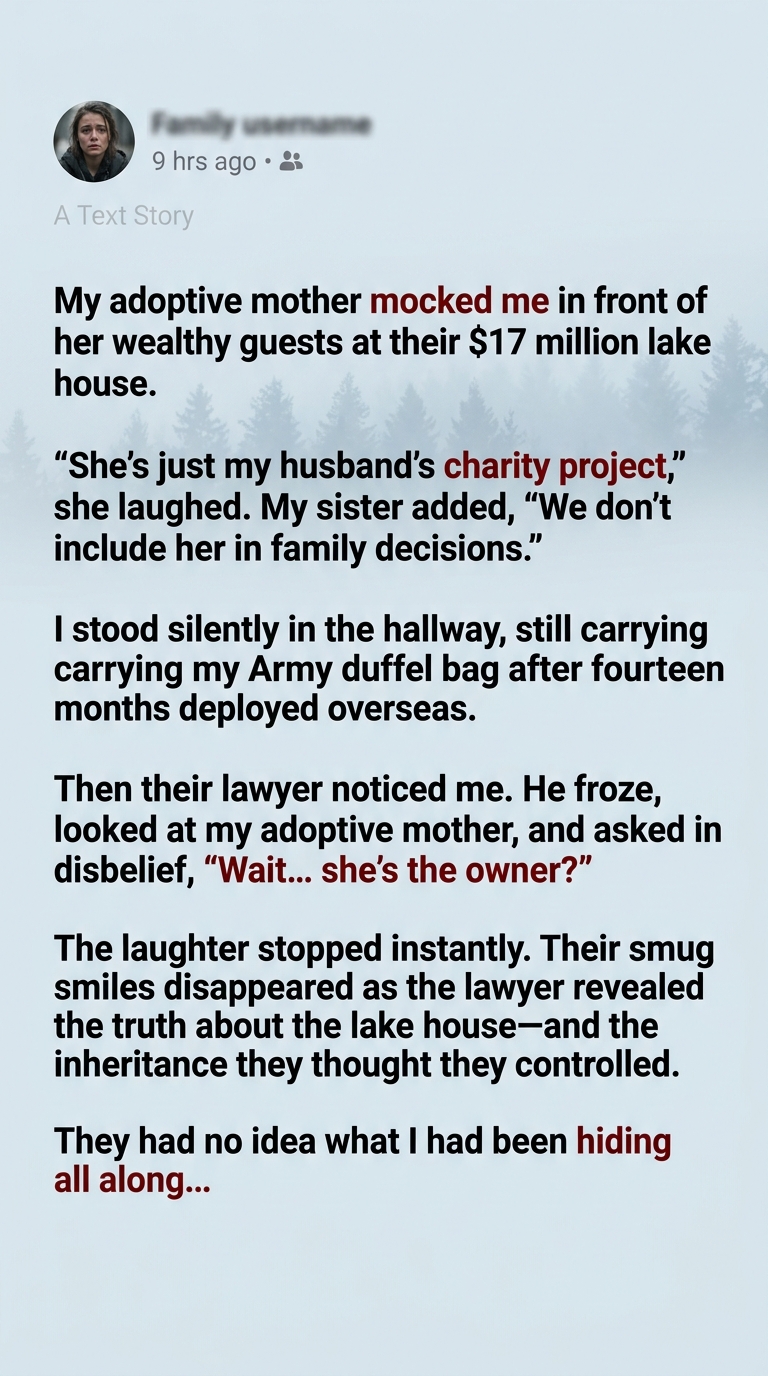
“Oh, yes. Our little soldier is back. She’s always been so dramatic about serving her country.”
One of the guests smiled politely.
Victoria continued, apparently enjoying the attention.
“Honestly, she’s just my husband’s charity project. We took her in when she was young, and now she thinks she’s part of the family.”
A few guests exchanged uncomfortable looks.
Caroline laughed.
“We don’t include her in family decisions. She wouldn’t understand them anyway.”
I stood perfectly still.
Fourteen months deployed overseas had taught me how to remain calm under pressure. I had learned to keep my expression neutral, assess a situation before reacting, and never let someone else’s behavior dictate my next move.
But hearing those words in the house where I had once believed I belonged hurt more than I wanted to admit.
Victoria finally noticed me standing in the hallway.
“Oh, there you are,” she said, as if I had interrupted her evening by existing. “You should probably take your things upstairs. We’re entertaining important people tonight.”
I tightened my grip on my duffel bag.
“Of course.”
I was about to turn away when a man near the dining room looked up.
He was older, with silver hair, a dark suit, and a leather document case tucked beneath his arm.
I recognized him immediately.
Mr. Bennett was the family’s longtime attorney. He had handled my adoptive father’s estate and had met with me several times before my deployment.
He stared at me.
Then he looked at Victoria.
Then back at me.
His face lost its color.
“Wait,” he said slowly. “She’s here?”
Victoria frowned. “Yes. That’s Emily. Why?”
Mr. Bennett took a step toward me, looking as though he had just discovered something impossible.
“Wait… she’s the owner?”
The room fell silent.
Someone stopped pouring champagne. Caroline lowered her phone. Victoria’s smile froze.
“What are you talking about?” she demanded.
Mr. Bennett opened his document case.
“I thought you had already explained the ownership transfer to your guests.”
Victoria’s expression hardened.
“What ownership transfer?”
He looked genuinely confused.
“The lake house. The property is owned by the trust established by your late husband. Emily is the sole beneficiary and the designated property owner under the finalized estate documents.”
A glass clinked against a plate.
My mother stared at him.
“That is absolutely ridiculous. My husband left this house to our family.”
“He left specific instructions regarding the property,” Mr. Bennett replied carefully. “And those instructions were followed.”
Caroline stood up.
“That’s impossible. Mom has been managing this house for years.”
“Managing the property is not the same as owning it,” he said.
Victoria turned toward me.
I could see the calculations moving behind her eyes.
“Emily,” she said sharply, “what is he talking about?”
I set my duffel bag beside the hallway table.
“Dad told me I would understand when the time was right.”
For the first time that evening, nobody laughed.
To understand why, I have to explain something about my adoptive father, Richard.
Richard had adopted me when I was eight years old.
My biological parents had died in a car accident, and after spending several months with relatives who couldn’t care for me, I had entered the foster system. Richard met me through a family friend who volunteered with children in temporary placements.
He was patient, gentle, and the first adult who ever made me feel that I wasn’t a burden.
Victoria, his wife, had been less enthusiastic.
She agreed to the adoption because Richard wanted another child, but she never seemed entirely comfortable with the decision. Caroline, their biological daughter, was twelve at the time and immediately resented sharing her parents’ attention.
I spent years trying to earn my place.
I worked hard in school. I helped around the house. I avoided asking for expensive clothes or vacations. When Caroline complained that I was taking too much attention away from her, I made myself smaller.
Richard noticed.
He would sit beside me in the garden and tell me, “You don’t have to earn your place here, Emily. You’re my daughter because I chose you.”
Those words kept me going through more difficult years than he ever knew.
When I turned eighteen, I enlisted in the Army. I wanted to serve, become independent, and build a life based on my own decisions.
Richard was proud of me.
Victoria called it another dramatic attempt to prove myself.
I left anyway.
Over the next several years, I completed my training, advanced in my career, and learned to manage my finances carefully. I wasn’t wealthy, but I was stable. I sent Richard photographs whenever I could and called him when my schedule allowed.
He always answered.
Then, two years before my deployment, Richard became seriously ill.
I came home on leave and spent as much time with him as I could. Victoria and Caroline were often busy with social events, charity galas, and business meetings. I helped organize his appointments, sat beside him during difficult treatments, and listened when he talked about the past.
One afternoon, he asked me to take a walk with him beside the lake.
The property was beautiful. The house stood on a bluff overlooking the water, surrounded by old trees and a private stretch of shoreline. Richard had bought it decades earlier, before his business became successful.
He had always said the house was more than an investment.
“It holds the best memories of my life,” he told me.
I asked him whether he was worried about what would happen to it.
He nodded.
“I’m worried about what happens to people when money gets involved.”
I didn’t know what to say.
He stopped walking and looked at me.
“Emily, you’ve spent your whole life believing you have to prove you deserve to be loved. You don’t. And you shouldn’t have to keep proving it after I’m gone.”
I felt tears gathering in my eyes.
“Dad, don’t talk like that.”
“I’m not trying to frighten you. I’m trying to make sure you understand something.”
He told me that he had arranged his estate carefully with Mr. Bennett. He wanted Victoria to have financial security, and he wanted Caroline to receive her own inheritance. But he had also made a specific decision about the lake house.
He wanted it preserved for me.
I was stunned.
“Why me?”
“Because I want you to have one place in this world where you never have to wonder whether you’re wanted.”
I began to cry.
He squeezed my hand.
“You are not my charity project. You are my daughter.”
He died several months later.
At the reading of the estate documents, Victoria was furious when she learned that the lake house had been placed in a trust designed to transfer ownership to me once the specified conditions were met.
She argued that she had spent years maintaining the property and entertaining business associates there. She said Caroline needed the house for future family gatherings. She insisted Richard had been confused about what he wanted.
Mr. Bennett explained the documents and the process. The trust was valid, and the transfer had been completed according to its terms.
Victoria eventually stopped arguing in front of the attorney.
But she never accepted the decision.
She continued living at the lake house under the arrangements permitted by the trust, telling friends that the property was still hers and that the legal details were merely formalities.
I never challenged her publicly.
I had been preparing for deployment, and I didn’t want a legal dispute to become the last thing connecting me to the family I had grown up with. I trusted Mr. Bennett to handle the paperwork, and I trusted my father’s instructions.
Then I left for fourteen months overseas.
During that time, Victoria apparently became more confident that no one would question her version of events.
Until I came home.
And until Mr. Bennett saw me standing in the hallway.
Back in the living room, Victoria was still trying to regain control.
“This is a private family matter,” she said to the guests. “I don’t know why we’re discussing legal documents at a social gathering.”
Mr. Bennett closed his document case.
“You brought the ownership question into the conversation when you described Emily as a charity project. I thought it was important to correct the misunderstanding.”
Caroline’s face had turned bright red.
“Emily, you knew about this the whole time?”
“Yes.”
“And you never said anything?”
“Dad asked me not to turn his decision into a fight.”
Victoria let out a sharp laugh.
“So you’ve been sitting on this information while we’ve been living here?”
“I didn’t hide the legal documents from you. You had access to the estate process. You simply didn’t like the outcome.”
Her mouth tightened.
“You cannot seriously expect us to leave our home.”
I looked around the room.
The expensive furniture. The framed photographs. The staircase where Richard had taught me to tie my shoes. The window overlooking the lake where he used to sit with a book in his lap.
“This was Dad’s home,” I said. “He made a decision about what should happen to it. I didn’t force him to make that decision.”
Victoria stepped closer.
“You owe us. We raised you.”
I felt something inside me settle.
For years, I had feared that disagreeing with Victoria meant proving her right about me. I had been afraid that setting boundaries would make me ungrateful, difficult, or undeserving of the family that had adopted me.
But I was no longer eight years old.
“I will always be grateful that Dad adopted me,” I said. “I will always remember what he gave me. But gratitude doesn’t mean surrendering every right he deliberately left me.”
Caroline folded her arms.
“So what now? Are you going to throw us out?”
I looked at her.
“I haven’t decided what happens next.”
That was the truth.
I had returned from deployment expecting to spend a few quiet days recovering and catching up on sleep. I hadn’t planned to make a major decision about the lake house on the evening I arrived.
I also wasn’t going to let a room full of wealthy guests pressure me into deciding something that would affect my future.
I turned to Mr. Bennett.
“I’d like to review all the current property arrangements with you privately. I want to understand the trust’s obligations, the expenses, and everyone’s legal rights before I make any decisions.”
He nodded.
“Of course. We can arrange that.”
Victoria looked horrified.
“You can’t be serious.”
“I am.”
“You’re going to make us negotiate with you?”
“No,” I replied. “I’m going to make sure everything is handled properly.”
Then I picked up my duffel bag and walked upstairs.
That night, I slept in my old bedroom for the first time in years.
I lay awake thinking about Richard, remembering his voice and the way he had always made room for me at the table.
I was angry at Victoria and Caroline. But beneath the anger was a deeper sadness: I had returned home hoping to feel welcomed, only to discover that they still saw me as an outsider.
The next morning, I met with Mr. Bennett.
We reviewed the trust documents, the property’s expenses, and the arrangements under which Victoria could continue using the house. He explained that I had several options, but any change would need to follow the trust’s terms and applicable law.
I didn’t make an immediate decision.
Instead, I asked for an independent review of the property finances and a clear accounting of the money being spent on maintenance, taxes, and household costs.
That request caused another argument.
Victoria accused me of treating her like a stranger. Caroline said I was punishing them for a comment made at a party.
I told them both that I was not making a decision out of revenge.
“I want the truth about the property, and I want to understand my responsibilities as its owner. That’s all.”
Over the next several weeks, the review uncovered several expenses that needed clarification. Nothing about that review automatically proved wrongdoing, but it reinforced my decision not to rely on verbal assurances alone.
I asked Mr. Bennett to put every future arrangement in writing.
Eventually, Victoria and I sat down for a private conversation.
She arrived wearing a perfectly pressed blouse and the expression she used whenever she wanted to appear reasonable.
“I assume you’ve made your decision,” she said.
“I’ve made a few decisions. The first is that I won’t discuss ownership in front of guests again. The second is that any agreement about the house will be documented and reviewed by the attorney.”
She stared at me.
“And the third?”
“I won’t let you insult me in my own home.”
Her eyes narrowed.
“You think owning a house makes you better than us?”
“No. I think being treated with respect should never have depended on whether I owned anything.”
For a moment, she seemed unable to respond.
Then she said, “Your father would hate seeing us fight like this.”
I felt the familiar sting of guilt.
But I remembered Richard’s words: You don’t have to earn your place here.
“Dad wanted us to be a family,” I replied. “That doesn’t mean he wanted me to accept being humiliated.”
Victoria looked away.
I told her I wasn’t going to make a sudden decision about her living arrangements. I would consider her needs, the trust’s obligations, and the practical realities of the property. But I would not pretend that the house belonged to her simply because she had lived there for years.
She left without another word.
Caroline contacted me later that week. Her first message was angry. Her second was defensive. Her third simply asked whether we could talk.
We met at a café.
She admitted that she had always felt threatened by my relationship with Richard. She said she had believed that his affection for me meant there was less left for her.
“I know that sounds childish,” she said. “But I grew up thinking I had to be the most important person in his life.”
I listened.
“I never wanted to take your place,” I told her. “I just wanted one.”
She started crying.
For the first time, she acknowledged that our mother’s comments had been cruel and that she had joined in because it was easier than challenging her.
It didn’t fix everything. It didn’t erase years of being treated as an outsider.
But it was a beginning.
In the months that followed, I worked with the attorney to establish a clear, lawful plan for the lake house. The arrangement respected the trust’s terms, clarified the property’s costs, and gave everyone involved a written understanding of their rights and responsibilities.
I didn’t sell the house immediately. I couldn’t bear to make such a permanent decision while my grief was still fresh.
Instead, I restored the room where Richard used to read, kept his favorite chair beside the window, and began visiting the lake on quiet weekends.
Sometimes, I invited friends from my unit. Sometimes, I sat alone and watched the sunlight move across the water.
The house slowly became what my father had intended it to be: a place where I could belong without having to prove that I deserved to be there.
Victoria and I never became close in the way I had once hoped. We learned to communicate politely, and I maintained boundaries that protected my peace. Caroline and I continued working on our relationship, slowly and imperfectly.
I didn’t need to destroy them to reclaim my place.
I didn’t need to make Victoria homeless or humiliate Caroline in front of her friends.
The truth was enough.
My father had loved me. He had made a careful decision about his estate. And the people who had laughed at me in that hallway had been wrong about who I was and what I meant to him.
One evening, I stood by the lake with Richard’s old photograph in my hand.
He was smiling in the picture, one arm around my shoulder.
I finally understood that he hadn’t left me the house to prove I was more deserving than Victoria or Caroline.
He had left it to me because he wanted me to know that I had a place in the world that no one could take away simply by calling me unwanted.
I had spent years trying to earn the love he had already given me.
I would spend the rest of my life learning how to accept it.
My adoptive mother called me her husband’s charity project. But the man who had chosen me as his daughter had made sure I never had to beg for a place in his family again. The lake house wasn’t the greatest thing he left me. The greatest gift was knowing I had always belonged.