I Thought My Stepfather Loved Me Like His Own Child—Until I Heard What He Said Before I Knocked on His Door
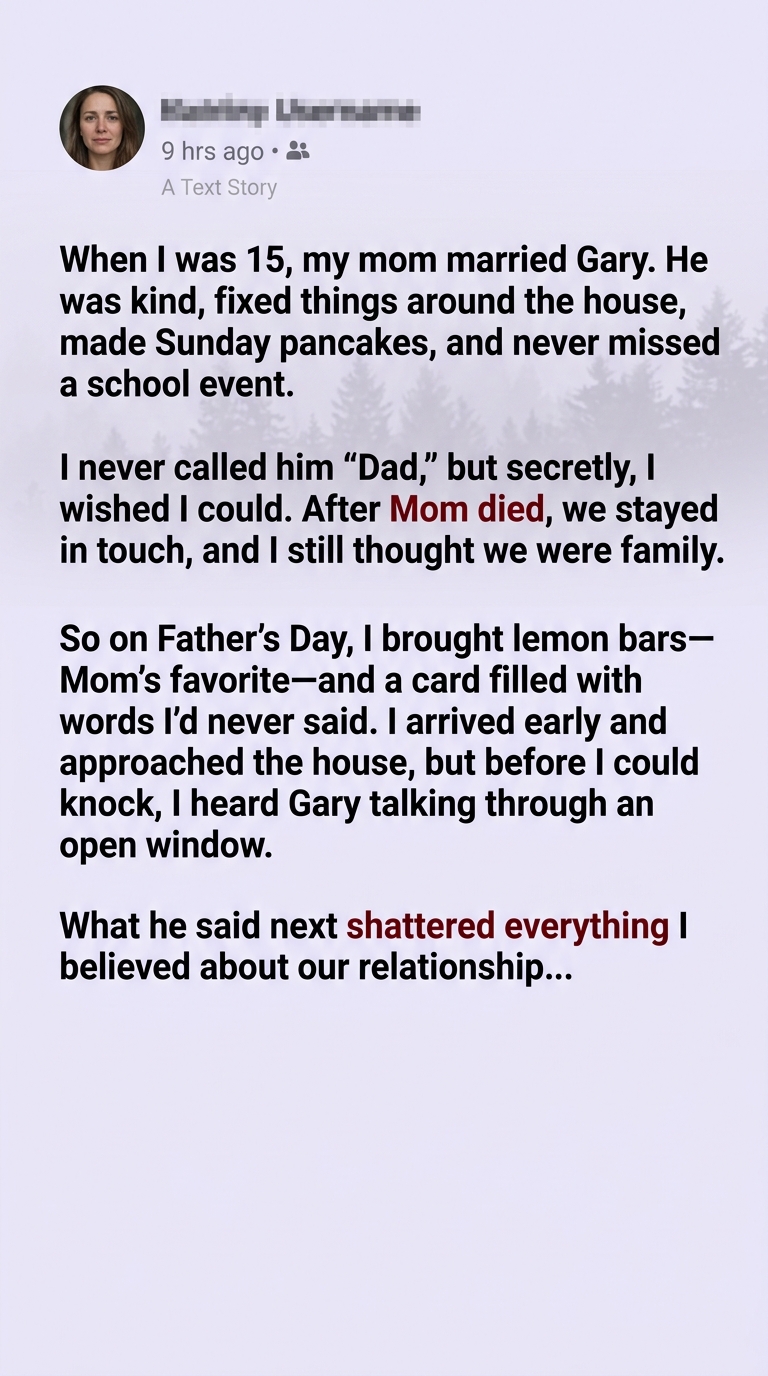
When I was fifteen, my mother married a man named Gary.
I didn’t like the idea at first. After watching my parents’ marriage fall apart, I had no interest in letting another man into our lives. I was polite to Gary, but I kept my distance. I never called him Dad, and I made sure he understood that I wasn’t looking for a replacement father.
Gary never pushed.
Instead, he showed up.
When my bedroom door broke, he fixed it without complaining. When my school project fell apart the night before it was due, he stayed up helping me rebuild it. Every Sunday morning, he made pancakes, even though mine were always burnt because I insisted on helping.
He attended every school event he could, sitting in the back row and clapping louder than anyone else.
When I failed a math test, he didn’t lecture me. He sat beside me at the kitchen table and helped me work through the problems until I understood them.
And whenever I came home upset, he never demanded an explanation. He simply asked whether I wanted to talk or wanted pancakes.
Somewhere along the way, I stopped seeing him as the man my mother had married.
I began seeing him as family.
I even started imagining what it might feel like to call him Dad.
But the word always caught in my throat.
I was afraid that saying it would somehow betray my biological father. I was also afraid that Gary might not want that kind of relationship with me.
So I never asked.
Years passed. I graduated from high school, went to college, and eventually moved into my own apartment. Gary helped me move my furniture and insisted on tightening every screw in my bed frame before leaving.
“You call if anything breaks,” he said.
“Even if it’s just a light bulb?”
He smiled. “Especially if it’s a light bulb. Those things are dangerous.”
I laughed, and he hugged me before heading home.
Then my mother became ill.
Everything changed so quickly that I still struggle to describe those months. Hospital visits replaced Sunday pancakes. The house that had once smelled of butter and maple syrup began to smell of medicine and disinfectant.
Gary stayed beside her through every appointment, every sleepless night, and every difficult conversation.
I watched him care for the woman he loved, and I loved him more for it.
When Mom died, I thought I might lose Gary, too.
For weeks, we barely spoke. We were both grieving, and neither of us knew how to reach the other without making the pain worse.
Eventually, I called him.
He answered on the second ring.
“Hey, kiddo.”
Those two words made me cry.
We began talking again. Sometimes I visited him for dinner. Sometimes he called to ask how work was going. On my birthday, he still sent me a message. At Christmas, he still asked whether I was coming home.
I never stopped thinking of him as my stepfather, but in my heart, he had become something more.
He was the man who had chosen to love me without demanding that I love him back in exactly the same way.
And I was finally ready to tell him.
That year, Father’s Day fell on a Sunday.
I spent the morning baking lemon bars using my mother’s recipe. They had been her favorite dessert, and Gary had always claimed mine were better than hers.
He was lying, of course.
Mom’s lemon bars had been perfect.
I packed the dessert into a small container, wrapped it in a ribbon, and placed a card on top.
I had spent three nights writing that card.
Inside, I thanked Gary for showing up when he didn’t have to. I thanked him for every school event, every repaired bicycle, every Sunday breakfast, and every quiet moment when he let me be upset without making me feel foolish.
At the bottom, I wrote the words I had carried inside me for years.
I know I never called you Dad, but I hope you know that you became one to me. You didn’t have to love me the way you did. You chose to. And I will always be grateful that you chose me.
I stared at the sentence for a long time before sealing the envelope.
Then I drove to Gary’s house.
I arrived early. His car was in the driveway, and the kitchen window was open. I could hear voices inside.
I smiled, imagining him making coffee and complaining about the weather.
I picked up the lemon bars and walked toward the front door.
Then I heard my name.
I stopped.
Gary was talking to someone in the kitchen.
“I don’t know what I’m going to do about her,” he said.
My smile faded.
A woman answered, but I couldn’t make out her words.
Gary sighed.
“She’s been coming around more lately. I know she means well, but she’s not my daughter. I was married to her mother. That’s what brought us together.”
The container suddenly felt heavy in my hands.
He continued.
“I did my best when she was growing up. Her mother needed me to be there, so I was. But now her mother’s gone, and I don’t want her thinking I can fill that space forever.”
I couldn’t breathe.
The woman said something I couldn’t hear.
Then Gary replied, “I never adopted her. I never promised to be her father. I think she needs to build her own life instead of holding on to something that was never really hers.”
The lemon bars slipped slightly in my hands.
I had spent years believing that I was lucky to have a man like Gary in my life. I had finally worked up the courage to tell him what he meant to me.
And now I was standing outside his house, listening to him explain that I had misunderstood everything.
I wanted to knock. I wanted to ask him whether every pancake, every school event, and every hug had been nothing more than an obligation to my mother.
Instead, I quietly turned around and walked back to my car.
I placed the dessert on the passenger seat and sat behind the steering wheel.
For several minutes, I couldn’t move.
Then I started the engine and drove home.
I didn’t call Gary that evening.
Or the next day.
For the first time since my mother died, I didn’t know whether I wanted to speak to him again.
Two days later, he called.
“Hey, kiddo. You okay? I haven’t heard from you.”
I almost laughed at the irony.
“I’m fine.”
“You sound strange.”
“I’m just busy.”
There was a pause.
“Did something happen?”
I closed my eyes.
“I came to your house on Sunday.”
Silence.
“I brought lemon bars,” I continued. “And a Father’s Day card.”
His voice changed.
“Oh.”
“I heard what you said through the kitchen window.”
He didn’t answer.
I waited for him to deny it, to explain that I had misunderstood, or to say that the conversation wasn’t what it sounded like.
Instead, he exhaled slowly.
“I see.”
“Was it true?” I asked. “Did you only stay in my life because Mom needed you to?”
“No,” he said quickly. “That’s not what I meant.”
“Then what did you mean?”
He was quiet for so long that I thought the call had dropped.
Finally, he said, “I need to tell you something. Can you come over?”
Every instinct told me not to go.
But I needed an answer.
When I arrived, Gary was sitting at the kitchen table. Two cups of tea sat in front of him.
He looked older than I remembered.
“I shouldn’t have said those things that way,” he began.
“But you said them.”
“Yes.”
He rubbed his hands together.
“When I married your mother, I promised her I would treat you well. I knew you had already been through a lot, and I didn’t want you to feel like you had to accept me as your father.”
I sat across from him.
“I thought you wanted me to.”
“I did,” he admitted. “But I was afraid of pushing you. Every time you called me Gary, I told myself that was what you needed. I didn’t want you to think I was trying to replace your dad.”
“Then why did you say I wasn’t your daughter?”
His eyes filled with tears.
“Because I was scared.”
I stared at him.
“Scared of what?”
He looked down at the table.
“Your mother is gone. For years, I knew my place in your life was connected to her. I was her husband, and I was the man who helped raise you. After she died, I didn’t know what I was supposed to be anymore.”
He took a shaky breath.
“When you started visiting more often, I was happy. But I was also afraid you were depending on me to be something I couldn’t be. I thought if I made the relationship smaller, it would hurt less if we drifted apart.”
I felt tears gathering in my eyes.
“So you were trying to push me away before I could leave you?”
He nodded.
“I know it sounds foolish.”
“It sounds cruel.”
“I know.”
For the first time, Gary didn’t try to defend himself.
He let the silence sit between us.
Then he reached into a drawer and pulled out a small box.
Inside were photographs from my childhood: Gary teaching me to ride a bicycle, Gary holding up a science project I had built, Gary standing beside me at my high school graduation.
At the bottom was a photograph I had never seen before.
It showed Gary sitting beside my hospital bed when I was sixteen, after I had undergone an emergency appendectomy. I remembered waking up and seeing him there, looking exhausted and frightened.
On the back, in his handwriting, were the words:
She asked for her mom. I wish I could make everything better for her.
I looked up at him.
“I remember that night,” I whispered.
“I sat there for hours,” he said. “You were in pain, and I couldn’t do anything except hold your hand. I remember thinking that I would give anything to take that pain away.”
His voice cracked.
“I know I’m not your biological father. I know I can’t replace him. But I loved raising you. I loved watching you grow up. I loved being the person you called when something broke.”
He wiped his eyes.
“I was wrong to pretend that love had an expiration date just because your mother died.”
I began to cry.
“Then why didn’t you just tell me you were scared?”
“Because I’m an old fool who thought distancing myself would protect us both.”
I looked down at my hands.
“I wasn’t asking you to replace my father,” I said. “I just wanted to know that I still mattered to you.”
Gary reached across the table but stopped before touching me.
“You do. You always have.”
I looked at him for a long time.
“Do you want me in your life?”
His answer came immediately.
“Yes.”
“Even if I keep coming around? Even if I call you when I need advice? Even if I want you to be part of my life for the rest of yours?”
He was crying openly now.
“Yes, kiddo. If that’s what you want, yes.”
I finally let him take my hand.
Then I told him about the card.
“I wrote that I wished I had called you Dad.”
He closed his eyes.
“I wish you had, too,” he whispered. “But I never wanted you to feel you had to.”
I shook my head.
“I didn’t call you Dad because I was afraid you wouldn’t want me to.”
He looked devastated.
We had spent years protecting each other from feelings neither of us had ever spoken aloud.
And in doing so, we had nearly lost the family we had already built.
I reached into my bag and pulled out the Father’s Day card. I had brought it with me, though I hadn’t known whether I would give it to him.
The envelope was slightly bent at the corners.
“I still want you to read it,” I said.
He opened it carefully.
As he read, tears fell onto the paper.
When he reached the final line, he covered his face with his hands.
I stood up and walked around the table.
Then, for the first time in my life, I wrapped my arms around him and whispered the word I had been afraid to say for years.
“Dad.”
He held me so tightly that I could feel him trembling.
“Oh, sweetheart,” he whispered. “I’ve wanted to hear that for so long.”
We cried together in the kitchen where he had once made me pancakes, in the house where I had learned that love could be quiet and patient, and in the place where I had nearly convinced myself I had never belonged.
The next Sunday, I returned with another batch of lemon bars.
Gary opened the door before I could knock.
“Happy Sunday, kiddo,” he said.
I smiled.
“Happy Sunday, Dad.”
He stepped aside and let me in.
My mother was gone, and nothing could bring her back. Gary and I couldn’t undo the fear, the misunderstandings, or the years we had spent keeping our feelings to ourselves.
But we could choose what happened next.
I had arrived at his house on Father’s Day believing I was about to lose the only father figure I had ever known.
Instead, I discovered that he had been afraid of losing me, too.
And sometimes, the most painful words we overhear are not the whole truth. Sometimes, they are the beginning of a conversation two people should have had years ago.
Gary was never my biological father.
But he had shown up, year after year, when I needed someone to show up.
And when I finally called him Dad, I wasn’t giving him a title he had earned through obligation.
I was naming the love he had given me freely.
Family wasn’t the promise we made when my mother was alive. It was the choice we made after she was gone—to keep showing up for each other, even when we were afraid.