The Starbucks Gift Card My Student Gave Me Changed My Life
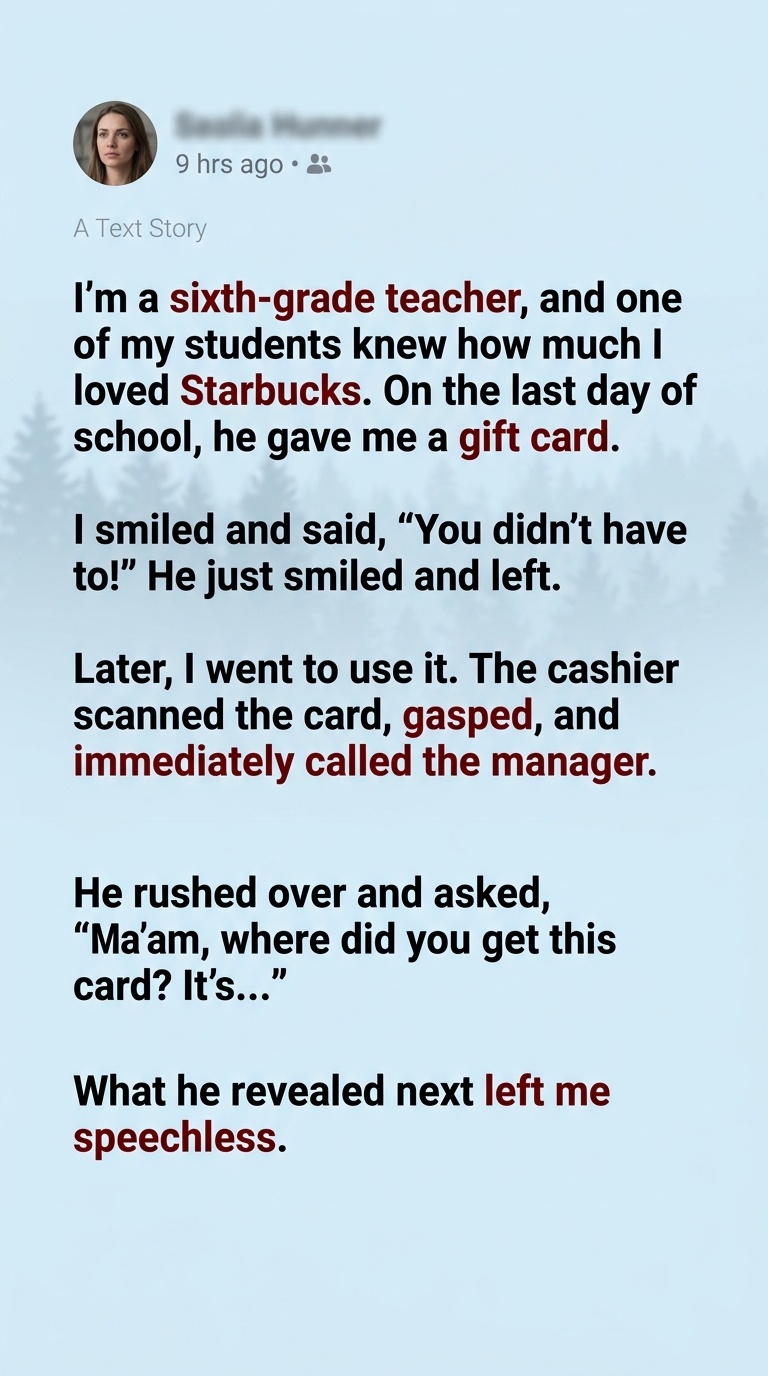
I’m a sixth-grade teacher, and anyone who knows me knows how much I love Starbucks.
After a long day of grading papers, managing noisy classrooms, and answering a hundred questions before lunch, a caramel latte was my little reward. My students teased me about it constantly, especially a quiet boy named Ethan.
Ethan was one of those children who rarely asked for anything. He sat near the back of my classroom, wore the same blue hoodie several times a week, and always seemed more concerned about everyone else than himself.
I knew his family struggled financially. Sometimes, he arrived at school without breakfast. When we had classroom celebrations, he would quietly decline snacks and say he wasn’t hungry.
But he was thoughtful. He held doors open for other students, helped clean the classroom without being asked, and once stayed after school to help me pick up hundreds of papers scattered across the floor.
On the last day of school, my students rushed around exchanging hugs, signing yearbooks, and promising to keep in touch.
Just before Ethan left, he approached my desk with a small white envelope.
“What’s this?” I asked.
“A present,” he said shyly.
I opened it and found a Starbucks gift card.
I smiled. “Ethan! You didn’t have to do this!”
He just smiled back.
“I wanted to,” he whispered.
Before I could say anything else, he waved goodbye and hurried out of the classroom.
I slipped the card into my purse, touched by the gesture. I assumed it held five or ten dollars. Perhaps he had saved his allowance for weeks to buy it.
The thought made me smile, but it also made me feel a little uncomfortable. I wished he hadn’t spent his money on me.
A few days later, I stopped at Starbucks on my way to school. I ordered my usual caramel latte and handed the cashier Ethan’s gift card.
She scanned it.
Then she stopped.
Her smile disappeared as she stared at the screen.
“I’m sorry,” she said. “Could you wait a moment?”
She scanned it again, then leaned toward her coworker and whispered something I couldn’t hear.
A few seconds later, the manager hurried out from the back.
“Ma’am,” he asked, looking from the card to my face, “where did you get this?”
My stomach tightened.
“From one of my students. He gave it to me on the last day of school. Is something wrong?”
The manager looked at the card again.
“This card has a balance of $10,000.”
I laughed nervously.
“I’m sorry, what?”
“Ten thousand dollars,” he repeated. “It’s an unusually large balance. I need to verify it before we can process a purchase.”
I stared at him, convinced there had been a mistake.
Ethan’s family couldn’t afford new school supplies. He sometimes came to class without breakfast. There was no way he had given me a ten-thousand-dollar gift card.
“Could someone have loaded that amount by accident?” I asked.
“It’s possible,” he said. “But we need to check the transaction history.”
He returned a few minutes later, carrying a printout.
“The card was purchased and loaded at one of our locations last week,” he explained. “The payment was approved, and the balance is valid. I can’t share the purchaser’s private information, but the transaction itself appears legitimate.”
I thanked him, paid for my coffee another way, and stepped outside.
My hands were trembling.
Why would Ethan give me ten thousand dollars?
And where could a sixth-grade boy possibly have gotten that kind of money?
I drove to school, unable to stop thinking about it. I knew I couldn’t simply accept the card without understanding what had happened.
That afternoon, I called Ethan’s mother, Mrs. Carter, using the contact information on file.
“I’m sorry to bother you,” I began, “but Ethan gave me a Starbucks gift card, and something unusual happened when I tried to use it.”
There was a long silence.
Then she asked quietly, “How much was on it?”
“Ten thousand dollars.”
I heard her inhale sharply.
“Oh, sweetheart,” she whispered. “He really did it.”
“Did what?”
Her voice broke.
“Please don’t be angry with him. He has been planning this for months.”
She asked if we could meet the following morning.
When Mrs. Carter arrived at school, she looked exhausted. She held a small envelope and kept wiping her eyes.
“Ethan’s father, Daniel, died two years ago,” she explained. “He worked as a delivery driver. He wasn’t wealthy, but he was the kindest man I’ve ever known.”
She told me that Daniel had been diagnosed with a serious illness shortly before he died. During his final months, he spent as much time as he could with Ethan, helping him with homework and talking about the future.
One afternoon, Ethan had come home upset because he thought his teacher didn’t like him. He had been struggling in class and worried he was disappointing me.
Daniel had told him something that stayed with him.
“Teachers don’t always have easy days,” he had said. “Sometimes, a small act of kindness can make a bigger difference than you realize.”
After Daniel died, Mrs. Carter found a savings account he had created for Ethan. It contained money he had put aside over several years, hoping to help his son with future education expenses.
The money was intended for Ethan’s future, and Mrs. Carter had been carefully managing it.
Then, a few months before the end of the school year, Ethan overheard her talking to a relative about how exhausted she had become while working extra shifts to keep their household afloat.
He remembered his father’s words.
He wanted to do something kind for someone who had helped him.
But he didn’t want to spend his father’s savings carelessly, and Mrs. Carter knew she had to protect the money set aside for Ethan’s future.
“So what happened?” I asked.
Mrs. Carter opened the envelope.
Inside was a handwritten letter from Daniel, written shortly before his death. He had left it for Ethan to read when he was older.
It said:
My son,
If you’re reading this, I hope you have grown into a kind man. I hope you remember that the value of a gift isn’t measured by its price, but by the love behind it.
If someone ever helps you when life feels difficult, don’t forget them. You may not always be able to repay them, but you can pass their kindness along.
And if you ever have enough to help someone who has helped you, do it because you want to—not because you feel you owe them.
Love, Dad.
Mrs. Carter wiped away a tear.
“Ethan read that letter after he had a difficult week at school,” she said. “He told me he wanted to give you something special because you never made him feel ashamed when he struggled. You helped him catch up after he missed school, checked on him when he was quiet, and made sure he had something to eat without embarrassing him.”
I remembered those moments. I hadn’t thought they were extraordinary. They were simply what I believed a teacher should do.
“But the card…” I began.
Mrs. Carter nodded. “Ethan asked me about giving you a gift. I told him we needed to keep his father’s savings safe. We agreed that he could choose a small present within our budget. I bought the gift card, and I loaded it with the amount we had agreed on. I don’t know why the register showed such a large balance, and I’m going to help investigate it. You shouldn’t spend anything until the company confirms what happened.”
Relief washed over me, followed by a fresh wave of emotion.
The gift card wasn’t a secret fortune. It wasn’t proof that Ethan had somehow found thousands of dollars.
It was a small, thoughtful gift that had somehow become a mystery.
And the mystery had led me to something far more important: a father’s final lesson, a mother’s quiet sacrifices, and a boy who wanted to show gratitude.
The following week, Starbucks confirmed that the displayed balance had resulted from a system error. The card held only the modest amount Mrs. Carter had originally loaded. The company corrected the error, and I thanked her for helping resolve the confusion.
I used the card to buy my usual caramel latte.
But I also did something else.
I wrote Ethan a letter.
I told him that the gift had made me feel appreciated, but that the greatest gift he had given me was the reminder of why I became a teacher in the first place.
I told him that he never had to spend money to prove he was a good person. His kindness, effort, and courage already said more than any gift card ever could.
On the first day of the new school year, Ethan came to my classroom to say hello.
I handed him a small package: a notebook filled with encouraging messages, a new set of pencils, and a copy of a book I thought he would love.
He opened it and smiled.
“Miss, you didn’t have to!”
I laughed, remembering his words from the last day of school.
“I know,” I said. “I wanted to.”
His eyes filled with tears, and he hugged me.
In that moment, I understood something I had spent years trying to teach my students.
Kindness doesn’t have to be expensive to be priceless.
Sometimes, the smallest gift can reveal the biggest heart.
And sometimes, a child reminds a teacher that the lessons that matter most are the ones no textbook can teach.