The Secret My Son Recognized on My Bride’s Shoulder
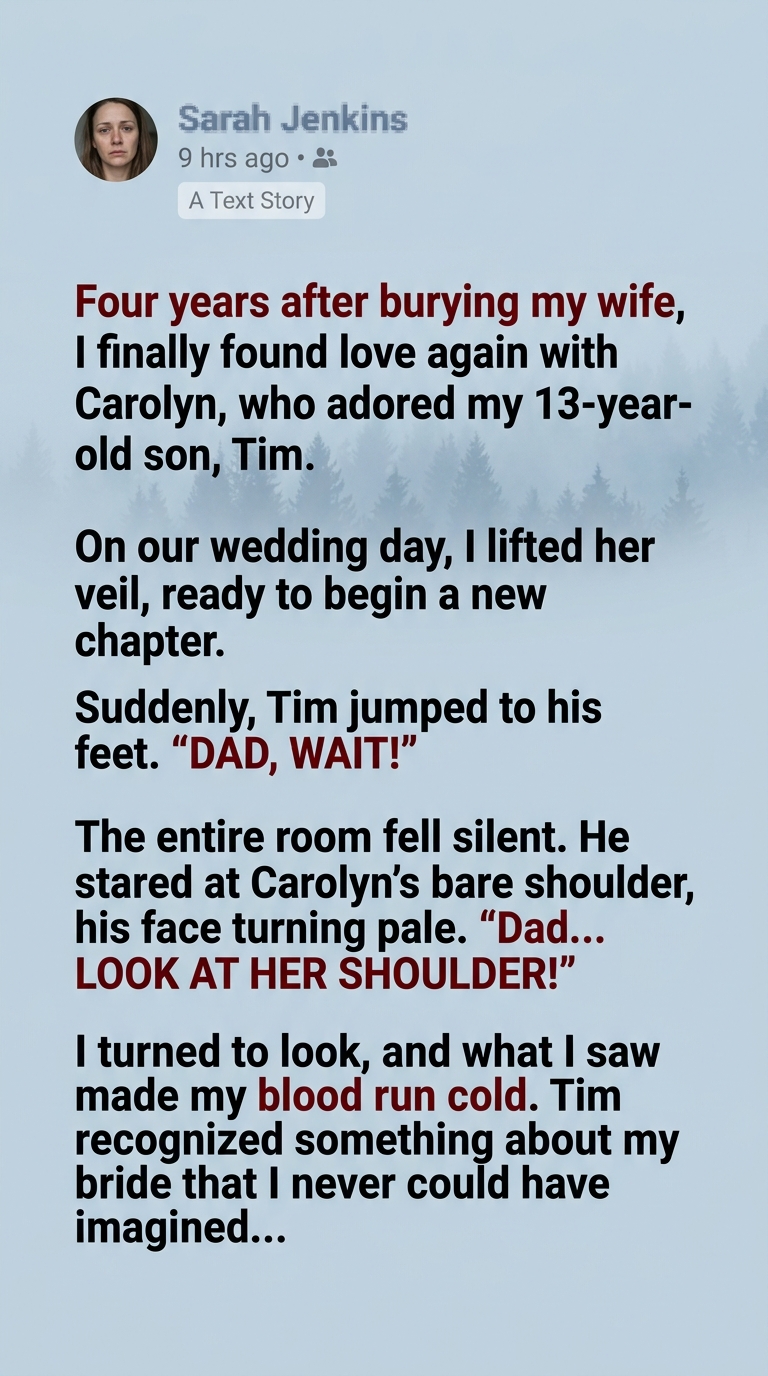
Four years after I buried my wife, I never imagined I would stand at an altar again.
My wife, Emily, had died after a short, devastating illness, leaving me alone with our thirteen-year-old son, Tim. For months, the two of us moved through the house like strangers, each trying to be strong so the other wouldn’t fall apart.
I learned how to make the meals Emily used to cook. Tim learned how to hide his tears behind headphones and closed bedroom doors. We kept her photographs everywhere, as if removing them would mean losing her twice.
Then I met Carolyn.
She wasn’t the kind of woman who tried to replace Emily. She never asked me to put away the photographs or told Tim to stop talking about his mother. Instead, she listened when he shared stories about her. She learned his favorite foods, attended his school events, and remembered the little things that made him feel understood.
One evening, I found Tim and Carolyn sitting on the living-room floor, laughing over an old board game.
For the first time in years, the house sounded alive.
Later that night, Tim stood in my doorway.
“You’re happy with her, aren’t you, Dad?”
I smiled. “I am.”
He looked down at his hands before asking, “And she really wants me to be part of your family?”
“Tim, she already considers you family.”
He nodded, and I thought that was his way of giving me permission to move forward.
When I proposed to Carolyn, she cried. Tim hugged us both and even insisted on helping choose the music for the ceremony.
I thought we were finally getting our happy ending.
Our wedding day was small, warm, and filled with people who had watched us rebuild our lives. Tim stood beside me in a dark suit, looking older than thirteen.
When Carolyn walked down the aisle, she looked beautiful. Her eyes filled with tears as she reached me, and I felt a kind of happiness I had been afraid to feel since Emily died.
The ceremony proceeded without a problem.
Then came the moment when I lifted Carolyn’s veil.
I brushed it back gently and smiled at her.
“Ready for our new beginning?” I whispered.
She nodded.
But before I could kiss her, a chair scraped loudly behind us.
“DAD, WAIT!”
Tim shot to his feet.
Every face in the room turned toward him.
His expression was so strange that my smile disappeared. He wasn’t embarrassed or nervous. He looked genuinely terrified.
“Tim?” I said. “What’s wrong?”
He pointed at Carolyn’s bare shoulder, where the edge of her wedding dress had slipped slightly as she turned toward him.
“Dad… LOOK AT HER SHOULDER!”
Carolyn instinctively covered it with her hand.
The room fell silent.
I followed Tim’s gaze.
There, just below her shoulder, was a small tattoo: a delicate paper crane with three tiny stars arranged above its wings.
It was beautiful, but I didn’t understand why it had frightened my son.
“Tim, what are you talking about?” I asked.
He shook his head, his eyes fixed on Carolyn.
“I’ve seen that before.”
Carolyn’s face drained of color.
For a moment, she looked as though she might faint.
Then Tim said the words that made my blood run cold.
“It’s in Mom’s box. The picture of the woman standing next to her. The woman Mom said she never wanted us to meet.”
I turned toward Carolyn.
She was crying now, but she wasn’t looking at me.
She was looking at Tim.
“How old were you when you saw that picture?” she whispered.
“Eight,” Tim answered. “I was looking through Mom’s things after she died. There was a photo of her with a woman who had the exact same tattoo. On the back, Mom wrote, ‘My sister, Claire. Before everything fell apart.'”
Carolyn closed her eyes.
I felt the ground shift beneath me.
“Claire?” I repeated. “My wife’s name was Emily.”
Carolyn looked at me then, and I saw a grief in her face that I had never noticed before.
“Claire was Emily’s middle name,” she said softly. “Her full name was Emily Claire Bennett.”
I stared at her.
“Who are you?”
She took a trembling breath.
“My name was Carolyn Bennett before I changed it. Emily was my older sister.”
For several seconds, I couldn’t make sense of the words.
My bride—the woman I had dated, loved, and promised to spend my life with—was my dead wife’s sister.
But I had never heard Emily mention a sister named Carolyn. Not once in twenty-seven years of knowing her.
“Why didn’t you tell me?” I asked.
Carolyn wiped her cheeks.
“Because Emily and I hadn’t spoken for nearly fifteen years before she died. We had a terrible argument when we were younger. I made a choice that hurt her, and she told me never to contact her again. I respected that for years, even when I regretted it.”
She looked at Tim.
“After Emily died, I found out about her funeral too late. I wanted to come, but I was afraid my presence would cause more pain. I had no right to walk into your grief.”
“Then how did you meet us?” I asked.
“At the community center. You were there with Tim for a charity event. I didn’t recognize you at first, but I recognized Emily’s eyes in his face. I asked his name, and when he told me, I knew.”
My stomach tightened.
“You knew who we were when we met?”
“Yes,” she admitted. “And I should have told you.”
“Instead, you let me fall in love with you.”
“I did.” Her voice broke. “At first, I told myself I would explain everything when the time was right. Then I saw how much Tim trusted me. I saw how happy you were becoming. Every day I waited made it harder to tell you. I was afraid you’d think I had come into your life to replace Emily.”
I wanted to shout. I wanted to demand how she could build a relationship with us while keeping something so important hidden.
But Tim spoke first.
“Did Mom hate you?”
Carolyn knelt in front of him, careful not to let her wedding dress trail across the floor.
“No, sweetheart. I think your mother was hurt by me. And I was too proud to admit how much I missed her. We both made mistakes, and we lost years we can never get back.”
“Then why didn’t you come back before she died?”
Carolyn couldn’t answer immediately.
“Because I was a coward,” she finally whispered. “I thought I had more time. I kept telling myself I would call her next week, or next month, when I could find the right words. Then I ran out of time.”
Tim’s face crumpled.
He had spent four years grieving his mother, and now he was learning that a part of her life had been hidden from him. I reached for him, but he stepped away.
“Did you only become friends with us because Mom was your sister?” he asked.
Carolyn shook her head quickly.
“No. I cared about your father because of the man he is. And I care about you because you’re Tim. You’re not a way to get back to your mother. You’re not a replacement for anything.”
“Then why didn’t you tell us the truth?”
She had no defense.
“I was afraid,” she said. “And being afraid doesn’t make what I did right.”
I looked at the guests. Some were whispering; others stared at the floor. The wedding we had planned for months had become something none of us could have imagined.
I took Carolyn’s hand, then gently let it go.
“I can’t marry you today,” I said.
She nodded through her tears.
“I understand.”
“No,” I said quietly. “I don’t think you do. This isn’t only about being Emily’s sister. It’s about trust. You knew the one person whose memory mattered most to us, and you kept that connection secret while becoming part of our family.”
“I know.”
“I need time. Tim needs time. And neither of us can promise what happens next.”
“I won’t ask you to.”
I turned to our guests and asked them to give us some privacy. The ceremony ended without vows or a kiss. Carolyn left with her closest friend, and Tim and I went home together.
That evening, he brought Emily’s old keepsake box into the living room.
Inside were photographs, birthday cards, and letters tied with faded ribbon. At the bottom was the picture Tim had described: Emily standing beside a younger woman, both of them smiling, their matching paper-crane tattoos visible on their shoulders.
On the back, Emily had written:
My sister, Carolyn. Before everything fell apart. I hope one day we find our way back to each other.
Tim read the sentence twice.
“She wanted to see her again,” he whispered.
I sat beside him.
“Maybe she did.”
“Then why didn’t she?”
“I don’t know, son. Sometimes people love each other and still let pride and fear keep them apart.”
He leaned against me, and for a long time we sat without speaking.
Over the next few weeks, Carolyn didn’t pressure us. She sent one letter explaining the argument that had separated her from Emily, along with photographs and memories she had kept for years. She apologized without asking us to comfort her.
I read everything, but I didn’t rush to forgive her.
Tim and I began talking more about Emily—not only about the years we had shared with her, but about the parts of her life we had never known. We learned that she had been stubborn, funny, and fiercely protective of her younger sister. We also learned that she had regretted their estrangement, even when she couldn’t bring herself to make the first call.
Eventually, Tim asked if he could see Carolyn again.
We met her at a quiet café.
She brought a small envelope containing an old photograph of Emily as a teenager, laughing with her mouth full of cake. Tim studied it, then asked Carolyn to tell him what his mother had been like when she was young.
Carolyn talked for nearly an hour.
She told us about the songs Emily loved, the trouble they got into as children, and the time Emily spent her entire allowance buying a birthday present for a stray dog. For the first time, we heard stories about Emily from someone who had known her before she became our wife and mother.
When we left, Tim hugged Carolyn briefly.
It wasn’t forgiveness for everything. It was a beginning.
As for me, I didn’t immediately return to the wedding plans. Carolyn and I had to rebuild our relationship honestly, without secrets or promises made out of guilt. We spoke with a counselor, answered difficult questions, and learned to sit with uncomfortable truths instead of hiding from them.
Months later, I understood something I hadn’t understood on our wedding day: Carolyn hadn’t become a stranger because she was Emily’s sister. She had become a stranger because she had hidden the truth from the people she claimed to love.
Whether we could build a marriage after that was a decision we had to make slowly, with our eyes open.
One evening, Tim placed the old photograph of Emily and Carolyn on the mantel beside his mother’s favorite picture of the three of us.
“Mom wanted them to make up,” he said.
I put an arm around him.
“Maybe we can make room for that wish without pretending nothing happened.”
He nodded.
We hadn’t found a magical ending. We had found something harder: the chance to face the truth and decide what to do with it.
And the little paper crane on Carolyn’s shoulder no longer looked like a warning.
It was a reminder that some broken relationships leave scars, and some secrets keep people apart long after the original hurt has faded.
I had almost married a woman without knowing the most important chapter of her life.
My son had recognized a symbol I had never thought to question.
And the woman I thought had come into our lives to help us begin again had brought us face-to-face with the past we had never truly finished grieving.
We didn’t know exactly what our future would look like.
But this time, whatever came next, we would build it on the truth.