I Reclined My Seat Into a Pregnant Woman’s Space—Then a Flight Attendant Revealed What I’d Done
I had been looking forward to my flight for weeks.
After a stressful business trip, all I wanted was to settle into my seat, recline, close my eyes, and enjoy three uninterrupted hours of peace. I had paid for my ticket, I was exhausted, and as far as I was concerned, I had every right to make myself comfortable.
That was why, about twenty minutes after takeoff, I pushed my seat all the way back.
It happened almost immediately.
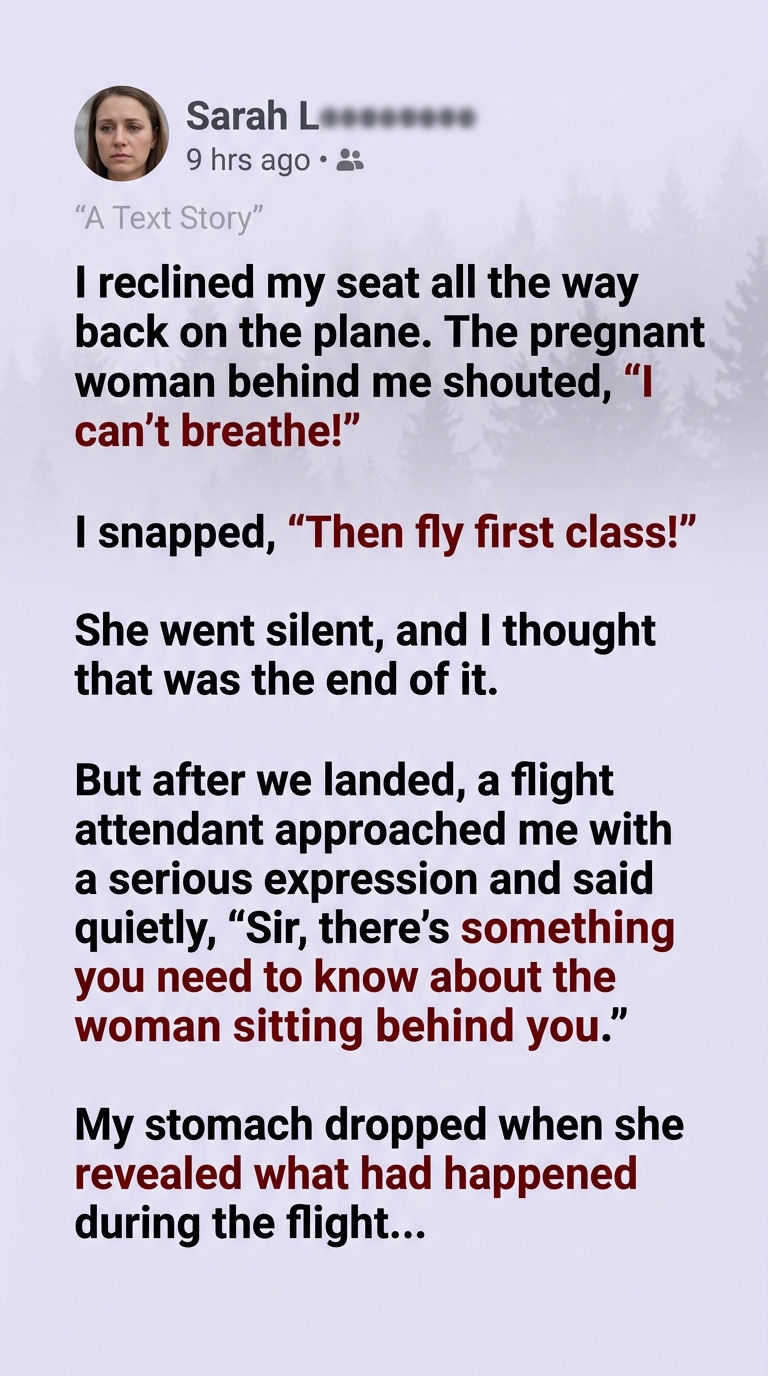
“Excuse me!” a woman shouted from behind me. “Could you please move your seat forward? I’m pregnant, and I can’t breathe properly!”
I turned around just enough to see her. She looked to be in her early thirties, with one hand resting on her visibly swollen belly and the other gripping the armrest.
My first reaction wasn’t sympathy.
It was irritation.
I had paid for my seat just like everyone else. The airline allowed reclining, and I didn’t see why I should have to sit upright simply because the person behind me was uncomfortable.
“Then fly first class!” I snapped.
The words came out louder and crueler than I intended, but I was too annoyed to take them back.
The woman stared at me.
For a moment, I thought she might argue. Instead, she slowly lowered her eyes and went silent.
I turned back around, put on my headphones, and convinced myself the problem was over.
I didn’t see the way she shifted awkwardly in her seat. I didn’t notice her breathing becoming uneven. And when the flight attendant walked past our row a little later, I didn’t pay attention to the quiet conversation taking place behind me.
I was too busy enjoying the extra space I had claimed.
About an hour into the flight, I felt someone lightly tap my shoulder.
It was a flight attendant.
“Sir, would you mind bringing your seat a little more upright for a moment?”
I sighed and pressed the button.
“Happy now?”
She gave me a tight smile.
“Thank you, sir.”
She didn’t explain why she had asked, and I didn’t bother asking her.
When the meal service arrived, I reclined my seat again.
I heard the woman behind me exhale sharply.
Then she said nothing.
I assumed she had accepted the situation.
The rest of the flight passed without another confrontation. I watched a movie, finished my drink, and even managed to nap for a while.
By the time we began our descent, I had completely forgotten about the woman behind me.
When the plane landed, I gathered my belongings and joined the line of passengers waiting to leave.
I was almost at the aircraft door when a flight attendant approached me.
It was the same woman who had asked me to move my seat.
“Sir, could I speak with you for a moment?”
Her expression was serious.
I immediately became defensive.
“What is it now? I moved my seat when you asked.”
She glanced toward the rear of the cabin, then lowered her voice.
“I think you need to know what happened to the woman sitting behind you during the flight.”
My stomach tightened.
“What happened?”
“She began experiencing significant breathing difficulty. Another passenger alerted us, and we had to assess her condition and provide assistance.”
I stared at her.
“Is she okay?”
“She was conscious when we last checked, and our crew followed the appropriate procedures. The ground medical team has been informed so she can be assessed after landing.”
For the first time, I felt a cold wave of fear.
The flight attendant continued.
“She repeatedly asked for more room because she was struggling to get comfortable. When your seat was fully reclined, it made it harder for her to adjust her position.”
I opened my mouth, but nothing came out.
Then she added something that made my heart sink even further.
“When we asked whether she wanted us to speak with you again, she said she didn’t want to cause trouble. She was afraid you’d become angry with her.”
I looked down at my suitcase.
The woman I had mocked had been struggling enough that the crew needed to check on her. And instead of listening when she first asked for help, I had humiliated her in front of strangers.
I had treated her discomfort like an inconvenience.
“Can I talk to her?” I asked.
The flight attendant nodded toward the terminal.
“The medical team is meeting her now. Please give them room to work. If she’s comfortable speaking with you afterward, you can apologize.”
I stood aside as the remaining passengers passed.
For the first time during the entire flight, I didn’t care about my luggage, my schedule, or how long it would take to get out of the airport.
I just wanted to know that she was safe.
A few minutes later, I saw her being escorted toward a medical assessment area. She was walking slowly, one hand supporting her belly. A woman who had been seated nearby was carrying her handbag.
I approached cautiously and stopped several feet away.
“Excuse me,” I said.
She turned toward me.
“I wanted to apologize for what I said earlier. I was rude, and I should have listened when you told me you were uncomfortable. I’m sorry.”
Her expression remained tired.
“Thank you,” she replied quietly.
I waited, hoping she might say more.
She didn’t.
I wanted to explain that I hadn’t known how badly she was feeling, that I had been exhausted, that I hadn’t meant to make things worse.
But every excuse sounded pathetic before I even said it.
She hadn’t needed me to understand her entire medical situation. She had simply asked me to move my seat because she was uncomfortable.
I could have responded with basic courtesy.
Instead, I had chosen cruelty.
“I hope you’re all right,” I said.
She nodded and turned back toward the medical staff.
That was all.
I walked away feeling smaller than I had when I boarded the plane.
During the ride home, I kept replaying the exchange in my mind.
I remembered the sharpness in her voice when she first asked me to move. At the time, I had interpreted it as entitlement. Now I wondered whether it had been fear, discomfort, or simple desperation.
I remembered her falling silent after my insult. I had taken that silence as victory.
I hadn’t considered that she might have stopped speaking because she didn’t have the energy to argue.
And I remembered how easily I had dismissed her with one sentence.
Then fly first class.
I had used money as a weapon, as if paying for a ticket made me more deserving of comfort than someone whose body was already under strain.
That night, I searched for information about airplane seat etiquette. I learned that reclining can affect the space available to the passenger behind, particularly during meals or when someone needs to adjust their position. The airline’s policy allowed reclining, but that didn’t mean every situation called for the same choice.
I also understood that I couldn’t know exactly what had caused the woman’s breathing difficulty. Pregnancy can make travel uncomfortable, and breathing problems can have many causes. I had no right to assume that my seat alone was responsible.
But I didn’t need to prove that I had caused her medical problem to recognize that I had behaved badly.
She had asked for help.
I had answered with contempt.
That was enough.
A few days later, I received an email from the airline asking passengers to share feedback about their flight. I thought about ignoring it, but instead I wrote a short account of what had happened. I didn’t ask for praise for apologizing, and I didn’t blame the airline or the passenger.
I simply admitted that I had treated another person’s discomfort as an inconvenience and that I should have handled the situation differently.
I never learned the woman’s name. I never found out what the medical assessment revealed, and I didn’t try to track her down.
She deserved privacy, not a stranger insisting on being forgiven.
But the experience changed how I approached situations like that.
On a later flight, when the passenger behind me struggled with the space my seat took up, I turned around and asked whether they needed me to adjust it. When a flight attendant asked passengers to keep their seats upright, I did so without complaining.
Those were small things. They didn’t erase what happened.
They were simply reminders that courtesy often costs very little.
I had boarded that plane believing that because I had paid for my seat, I was entitled to use it however I pleased.
I left with a different understanding.
Having a right doesn’t mean every use of it is considerate. Being tired doesn’t excuse being cruel. And someone else’s inability to argue back doesn’t mean you’ve won.
I still think passengers deserve reasonable comfort on flights. I still think airlines should design cabins that take different needs into account.
But none of that changes what I should have done that day.
I should have listened.
I should have spoken kindly.
And when a pregnant woman told me she was struggling to breathe, I should never have answered by telling her to spend more money.
I can’t change the words I used on that plane.
I can only make sure that next time someone tells me they’re struggling, I don’t make them regret asking for help.