A Stranger Borrowed My Phone at the Train Station—Two Weeks Later, His Message Changed Everything
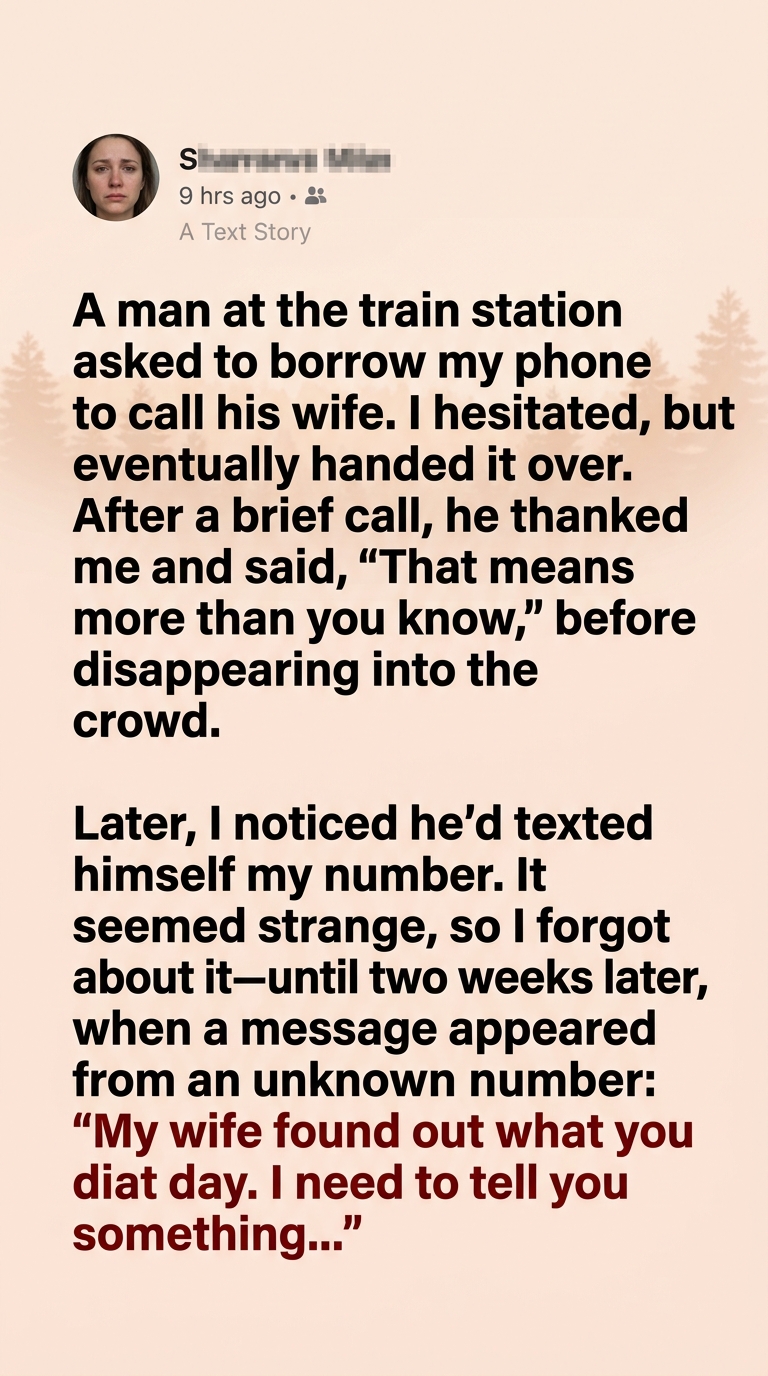
I was standing on a crowded train platform when a man approached me and asked to borrow my phone.
He looked to be in his late forties, wearing a wrinkled gray jacket and carrying a small duffel bag. His hair was messy, his eyes were red, and he kept glancing at the departure board as though he were running out of time.
“I’m sorry to bother you,” he said. “My phone died, and I desperately need to call my wife. Could I use yours for just a minute?”
My first instinct was to say no.
We hear so many warnings about strangers, stolen phones, and scams that even a simple request can make us suspicious. I tightened my grip on my phone and studied his face.
He seemed genuinely distressed.
“Please,” he added quietly. “It’s important.”
After a moment’s hesitation, I handed it to him.
He dialed a number from memory and turned slightly away from me.
“Hello, sweetheart,” he said.
His voice cracked.
I couldn’t hear the woman on the other end, but I could hear him clearly.
“No, please don’t hang up. Just listen to me for a minute.”
He closed his eyes.
“I know you’re angry. You have every right to be. I should have told you the truth a long time ago.”
There was a long pause.
Then he whispered, “I never stopped loving you.”
My discomfort faded into curiosity, but I looked away to give him some privacy.
He spoke for another minute, saying things I couldn’t quite make out. At one point, he wiped his face with his sleeve.
Finally, he said, “I understand. I’ll leave you alone if that’s what you want. I just needed you to hear it from me.”
He ended the call and returned my phone with both hands.
“Thank you,” he said.
His eyes were wet.
“That means more than you know.”
Before I could ask whether he was all right, he picked up his bag and disappeared into the crowd.
I watched him walk toward the far end of the platform, then boarded my train.
I thought about him for a few minutes. I wondered whether he was going through a divorce or trying to repair a broken relationship. But I didn’t know him, and his problems weren’t mine to solve.
By the time I got home, I had almost forgotten the encounter.
Then, while checking my recent calls, I noticed something strange.
The number he had dialed wasn’t saved in my contacts, but a few minutes after the call, a text message had been sent from my phone to an unknown number.
The message contained only my own phone number.
Apparently, the stranger had texted himself my contact information.
I stared at the screen.
Why would he do that?
Had he accidentally sent my number to someone? Was he planning to contact me? Had I just made a terrible mistake by lending him my phone?
I considered blocking the number, but I couldn’t tell which contact it belonged to. I checked my call history again, then shrugged.
Perhaps he had a reason. Perhaps he had simply been confused.
I deleted the message and moved on.
For the next two weeks, nothing happened.
Then, on a Tuesday evening, my phone buzzed while I was making dinner.
An unknown number had sent me a message.
My wife found out what you did that day. I need to tell you something…
I stopped stirring the pan.
My first thought was that someone was trying to scam me.
I typed a cautious reply.
Who is this?
The answer arrived almost immediately.
I’m the man who borrowed your phone at the train station. My name is Daniel. I’m sorry for contacting you like this, but I didn’t know how else to reach you.
I set the spoon down.
What did I do? I asked.
A few seconds passed.
Then he wrote:
You helped me make a call I had been afraid to make for eleven years. My wife discovered your number in my call history and assumed you were someone I had been hiding from her.
I frowned.
I’m sorry, but I don’t understand.
His next message was longer.
My wife, Sarah, and I have been separated for almost a year. We still legally live as a married couple, but she moved out after I admitted something I had hidden from her for most of our marriage. She hasn’t wanted to speak to me since.
I remembered his trembling voice at the station.
What did you tell her? I asked.
Daniel replied:
The truth about our daughter.
I stared at the screen.
He explained that eleven years earlier, his wife had given birth to a baby girl who died shortly after delivery. The loss had devastated them both. Sarah had wanted to talk about their daughter, keep photographs, and remember the little life they had held for only a few hours.
Daniel had done the opposite.
He buried himself in work. He packed away the hospital paperwork and avoided conversations that made him feel helpless. Whenever Sarah cried, he told her they needed to move forward.
He thought he was protecting himself—and, in his mind, protecting her.
Instead, he made her feel as though she had to grieve alone.
Eventually, Sarah stopped trying to reach him emotionally. Years of silence and resentment accumulated until their marriage finally broke apart.
“I know I hurt her,” Daniel wrote. “But I was ashamed of how I handled everything. I thought if I could keep the past buried, I could somehow keep us from falling apart.”
I reread his message.
And the call at the station?
He replied:
That morning, I found a box of our daughter’s things while clearing out the house. There was a tiny knitted hat Sarah had made, a hospital bracelet, and a photograph we had never framed. I realized I had spent eleven years refusing to say our daughter’s name because I was afraid of how much it would hurt.
Then he sent another message.
I called Sarah because I wanted to tell her I was sorry. I wanted to tell her I remembered everything, and that I had never stopped thinking about our little girl.
I remembered how he had said, “I never stopped loving you.”
At the time, I had assumed he was trying to save his marriage.
Now I understood that he was trying to say something much harder.
He was admitting that love had never been enough to overcome his fear.
But I still didn’t understand why Sarah had discovered my number.
Daniel explained that after the call, he had texted my number to his own phone so he could remember the contact he had used. He had intended to delete it, but he hadn’t thought much about it.
Two weeks later, Sarah had found the message while looking through an old phone they still shared for family bills and records.
She saw an unfamiliar number and assumed Daniel was secretly involved with someone else.
When she confronted him, he told her about the train station and the call.
At first, she didn’t believe him.
Then she asked him what he had said to her.
Daniel told her the truth: he had called to apologize for the way he had handled their daughter’s death, not to demand that she return to him.
Sarah had cried.
For the first time in years, they had spoken honestly about their daughter.
And that was when Daniel decided he needed to explain everything to me.
Why? I typed. I only lent you my phone.
His answer came slowly.
Because when Sarah saw your number, she asked whether you knew about our daughter. I told her you were a stranger who had shown me kindness without asking any questions. She said that someone had given me the chance to make the call I had been avoiding for eleven years.
He continued:
She wanted me to thank you properly. But she also wanted me to tell you that the call didn’t magically fix anything. It only opened a door we had both been too afraid to open.
I sat down at the kitchen table.
I had expected a strange story, perhaps an awkward misunderstanding or an attempt to scam me. I hadn’t expected to become a tiny part of a family’s long and painful history.
I wrote back:
I’m glad you were able to talk to her. I hope things get better for both of you.
Daniel thanked me again.
Then he asked whether I would be willing to hear one last thing.
I hesitated before replying yes.
He sent a photograph.
It showed a small wooden box resting on a table. Inside were a knitted hat, a hospital bracelet, and a faded photograph of a newborn wrapped in a blanket.
Beside the box was a handwritten card.
Daniel explained that he and Sarah had met at a quiet café the previous weekend. They had not decided whether they would get back together. There were too many years of hurt, and neither wanted to pretend that one conversation could erase them.
But they had finally talked about their daughter without either of them shutting down.
They had chosen a name for the little girl that they had never been able to say aloud together.
“Emily,” Daniel wrote.
They had also decided to place the photograph in a frame and keep the box somewhere they could both visit when they needed to remember her.
For the first time, Daniel said, Sarah had told him what she needed from him: not grand gestures, not promises that he would never make another mistake, but the willingness to sit beside her when the grief returned.
He had listened.
I looked at the photograph for a long time.
I couldn’t imagine what it felt like to lose a child, let alone to spend eleven years unable to talk honestly about that loss with the person you loved. I had no words that could make such pain smaller.
So I simply replied:
Thank you for sharing Emily’s story with me. I hope you both find peace, whatever happens next.
Daniel sent a final message.
You didn’t know us. You didn’t know our story. You just trusted me enough to make one phone call. I’ll never forget that.
After that, we didn’t speak again.
For a while, I thought about the encounter whenever I stood on a train platform or saw someone struggling with a dead phone. I became more careful about lending my device, of course, but I also remembered how close I had come to refusing a simple request from someone who was carrying more pain than I could see.
I never learned whether Daniel and Sarah eventually rebuilt their marriage.
Perhaps they did. Perhaps they found that forgiveness could exist without reconciliation. That was their decision to make, and I hoped they would find the right answer for themselves.
What stayed with me was something smaller.
A stranger had approached me in a crowded station, asked for one minute of my time, and walked away carrying the chance to say words he had buried for eleven years.
I had thought I was lending him a phone.
I hadn’t realized I was helping him begin a conversation that should have happened long ago.
And that message, two weeks later, reminded me that we rarely know how much a small act of kindness can mean to someone else.
Sometimes, the most important thing we give another person isn’t money, advice, or even a solution.
Sometimes, it’s simply the chance to make the call they have been afraid to make.