He Divorced Me After I Paid His $150,000 Debt—Then He Checked His Bank Account
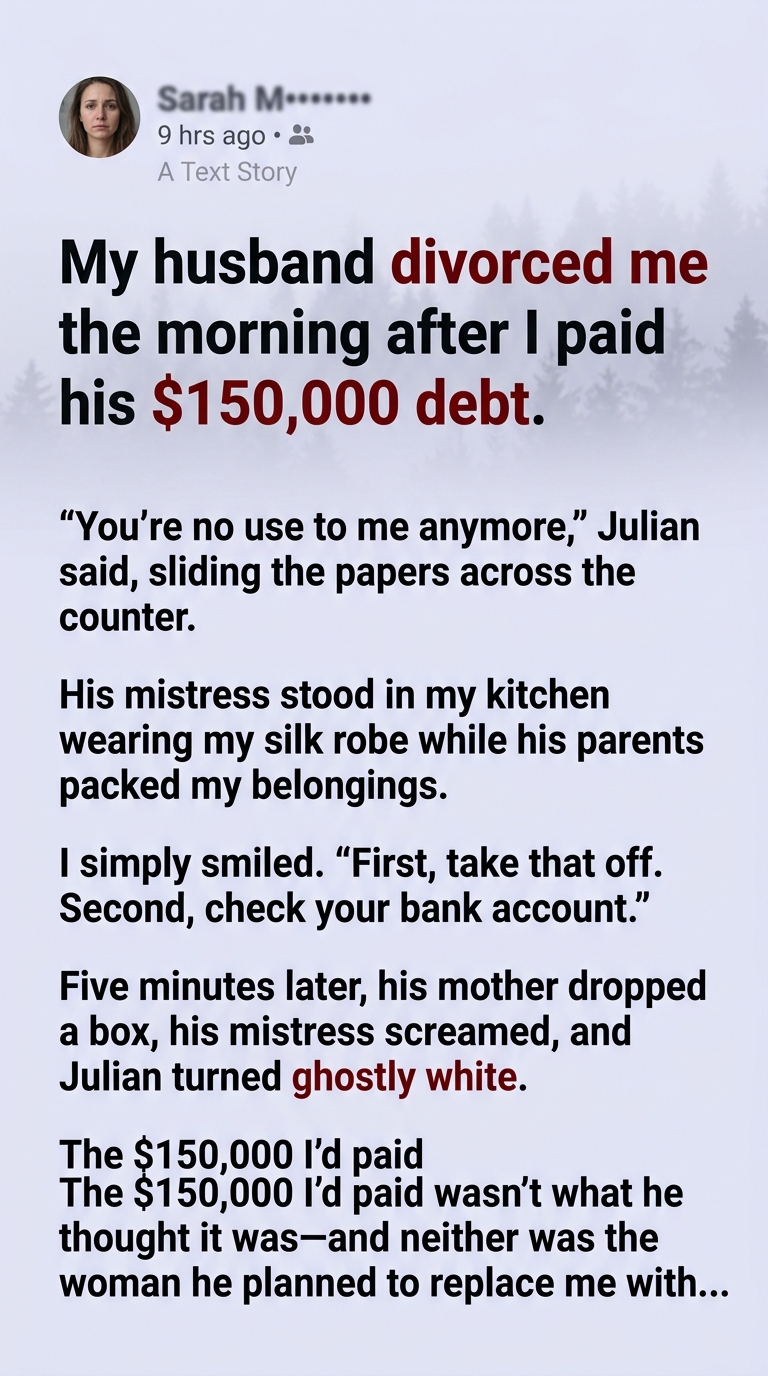
My husband divorced me the morning after I paid his $150,000 debt.
“You’re no use to me anymore,” Julian said, sliding the divorce papers across the kitchen counter.
He said it so casually that, for a moment, I thought I had misunderstood him.
We had been married for seven years. I had stood beside him when his business failed, worked late nights to keep our household afloat, and sold investments I had spent years building to help him escape the debt that threatened to destroy everything he owned.
And now he was standing in our kitchen, asking me to sign away our marriage as if he were canceling a subscription.
His mistress stood beside the refrigerator wearing my cream silk robe.
She was young, beautiful, and smiling with the smug confidence of someone who believed she had already won.
Behind her, Julian’s mother, Patricia, was packing my belongings into cardboard boxes. His father carried my framed photographs toward the front door.
Nobody had asked me to leave.
They had simply decided I was finished.
I looked at the divorce papers, then at Julian.
“Is there anything else?” I asked.
He smirked.
“Don’t make this difficult. You helped me when I needed you. I appreciate that. But let’s be honest, Eleanor. You and I haven’t been happy for a long time.”
I almost laughed.
For months, he had kissed my forehead before leaving for work, told me he loved me, and begged me to help him save his company. The night before, he had held my hands and promised we would finally start fresh once the debt was gone.
Apparently, his idea of a fresh start involved throwing me out of my own home.
I glanced at the woman in my robe.
“First, take that off.”
Her smile disappeared.
“Excuse me?”
“You heard me. That’s mine.”
She looked at Julian, expecting him to defend her.
He rolled his eyes. “It’s just a robe, Eleanor. Don’t be petty.”
I turned back to him.
“Second, check your bank account.”
He frowned.
“What are you talking about?”
“Check it.”
Something in my voice made him reach for his phone.
I watched him open his banking app. At first, his expression was merely annoyed. Then his eyebrows drew together. He refreshed the screen.
His face changed.
“What the hell is this?”
Patricia stopped packing.
Julian tapped the screen repeatedly, then called his bank. His mistress stepped closer, trying to see what he was looking at.
Within five minutes, Patricia dropped the box she was holding.
The mistress screamed.
And Julian turned so pale that he looked as though someone had pulled the blood straight out of his body.
Because the $150,000 I had paid wasn’t what he thought it was.
And neither was the woman he planned to replace me with.
To understand why, you need to understand what Julian never bothered to learn about his wife.
My name is Eleanor Hayes, and I had money long before I married him.
Not the kind of money that makes headlines. I didn’t own a mansion or drive sports cars. I lived comfortably, invested carefully, and ran a small financial consulting firm that I had built from the ground up.
My parents had taught me something I never forgot: money can disappear, but financial discipline can keep you from losing everything.
When I met Julian, he was charming, ambitious, and full of plans. He had started a logistics company and spoke passionately about turning it into a national business.
I admired his determination.
When we married, I kept my business separate from his. We agreed that my investments would remain mine and that his company would remain his responsibility.
At the time, it seemed sensible.
For the first few years, our marriage was happy. We traveled, cooked together, and talked about the future. Julian would tell friends how lucky he was to have a wife who understood business.
But when his company began losing money, admiration slowly turned into entitlement.
At first, he asked for a small loan to cover payroll. Then he needed help with a supplier dispute. Then came the tax bill, the overdue credit lines, and the increasingly desperate calls from creditors.
Each time, he promised it would be the last.
Eventually, his total personal liability reached $150,000.
“I can’t lose everything I’ve built,” he told me one night, sitting at the edge of our bed. “If I can clear this debt, I can restructure the company. I can recover.”
I asked him to show me every statement and agreement.
He became defensive.
“Don’t you trust me?”
“I trust you enough to want the facts.”
He gave me the documents reluctantly. I reviewed them with an independent attorney and accountant. The situation was worse than he had admitted, but there was a way to settle the obligations through an arrangement with the creditors.
I could afford to help.
But I wasn’t willing to hand him $150,000 without safeguards.
We signed a formal settlement agreement. The payment would go directly toward the specified debts, and the agreement clearly documented the terms. My attorney retained copies of every document, and the money was transferred through the appropriate channels.
Julian signed everything without reading it carefully.
He was too busy celebrating the end of his financial crisis.
That should have been my first warning.
The second came three weeks later, when I noticed unfamiliar hotel charges on a shared card.
The third came when a woman named Vanessa called our house looking for Julian.
She hung up the moment I answered.
I eventually discovered the affair through messages he had left open on his tablet. The affair had been going on for months, and Vanessa believed Julian was about to become wealthy again.
She thought the financial rescue meant he was finally free to build a new life with her.
What she didn’t know was that Julian had been lying to her, too.
He had told her that his company was about to be sold for a fortune. He claimed I was a controlling wife who had trapped him in an unhappy marriage and that he had stayed with me only because he needed my money.
He had promised Vanessa a house, expensive holidays, and a life in which she would never have to worry about bills again.
I read every message.
I cried for one night.
The next morning, I called my attorney.
I did not scream at Julian. I did not confront Vanessa. I did not announce that I knew the truth.
I simply began protecting myself.
My attorney reviewed our financial arrangements, confirmed which assets were mine, and helped me understand the consequences of the settlement agreement. I gathered records of my contributions, secured my personal accounts, and made sure my business and property documents were in order.
I also discovered something Julian had never bothered to investigate.
The $150,000 settlement had not made his company valuable overnight. It had resolved specified debts, but the business still had serious problems. He had confused being temporarily rescued with being financially successful.
Worse, Vanessa’s story was not quite what she had told him.
She had approached Julian while claiming to work in private investment consulting. She said she had contacts who could secure a buyer for his company.
In reality, she had no authority to arrange the sale she promised.
My attorney found public records showing that Vanessa had been involved in a previous business dispute concerning misleading financial representations. That did not, by itself, prove she had committed a crime, but it was enough to make me question everything she had told Julian.
I decided not to warn him.
He had made it abundantly clear whose advice he valued.
Then, the night before he served me with the divorce papers, Julian came home carrying a bottle of champagne.
“It’s over,” he announced. “The debt is gone. We’re finally free.”
He poured two glasses and kissed my cheek.
“We can start fresh tomorrow.”
I looked at him and wondered whether he had ever loved me—or whether he had simply loved the security I provided.
I didn’t ask.
Instead, I quietly completed the final steps my attorney had recommended.
By morning, Julian had revealed exactly who he was.
And now he was standing in our kitchen, staring at his phone.
“What is this?” he demanded.
I folded my hands on the counter.
“Read the details.”
He scrolled through the banking notification. His face tightened as he realized the transfer he had expected to see in his personal account wasn’t there.
The money had gone directly to the creditors named in the settlement agreement.
The debts specified in the agreement had been settled, but he had never received a personal windfall. The payment had never been a gift of $150,000 for him to spend however he wanted.
He had assumed that because I had paid the debts, he would emerge with cash, a healthy business, and a clean slate.
Instead, he had a business that still required work, a divorce he had initiated, and a settlement agreement that documented exactly what I had contributed.
“You said you paid my debt!” he shouted.
“I did.”
“Then where is the money?”
“Where it was supposed to go. To the creditors.”
He looked as if he might throw his phone.
“You tricked me!”
“No, Julian. I paid the debts we agreed to settle. You signed the documents.”
His mother lowered the box in her hands.
“Julian, what is she talking about?”
He ignored her and turned back to me.
“You can’t do this to me. I need that money.”
“You needed your debts paid. They’re paid according to the agreement. That doesn’t mean you get to turn my contribution into spending money.”
Vanessa snatched his phone from his hand.
“That’s impossible. You told me she was giving you the money!”
Julian ripped the phone back.
“Not now!”
She stared at him.
“You said we were going to buy the apartment next month. You said your company was worth millions.”
“Vanessa, shut up.”
Her face reddened.
“Don’t tell me to shut up! You said everything was taken care of!”
I watched the two of them turn on each other.
For months, Vanessa had believed Julian was a successful businessman on the verge of a fortune. Julian had believed Vanessa could deliver the future she had promised. Neither had bothered to ask for evidence.
Now they were discovering how much of their relationship had been built on fantasy.
But the bank account was only the beginning.
Julian’s mother slowly approached the counter.
“Eleanor,” she said, her voice suddenly cautious, “what exactly did you do?”
I looked at the boxes scattered around my kitchen.
“Nothing more than protect what was mine.”
Patricia swallowed.
“But Julian said the house belonged to him.”
I almost felt sorry for her.
Almost.
The house had been purchased with my separate funds before our marriage. Its ownership had been documented in the records, and my attorney had confirmed my position under the applicable law. There could still be procedural questions to resolve as part of the divorce, but Julian had no basis to assume that ordering me out would make him the owner.
I took a folder from my bag and placed it on the counter.
“Here’s the property documentation. Here’s the settlement agreement. And here’s my attorney’s contact information.”
Julian stared at the folder.
“You can’t kick me out of my own house.”
“I haven’t asked you to leave today. But you cannot decide that I must leave simply because you’ve handed me divorce papers. The next steps will be handled properly.”
His father, Robert, finally spoke.
“Julian, you told us she was moving out.”
Julian said nothing.
Robert looked at the paperwork, then at the boxes he had helped carry from the bedroom.
For the first time that morning, he looked ashamed.
Vanessa, meanwhile, had started scrolling through messages on her own phone.
“Who is this?” she demanded suddenly.
Julian’s expression shifted.
“What?”
She held up the screen.
A message from a man named Marcus had appeared. Vanessa had been exchanging messages with him about a proposed investment opportunity connected to Julian’s company.
The messages suggested she had been exploring other arrangements even while promising Julian a future together. There was no proof in that moment that she had committed fraud, but it was clear she had not been as devoted to him as she claimed.
“You told me you were done with him,” Julian said.
Vanessa laughed bitterly.
“And you told me your company was about to make us rich!”
“You used me!”
She stepped back.
“You used me first!”
Their voices rose until Patricia shouted for them to stop.
Then Vanessa turned toward me.
“You knew about all this, didn’t you?”
“I knew enough to stop trusting promises without evidence.”
“You could have warned him!”
“I could have. But I wasn’t responsible for making sure he treated you honestly. I was responsible for protecting myself.”
Her mouth opened, then closed.
For once, she had nothing to say.
Julian looked at me as if he were seeing a stranger.
“You planned this.”
“No,” I replied. “I planned to protect myself if the marriage ended. You decided to end it.”
I pushed the divorce papers back toward him.
“I’ll review these with my attorney. I won’t sign anything under pressure.”
He stared at me.
“You’re going to fight me over everything?”
“I’m going to make sure everything is handled fairly and legally. That includes the debts I paid, the property I own, and the belongings you are trying to remove.”
His mother looked down at the broken box on the floor.
The scene seemed to finally reach her. She had arrived expecting to pack up an unwanted wife, but now she was standing in the home of a woman she had never bothered to understand.
“Eleanor,” she whispered, “I didn’t know.”
“You didn’t ask.”
She flinched.
I didn’t raise my voice. I didn’t need to.
For years, I had tried to win the approval of Julian’s family. I had hosted their dinners, remembered their birthdays, and listened patiently when they criticized my work as if it were a hobby. I had believed that if I gave enough, they would eventually see me as one of their own.
That morning, I finally understood that generosity could not force people to respect you.
Robert quietly began returning the boxes to the living room. Patricia helped him. Neither apologized immediately, and I didn’t ask them to.
Vanessa removed my robe and dropped it on a chair.
“I need to go,” she muttered.
Julian turned toward her.
“You’re leaving me?”
She gave him a disbelieving look.
“You just divorced your wife in front of me, and now you’re shocked I’m leaving?”
She grabbed her bag and walked out.
The front door slammed.
Julian stood motionless in the kitchen, surrounded by the remains of a life he had assumed would always be waiting for him.
Then he turned to me.
“Eleanor, please. We can talk about this.”
I looked at the man who had kissed me the night before and discarded me the next morning.
“What is there to talk about?”
“I was angry. I didn’t mean it like that.”
“You told me I was no use to you anymore.”
He lowered his eyes.
“I was wrong.”
“Yes,” I said. “You were.”
He reached for my hand, but I stepped away.
For the first time in our marriage, I did not feel responsible for comforting him.
The legal process took several months. My attorney handled the property issues, reviewed the divorce terms, and made sure the financial settlement was documented properly. I did not try to ruin Julian or seize anything that wasn’t mine. I simply refused to surrender what belonged to me because he had expected me to remain silent.
The settlement agreement also made it clear what I had paid and which obligations had been resolved. Any remaining financial disputes were handled through the appropriate channels rather than through threats or dramatic confrontations.
Julian’s company survived, but it did not become the empire he had promised Vanessa. He had to restructure, reduce expenses, and accept that rebuilding a business required more than one large payment.
His relationship with Vanessa ended within weeks.
I heard from Patricia once after the divorce was finalized. She apologized for helping pack my belongings without asking me what was happening. I thanked her for the apology, but I did not pretend that one conversation erased years of assumptions.
As for Julian, he sent me several long messages about regret, loneliness, and the mistakes he had made.
I read them.
I did not return to the marriage.
Eventually, I moved my things back into the rooms his parents had tried to empty. I unpacked my books, rehung my photographs, and replaced the flowers on the kitchen counter.
The silk robe went into a donation bag.
I didn’t want to keep anything that reminded me of that morning.
Months later, I sat alone at the same kitchen counter where Julian had pushed the divorce papers toward me. Sunlight fell across the wood, and the house was quiet.
I thought about the $150,000.
For a long time, I had considered that money the price of saving my marriage. I had believed that if I could help Julian escape his crisis, we might recover the life we once had.
I was wrong.
The payment didn’t destroy my marriage. It revealed what remained of it.
Julian had mistaken my kindness for weakness, my financial stability for an endless supply of money, and my commitment for permission to treat me however he pleased.
He thought the moment his debts were paid, I had served my purpose.
What he never understood was that I had been building a life of my own long before he entered it.
And I could build one again without him.
I kept the settlement documents in a secure file, not as a trophy, but as a reminder to protect myself even when I loved someone.
I also made a promise to myself: never again would I confuse rescuing someone with being responsible for their life.
Julian had divorced me believing I was the one who had lost everything.
But when I looked around my home that morning, I realized the truth.
I still had my work, my independence, my future, and the freedom to decide who deserved a place in it.
He had wanted to replace me.
Instead, he had lost the only person who had been willing to help him when he had nothing.
And I had finally stopped paying for the privilege of being loved.