My Husband Said, “I’m Taking the Dog. You Can Keep the Kid.” Then Our 7-Year-Old Son Spoke in Court
The night I discovered my husband was cheating, I learned exactly how little he thought our family was worth.
I had come home early from work because Mark, our seven-year-old son, had a fever. I picked up his favorite chicken soup, stopped at the pharmacy, and hurried home, expecting to find my husband, Daniel, working in his home office.
Instead, I found Daniel’s car parked outside a restaurant across town.
I recognized the car beside it, too.
It belonged to his co-worker, Vanessa.
At first, I told myself there had to be an explanation. Perhaps they were discussing a project. Perhaps other colleagues were inside. Perhaps I was being paranoid.
Then I walked past the restaurant window.
Daniel was sitting in a corner booth with Vanessa’s hand resting on his. When she leaned forward and kissed him, he smiled in a way I hadn’t seen directed at me in years.
I stood there, holding a pharmacy bag in one hand and Mark’s medicine in the other, watching my marriage collapse through a pane of glass.
I didn’t scream. I didn’t storm inside.
I took out my phone and photographed what I could see.
Then I went home.
Daniel arrived nearly two hours later. He kissed Mark on the forehead, asked whether he had eaten, and behaved as if he hadn’t just spent the evening betraying his family.
I waited until Mark was asleep before confronting him.
“Who is Vanessa?”
His expression barely changed.
“She’s someone from work.”
“Someone from work who kisses you in restaurants?”
For a moment, he said nothing.
Then he sighed as if I had inconvenienced him.
“How long have you been following me?”
That was his first question.
Not whether I was hurt. Not whether we could talk. Not even an attempt to deny what I had seen.
He was angry that I had discovered the truth.
“How long?” I repeated.
Daniel rubbed his face.
“Months.”
The word landed between us like a stone.
Months of late meetings. Months of unexplained expenses. Months of telling our son he was too tired to play with him while finding energy for another woman.
I asked whether he wanted to save our marriage.
He looked at me as though the question were ridiculous.
“I don’t want to keep pretending we’re happy,” he said. “We should get divorced.”
I had suspected that answer before he said it. Still, hearing it made my knees weak.
Then he added something I would never forget.
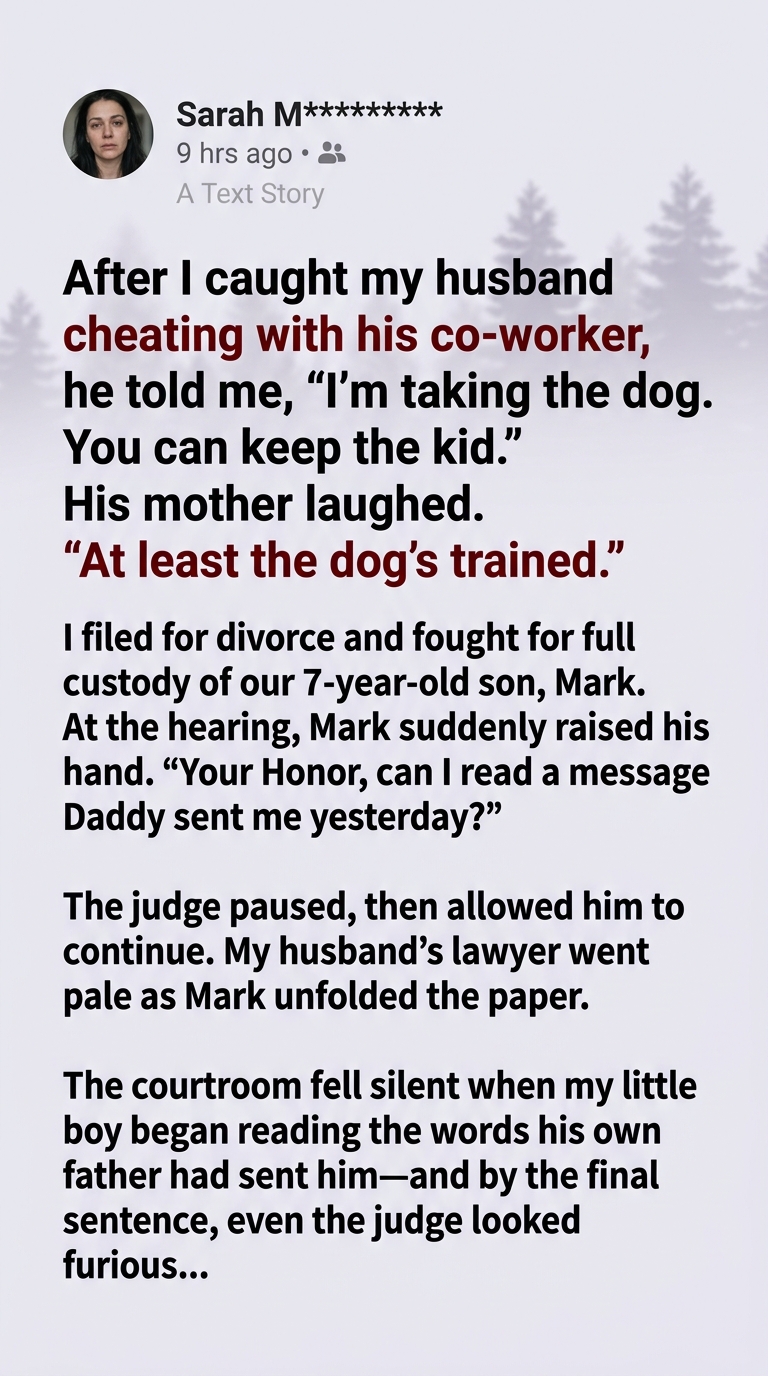
“I’m taking the dog. You can keep the kid.”
I stared at him.
“Our son has a name, Daniel.”
He shrugged.
“Mark will be fine with you. The dog actually needs me.”
His mother, Patricia, was staying with us that week. She had apparently been listening from the hallway because she walked into the living room with a laugh.
“At least the dog’s trained,” she said.
For a second, I couldn’t believe what I had heard.
This woman had held Mark as a newborn. She had taken photographs at his first birthday and bought him a little blue bicycle for Christmas. Yet now she stood beside her son, laughing at the idea that a child could be dismissed like an unwanted piece of furniture.
I looked from her to Daniel.
Neither of them seemed ashamed.
That was when something inside me became very still.
“You can have your divorce,” I said. “But Mark is not a bargaining chip, and neither is the dog.”
Daniel smirked.
“We’ll see what a judge thinks.”
He seemed certain that money, charm, and his mother’s support would carry him through anything.
He had no idea what was coming.
The next morning, I contacted a divorce attorney. I gathered financial records, documented the circumstances surrounding Daniel’s affair, and began making arrangements to protect Mark’s routine.
I didn’t tell Mark every ugly detail. He was seven, and he deserved to be a child.
But children notice more than adults realize.
He noticed that his father stopped reading him bedtime stories. He noticed that Grandma Patricia suddenly referred to our home as “your mother’s house.” He noticed that Daniel began taking phone calls outside and returned with a different expression.
One evening, while I was helping him with his spelling homework, he asked a question that made my chest tighten.
“Mom, when Daddy leaves, does that mean I did something bad?”
I put down the pencil.
“No, sweetheart. Nothing you did caused this.”
“Then why does Daddy get mad when I ask if he’s coming home?”
I took his hands in mine.
“Sometimes adults make choices that hurt other people. That’s never a child’s fault.”
Mark nodded, but his eyes remained worried.
I wished I could promise him that his father would always make good choices.
Instead, I promised him something I could control.
“You will always have someone who listens to you, Mark. You can tell me anything.”
The divorce proceedings began several weeks later.
Daniel hired an expensive attorney and presented himself as a devoted father who had simply grown apart from his wife. He claimed I was bitter about the affair and was trying to punish him by keeping Mark away.
He described himself as the parent who could provide the most opportunities.
He talked about his income, our house, and his flexible schedule.
He did not mention the times he had canceled plans with Mark. He did not mention his cruel remark about taking the dog instead of his own child. And he certainly did not mention his mother’s laughter.
I knew the affair alone would not decide custody. I also knew that anger and humiliation would not make me a better parent.
So I focused on what mattered: Mark’s safety, stability, school routine, emotional well-being, and the evidence relevant to his care.
Our attorneys exchanged documents. The court arranged the appropriate procedures for considering Mark’s needs. I followed my lawyer’s advice and avoided using my son as a messenger or asking him to take sides.
Daniel, however, seemed determined to win.
He began telling people that I was unstable. He said I was turning Mark against him. Patricia repeated those claims to anyone willing to listen.
Then Daniel made a mistake.
He sent Mark a message directly.
At first, I didn’t know anything about it. Mark had his own little tablet, which we used for schoolwork and occasional video calls with relatives. Daniel had started messaging him there, supposedly to maintain their relationship.
One evening, I found Mark sitting on his bed with the tablet turned off beside him.
He looked as though he had been crying.
“What’s wrong, sweetheart?”
“Nothing.”
I sat beside him.
“You don’t have to talk right now. But if something is upsetting you, I’m here.”
He stared at the floor.
“Daddy says I’m supposed to tell the judge something.”
My stomach tightened.
“What does he want you to say?”
Mark shook his head.
“He said I have to say I want to live with him. He said if I don’t, he’ll know you made me do it.”
I took a slow breath.
“Did Daddy tell you to say anything else?”
Mark hesitated.
“He said Grandma won’t want to see me anymore if I make him lose.”
I felt anger rise in my chest, but I kept my voice calm.
“That’s a lot for a little boy to carry. You are not responsible for making either parent happy, Mark. You don’t have to choose a side to earn anyone’s love.”
He looked at me.
“Can I show you something?”
He reached into the drawer of his bedside table and pulled out a folded sheet of paper.
“I wrote it down because I was scared I’d forget.”
I unfolded it carefully.
It was a handwritten copy of a message Daniel had sent him. Mark had copied the words as best he could, including the punctuation.
At the top, he had written the date.
I read the message once.
Then I read it again.
My hands went cold.
Daniel had written:
“Mark, when you talk to the judge, you need to say you want to live with me. Tell them Mom gets upset and can’t take care of you properly. If you tell the truth the way I explained it, we’ll get to live together, and I’ll buy you the gaming system you want. If you tell them what really happened, you’re choosing your mother over me. Don’t disappoint your dad.”
At the bottom, Mark had added one sentence in his own handwriting.
“I don’t know what the truth is supposed to be because Dad says it’s a secret.”
I covered my mouth.
The affair had hurt me. Daniel’s cruelty had frightened me. But this was different.
He had taken our son’s love for him and turned it into a test.
He had made a seven-year-old believe that telling the truth could cost him his father.
I wanted to call Daniel immediately. I wanted to demand an explanation and hear him try to justify the unjustifiable.
Instead, I photographed the paper, saved the original, and contacted my attorney.
My lawyer listened carefully as I explained what Mark had told me.
“Don’t question him repeatedly,” she advised. “Keep the original, document how it came to you, and let the court determine the appropriate way to consider this. Mark should not have to carry this conflict by himself.”
I followed her advice.
I didn’t coach Mark on what to say. I didn’t tell him that his father was a bad person. I simply reminded him that he could be honest with the adults responsible for helping him.
The custody hearing arrived on a gray Monday morning.
Daniel entered the courtroom wearing a dark suit and an expression of injured dignity. Patricia sat behind him, dressed in cream-colored silk, looking as though she were attending a business celebration.
Daniel glanced at me and smiled.
It was the same smile he had worn when he told me I could keep the kid.
Our attorneys presented their arguments. Daniel’s lawyer emphasized his income, his proposed parenting schedule, and the opportunities he claimed he could offer Mark.
My attorney addressed Mark’s routine and the concerns raised by the evidence. She explained that we were seeking an arrangement that protected his well-being and gave the court reliable information rather than relying on either parent’s accusations.
The judge listened without interrupting.
Then Daniel’s attorney suggested that Mark had been influenced by me and might simply be repeating things he had heard at home.
My heart pounded.
Mark was sitting with the court-approved support person who had accompanied him for the relevant proceedings. He was wearing a blue shirt and holding his small hands together in his lap.
He looked impossibly tiny in that room.
Then he raised his hand.
The judge looked toward him.
“Yes, Mark?”
Mark swallowed.
“Your Honor, can I read a message Daddy sent me yesterday?”
The courtroom became silent.
Daniel’s smile disappeared.
His lawyer turned toward him so quickly that their shoulders nearly collided.
The judge paused.
“Is this something you have brought with you, Mark?”
Mark nodded and reached into the folder his attorney had helped him prepare.
“Yes, Your Honor. I wrote it down because I was scared I’d forget.”
After checking the appropriate procedure with the adults involved, the judge allowed the message to be considered.
Mark unfolded the paper.
His fingers trembled.
I wanted to cross the room and hold him, but I remained seated. He needed to know that he could speak without having to take care of my feelings.
He began reading.
“Mark, when you talk to the judge, you need to say you want to live with me.”
Daniel shifted in his chair.
Mark continued.
“Tell them Mom gets upset and can’t take care of you properly. If you tell the truth the way I explained it, we’ll get to live together, and I’ll buy you the gaming system you want.”
His voice faltered.
The judge leaned forward.
Mark looked down at the paper and took a breath.
“If you tell them what really happened, you’re choosing your mother over me. Don’t disappoint your dad.”
No one spoke.
Mark lowered the page.
Then he looked directly at the judge.
“Your Honor, I don’t understand why Daddy wants me to say things that aren’t true.”
His little voice shook.
“He told me that if I loved him, I would help him win.”
I saw Daniel’s attorney go pale.
The judge’s expression changed. The patience that had marked the earlier proceedings gave way to unmistakable concern.
“Mark,” the judge said gently, “you are not responsible for deciding which parent wins. That is the court’s job. You are not in trouble for telling the truth.”
Mark nodded.
Then he looked at the paper again.
“There was one more thing,” he whispered.
The judge waited.
Mark unfolded the last part of the page.
“Daddy said Grandma Patricia would be ashamed of me if I chose Mom. He said she might stop loving me.”
Patricia’s face drained of color.
For the first time that morning, she didn’t look at me. She looked at her grandson.
Mark’s eyes filled with tears.
“I don’t want Grandma to stop loving me. And I don’t want Daddy to be sad. But I don’t want to lie about Mom.”
The courtroom fell silent again.
Then the judge spoke, his voice firm.
“A child must never be placed in the position of believing that affection depends on giving a parent a particular answer. The court takes this concern seriously.”
Daniel’s lawyer stood.
“Your Honor, we would request an opportunity to review the context of this communication before any conclusions are drawn.”
“That request is noted,” the judge replied. “The court will consider the evidence and the relevant circumstances carefully.”
Daniel suddenly leaned toward his attorney and whispered urgently.
His attorney did not respond immediately.
For once, Daniel could not charm his way out of the room with a confident smile and a carefully rehearsed story.
The judge ordered the message preserved and directed the parties to follow the appropriate procedures for evaluating the concerns it raised. The court also arranged for Mark’s views and emotional needs to be considered in an age-appropriate manner, without making him responsible for the final decision.
The hearing did not end with a dramatic declaration that one parent had won everything.
It ended with something more important: the judge made it clear that Mark’s welfare, not Daniel’s pride or my anger, would guide the decision.
Over the following weeks, the court reviewed the evidence and the parenting circumstances. The message was considered alongside the broader record, rather than in isolation. The court also considered Mark’s need for stability and protection from adult conflict.
Eventually, the judge issued a custody order granting me primary physical custody and establishing clear conditions for Daniel’s contact with Mark. The arrangement included safeguards intended to prevent further pressure on our son and required the adults to communicate through appropriate channels about parenting matters.
Daniel was furious.
He accused me of destroying his relationship with his son. Patricia said I had humiliated the family.
I didn’t argue with either of them.
I had not written the message. I had not asked Mark to copy it. And I had not forced him to read it in court.
I had simply refused to pretend it didn’t matter.
After the hearing, Daniel approached me in the corridor.
“You got what you wanted,” he said bitterly.
I looked at him.
“No, Daniel. I wanted our son to have a father who didn’t make him afraid to tell the truth.”
His face tightened.
“You’re making me sound like a monster.”
“I don’t have to make you sound like anything. Your own words are in the record.”
For a moment, he looked as though he might shout.
Then he noticed Mark standing beside his support person, watching us.
Daniel said nothing.
I took my son’s hand, and we walked away.
The months that followed were not magically easy. Mark still missed his father sometimes. He still asked whether Daniel would attend school events or remember his birthday.
I never told him he wasn’t allowed to love his dad.
I told him he could love someone and still recognize when their behavior hurt him. I reminded him that adult problems were not his responsibility and that no gift, promise, or threat should decide what he told a trusted adult.
With professional support, Mark gradually began to sleep more peacefully. He returned to playing soccer with his friends and drawing elaborate pictures of imaginary cities.
One afternoon, I found him sitting at the kitchen table, working on a school assignment about families.
He had drawn himself, me, and our dog, Benny, beneath a bright yellow sun.
I smiled.
“That’s a lovely picture.”
Mark picked up his pencil and added another detail.
“What are you drawing now?”
“The dog,” he said. “Benny needs a bigger tail.”
I laughed.
He looked up at me.
“Mom?”
“Yes, sweetheart?”
“Did I do the right thing in court?”
I sat beside him.
“You told the truth about something that scared you. That was brave. But you were never supposed to have to solve the problem yourself. The adults should have protected you.”
He thought about that for a moment.
“Even Daddy?”
“Especially Daddy. Being a parent means protecting your child, not asking your child to protect you.”
Mark looked down at his drawing.
“I’m glad you believed me.”
I wrapped my arms around him.
“I will always listen to you, Mark. And if I ever need help understanding something, I’ll ask the right people. You don’t have to prove that you deserve to be heard.”
He leaned against me.
Then he asked the question I had been waiting for.
“Can we get ice cream?”
I laughed through my tears.
“Yes. We can absolutely get ice cream.”
We went to his favorite little shop, where he chose chocolate with rainbow sprinkles. Benny waited at home, completely unaware that he had once been the centerpiece of a cruel joke.
As Mark ate his ice cream, he told me about a game he wanted to play with his friends. He talked about school, soccer, and a funny thing his teacher had said.
Ordinary things.
Beautiful, ordinary things.
I realized that was what I had been fighting for all along—not to punish Daniel, not to embarrass Patricia, and not to win a courtroom battle.
I wanted my son to have a childhood that belonged to him.
A childhood where love wasn’t a prize for saying the right thing. Where a child could speak honestly without fearing that someone would stop loving him. Where the adults carried the burdens they had created instead of placing them on small shoulders.
Daniel had once told me, “I’m taking the dog. You can keep the kid.”
He had treated fatherhood like an inconvenience and affection like a bargaining chip.
But Mark was never something to be kept, discarded, or won.
He was a little boy who deserved to be heard.
And when he finally found the courage to speak, the most important thing I did was not celebrate that my husband had been exposed.
It was make sure my son knew the truth:
He never had to choose between telling the truth and being loved.