My 8-Year-Old Son Kept Bringing His Lunch Home Untouched—Then I Found the Notes He Had Been Hiding
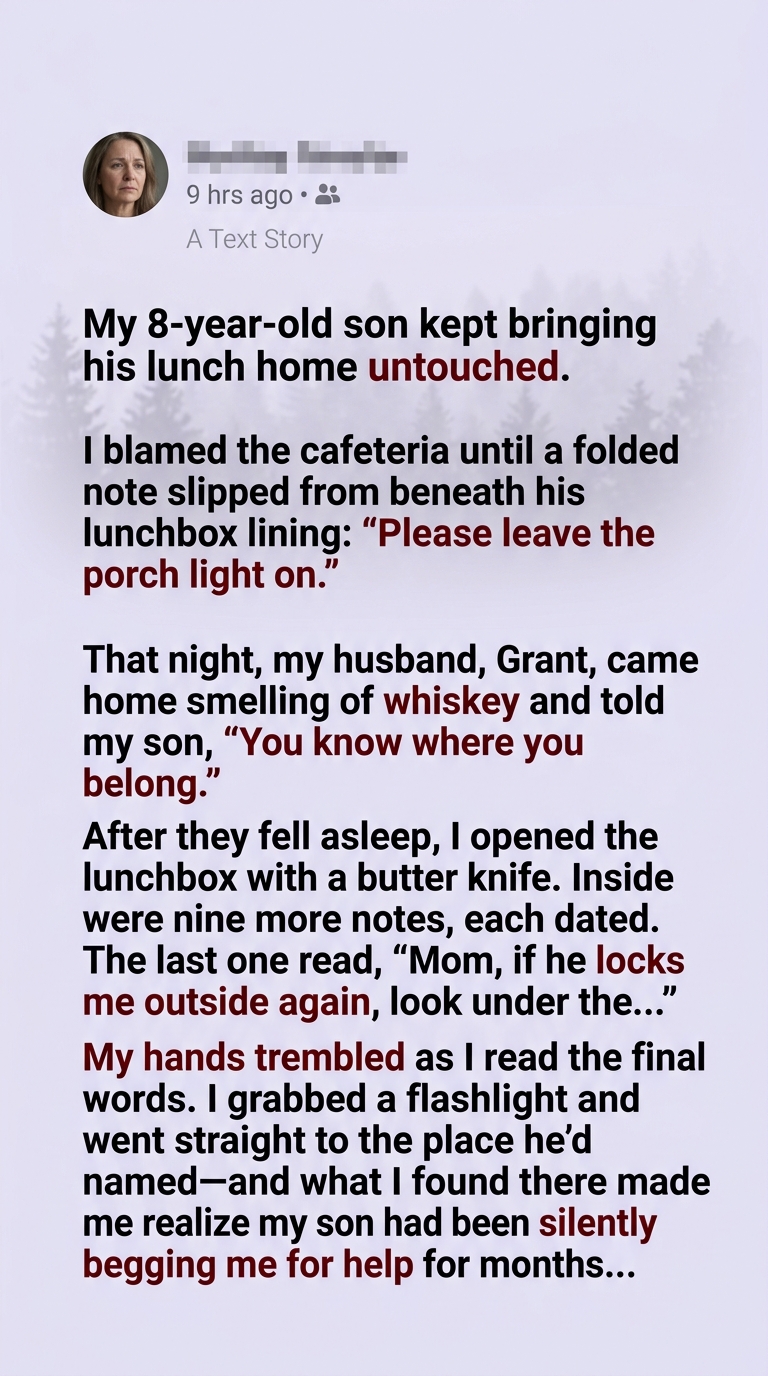
For three weeks, my eight-year-old son, Noah, came home from school with his lunchbox still full.
Every sandwich was untouched. Every apple slice remained in its little plastic container. Sometimes, the juice box was still sealed.
At first, I blamed the cafeteria.
“Is the food at school really that bad?” I asked him one afternoon as I unpacked his backpack.
Noah stood beside the kitchen counter, staring at the floor. His small fingers twisted the strap of his backpack.
“I’m not hungry, Mom.”
“You used to eat everything I packed.”
He shrugged.
“Can you at least try to eat something tomorrow? You need energy to learn.”
He nodded, but he wouldn’t look at me.
I should have realized then that something was wrong.
But my husband, Grant, had been making our home feel smaller and colder for months. His drinking had become more frequent, his temper shorter, and his footsteps at night were enough to make Noah stop talking in the middle of a sentence.
I had grown so accustomed to managing Grant’s moods that I barely noticed how carefully our son had learned to do the same.
That evening, Grant came home smelling of whiskey.
He tossed his keys onto the counter, opened the refrigerator, and complained that dinner wasn’t ready. Noah was sitting at the table, working on a drawing.
“Why are you still sitting there?” Grant demanded.
Noah immediately pushed his chair back.
“I finished my homework.”
“Then clean up your mess.”
“I’m sorry.”
Grant looked at the drawing.
It was a picture of our house. There was a little boy standing near the front door, and above him Noah had drawn a yellow circle surrounded by black lines.
“What’s that supposed to be?” Grant asked.
Noah swallowed.
“The porch light.”
Grant’s expression hardened.
“You know where you belong.”
The room went silent.
Noah lowered his head and carefully gathered his pencils. He didn’t cry. He didn’t argue. He simply moved as quickly and quietly as possible.
That frightened me more than a tantrum ever could have.
After dinner, I tucked him into bed. He wrapped his arms around my neck and held on longer than usual.
“Mom?”
“Yes, sweetheart?”
“If I ever tell you something bad, will you believe me?”
My heart tightened.
“Of course I will.”
He stared at me for a long moment.
“Even if someone says I’m lying?”
I brushed his hair away from his forehead.
“Especially then. You can always tell me the truth.”
He nodded, but he didn’t tell me anything.
I kissed his forehead and turned off the light.
I thought that was the end of the conversation.
I was wrong.
At around eleven that night, after Grant had fallen asleep on the couch and the house had gone quiet, I went downstairs to collect Noah’s lunchbox.
I wanted to wash it before morning.
As I lifted the plastic container, a folded piece of paper slipped from beneath the loose lining inside the lunchbox.
I almost threw it away, thinking it was an old school worksheet.
Then I noticed the handwriting.
It was Noah’s.
The letters were small and uneven, as if he had written them in a hurry.
“Please leave the porch light on.”
I read it once.
Then again.
Why would my eight-year-old son need to remind me to leave the porch light on?
I turned the paper over, hoping there might be an explanation on the back.
There was nothing.
A strange feeling settled in my stomach. I ran my fingers along the lunchbox lining and noticed that one corner had been carefully peeled back. Something was tucked beneath it.
I fetched a butter knife from the drawer and gently lifted the loose edge.
Inside were nine more folded notes.
Ten notes in total.
Each one was dated.
My hands began to tremble as I opened the first.
“Monday: I stayed quiet today.”
The second read:
“Tuesday: I tried not to make him mad.”
The third:
“Wednesday: I waited by the door.”
I sat down at the kitchen table.
The dates stretched back almost three weeks.
Some notes were only a sentence long.
“I didn’t spill anything.”
“I said sorry.”
“I waited until he stopped yelling.”
One of them had a tiny drawing of our front porch. The light above the door was colored yellow.
Beneath it, Noah had written:
“I can see the light from the steps.”
I covered my mouth.
I wanted to believe there was another explanation. Perhaps these were fragments of a story he was writing at school. Perhaps a teacher had assigned a strange creative-writing exercise.
But the dates were real.
And so was the fear in those little sentences.
Then I unfolded the final note.
The handwriting was shakier than the others. Several words had been crossed out, and a dark smudge marked the bottom corner.
It read:
“Mom, if he locks me outside again, look under the…”
The sentence ended there.
Below it, Noah had written a place.
I stared at the words until they blurred.
Then I grabbed a flashlight from the utility drawer and went straight outside.
The night air was cold. The porch light was off.
I switched it on and followed the narrow path around the side of the house, toward the old wooden storage bench beneath the kitchen window.
Grant had bought that bench years earlier. It was supposed to hold gardening tools, but it had gradually become a place for broken toys, spare paint cans, and things we never got around to fixing.
I had not opened it in months.
The flashlight beam shook as I lifted the lid.
At first, I saw only an old blanket and a few dusty flowerpots.
Then I noticed the corner of a blue school sweater.
I pulled it free.
Beneath it lay Noah’s missing winter coat, a small pair of socks, a bottle of water, two unopened granola bars, and a plastic bag containing several of his school drawings.
There was also a folded sheet of paper.
My knees nearly gave out when I opened it.
It was a list.
Noah had written it in his careful school handwriting.
Things I need if I have to stay outside:
- My coat.
- Water.
- Something to eat.
- My flashlight.
- Mom’s number.
At the bottom, he had drawn the porch light again.
This time, the little yellow circle had a face.
And the face was crying.
I sank onto the cold porch step.
My son had not been hiding snacks because he disliked his lunch.
He had been preparing for the possibility that he would be locked outside again.
The untouched meals suddenly made sense. He had been saving food, writing notes, and trying to create a plan with the limited understanding of an eight-year-old who believed he had to solve a grown-up’s problem by himself.
I pressed the paper against my chest and tried to breathe.
Then I found one more note tucked into the pocket of his coat.
It was dated four days earlier.
“I knocked, but he said I couldn’t come in until I learned to listen. I was cold. I thought Mom was asleep. I didn’t want to wake her because he said it would make things worse.”
I couldn’t stop crying.
I remembered that night.
Grant had told me Noah had gone to bed early after misbehaving. I had been exhausted after a long day at work. I had accepted the explanation without asking Noah about it.
I had been upstairs, believing my child was safe.
Meanwhile, he had been outside in the dark, waiting for a light to come on.
I returned to the house and went directly to Noah’s bedroom.
He was asleep beneath his blanket, curled around his stuffed dog.
I knelt beside him and gently touched his shoulder.
“Sweetheart?”
He woke with a start.
“Did I do something wrong?”
Those seven words broke something inside me.
“No,” I whispered. “You haven’t done anything wrong.”
He looked at my face, then at the papers in my hand.
His expression changed.
For a moment, he looked like he might deny everything. His lips trembled, and he pulled the blanket toward his chin.
“I didn’t want you to get mad.”
I took his hand.
“I am not mad at you. Not even a little.”
He started crying.
Not the quiet, careful tears I had occasionally seen him wipe away when Grant raised his voice. These were deep, frightened sobs that seemed to have been trapped inside him for weeks.
I gathered him into my arms.
“Tell me what happened, Noah. You don’t have to protect anyone from the truth.”
He clung to me.
“Sometimes he says I’m bad,” he whispered. “Sometimes he makes me stay outside. He says if I tell you, you’ll be angry because I made him do it.”
I closed my eyes.
“Did he lock you out tonight?”
“No.”
“Has he done it before?”
Noah nodded against my shoulder.
“How many times?”
“I don’t know.”
He was eight years old. He couldn’t tell me exactly how many times he had been frightened, how long he had stood in the cold, or how many meals he had saved because he didn’t know when he would next be allowed inside.
He only knew that the porch light meant there was still a chance someone would notice him.
I held him until his breathing slowed.
Then I made a decision.
I would not confront Grant alone in the middle of the night. I would not give him another opportunity to frighten Noah into silence. And I would not ask my son to be brave enough to face a man he feared.
Instead, I called my older sister, Rachel, who lived twenty minutes away.
When she answered, I could barely get the words out.
“Rachel, I need you. It’s about Noah. Something is very wrong.”
She was at our house within half an hour.
I showed her the notes, the coat, the food, and the list Noah had written. Her face went pale.
She didn’t ask why I hadn’t noticed sooner.
She simply hugged me and said, “We’re going to get him somewhere safe.”
Before dawn, we packed a bag for Noah and took him to Rachel’s home. I told him we were going on a little trip, but I did not pretend everything was normal.
“Grant is not coming with us,” I explained. “You are safe with Aunt Rachel. I will be with you, and we are going to get help.”
He looked at me carefully.
“Are you coming back?”
“I will be with you,” I promised. “You don’t have to handle this alone anymore.”
I contacted a local family-support service and a lawyer to understand the safest next steps. I documented the notes and the belongings we had found, and I arranged for Noah to speak with a trained child counselor. I did not ask him to repeat his story to every person who wanted to hear it.
The counselor explained that children sometimes hide what is happening to them because they fear punishment, blame themselves, or believe they must protect a parent. Noah had been trying to keep the peace in the only ways he knew.
That explanation stayed with me.
He had not been silent because he trusted Grant.
He had been silent because he was afraid of what would happen if he spoke.
Later that morning, Grant called.
“Where are you?” he demanded. “Why is Noah not here?”
I told him Noah was safe with family and that I would not bring him home until I had taken advice and made arrangements to protect him.
Grant immediately became angry.
“He’s my son, too! You can’t just take him away because of some stupid notes!”
I looked down at the papers spread across Rachel’s kitchen table.
“They aren’t stupid notes, Grant. They’re written by an eight-year-old who thought he needed to prepare for being locked outside.”
There was a long silence.
Then he said, “He exaggerates. You know how sensitive he is.”
I had heard versions of that sentence for months.
Noah was too sensitive.
Noah misunderstood.
Noah needed to learn respect.
Grant always had a way to make his own behavior sound like someone else’s failure.
But this time, I had the evidence in my hands.
“You can explain yourself through the appropriate process,” I said. “You will not speak to Noah about these notes or pressure him to change his story.”
Grant began shouting, but I ended the call.
My hands were shaking afterward.
For years, I had mistaken the absence of a fight for peace. I had told myself that if I chose my words carefully enough, cooked the right dinner, and kept Noah quiet when Grant was angry, things would eventually settle down.
I finally understood that I had been organizing our lives around a danger Noah had been forced to anticipate.
That was not peace.
It was fear wearing the clothes of an ordinary family.
The following weeks were difficult.
Grant denied everything at first. He claimed the notes were taken out of context and accused me of turning Noah against him. He sent messages promising to change, followed by others blaming me for destroying our family.
I stopped responding to the arguments and let the professionals involved guide communication and safety arrangements.
Noah stayed with Rachel while I worked through the legal process. He attended counseling, and I learned how to listen without rushing him, questioning every detail, or demanding that he reassure me.
Some days, he seemed like his old self. He drew pictures, laughed at cartoons, and asked for extra pancakes.
Other days, he startled when a door slammed or asked whether he was allowed to leave a lamp on overnight.
I answered the same way every time.
“Yes, sweetheart.”
“You can ask for help.”
“You are not in trouble for telling the truth.”
One evening, about a month after we left, I was making dinner when Noah walked into the kitchen holding his lunchbox.
The lining had been repaired. I had washed the plastic containers and replaced the broken latch.
He set it on the table.
“Mom?”
“Yes?”
“Do I still have to put notes inside?”
I turned off the stove.
“No. You don’t have to hide notes anymore.”
He looked down at the lunchbox.
“Can I just tell you things now?”
I pulled out a chair and sat beside him.
“You can always tell me things. Even if they’re scary. Even if you’re worried I’ll be upset. You never have to find a secret way to ask me for help.”
He studied my face for a moment, as if checking whether I meant it.
Then he nodded.
The next morning, he came home from school with an empty lunchbox.
For a few seconds, I couldn’t speak.
It was such a small thing. Just a plastic container with crumbs in the corners and an empty juice box.
But I held it as carefully as if it were made of glass.
“Did you eat everything?” I asked.
“Almost,” he said, smiling a little. “I traded my apple for Liam’s crackers.”
I laughed, and he laughed with me.
Then he wrapped his arms around my waist.
“I wasn’t hungry before because I was saving it,” he admitted. “I thought if I got locked out again, I’d need food.”
I held him close.
“You never have to prepare for being left outside again.”
The legal process continued, and Grant was not allowed to return to our home while the arrangements were being reviewed. I followed the advice I received and made sure Noah’s safety remained the priority. Grant eventually began addressing his drinking and anger through professional support, but I made it clear that promises alone would not restore his access to our son. Any future contact would have to be safe, appropriate, and guided by the arrangements put in place.
I didn’t make Noah responsible for deciding whether his father deserved another chance.
That was a grown-up decision, and it was my responsibility to protect him while it was made.
Months later, I installed a new porch light at our home.
It was brighter than the old one, illuminating the steps, the walkway, and the little garden beside the door.
Noah watched from the porch as I tested it.
“That’s really bright,” he said.
“Good,” I answered.
He slipped his hand into mine.
“Now you can see everything.”
I looked down at him.
“Yes, sweetheart. Now I can.”
He was quiet for a moment.
Then he asked, “If I’m scared again, can I wake you up?”
I knelt so that we were eye to eye.
“Any time. Even if it’s the middle of the night. Even if you think it’s a small thing. Even if someone tells you not to.”
He leaned forward and rested his forehead against mine.
For the first time in months, he didn’t look toward the door as if he were waiting for someone to become angry.
He looked at me.
And I understood something I would carry for the rest of my life: children should never have to turn their fear into secret notes, hide food in a lunchbox, or make plans for surviving their own homes.
Noah had been begging for help in the only way he believed was safe.
I couldn’t change the nights he had already endured. I couldn’t erase the fear that had taught him to stay quiet.
But I could make sure he never had to face it alone again.
That night, I left the porch light on.
Not because Noah needed to find his way back inside.
But because I wanted him to know that, from now on, he would always have a safe place to come home to.