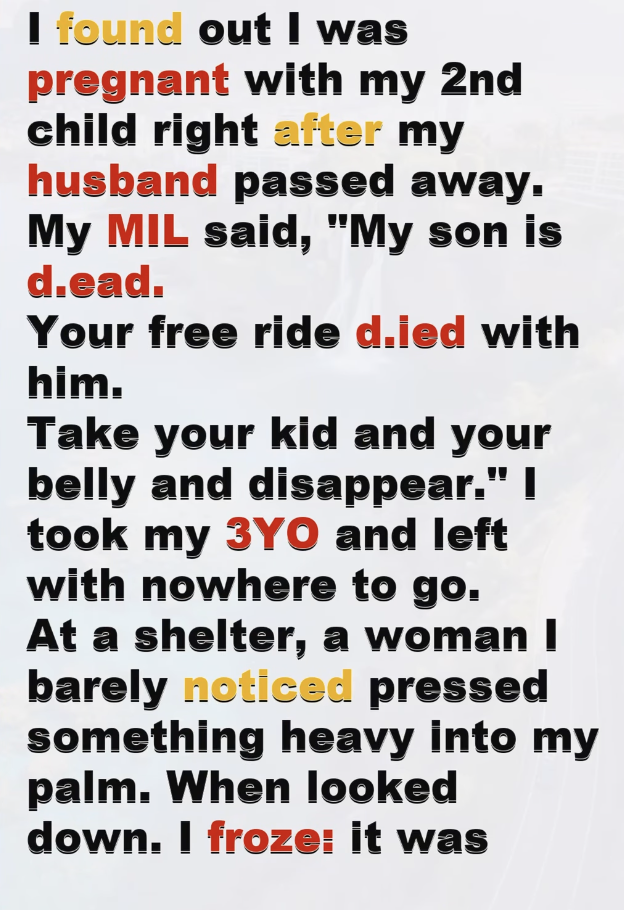
I found out I was pregnant with my second child just weeks after my husband died.
One moment I was planning a funeral, trying to explain to my three-year-old why Daddy wasn’t coming home, and the next I was staring at two pink lines in a bathroom, shaking so hard I had to sit on the floor.
My husband, Caleb, had died in a car accident coming home from work. He was only thirty-two. We had been together since college. He was kind, steady, the kind of man who remembered to buy my favorite tea when I was stressed and who could make our little boy laugh even on his worst day.
His death split my life clean in half.
Before, I had a home, a family, a future I could picture.
After, I had bills, grief, a toddler asking for a father who was never coming back, and a baby growing inside me that my husband would never get to meet.
At first, my mother-in-law, Diane, acted like she was grieving with me. She cried at the funeral. Held my hand in front of people. Called me “family.”
But after the casseroles stopped coming and the sympathy visits dried up, something in her changed.
Or maybe it had always been there, hidden under politeness.
She started making little remarks.
“You’ll need to be realistic now.”
“I hope you’re not expecting everyone else to carry you.”
Then the comments got uglier.
When I told her I was pregnant, hoping—stupidly—that maybe the news would bring us closer because this baby was the last piece of her son left in the world, she stared at me like I’d insulted her.
Then she said, cold as ice, “My son is dead. Your free ride died with him.”
I actually thought I’d misheard her.
But she kept going.
“Take your kid and your belly and disappear.”
At the time, I was living in a small guest house on her property. Caleb and I had moved there temporarily while saving for a bigger place, and after he died, I couldn’t afford to leave right away. I was working part-time from home, barely functioning, drowning in hospital bills and funeral costs.
Diane knew that.
She just didn’t care.
The next morning, while I was packing a bag for my son, she came in, took one look at the half-filled suitcase, and said, “Good. I want you gone by tonight.”
I begged.
Not for me—for the children.
I told her I just needed a little time. A week. Even a few days.
She folded her arms and said, “You should have thought of that before deciding to become my problem.”
By that evening, she had changed the locks on the guest house.
I was standing in the driveway with my three-year-old, one suitcase, a diaper bag, and nowhere to go.
I slept in my car for two nights before a police officer doing a welfare check directed me to a women’s shelter.
I had never felt so broken.
At the shelter, I tried to stay invisible. I kept my head down, fed my son crackers and juice boxes, and answered questions in short, polite sentences. I was ashamed in a way I had never known before. Not because I’d done anything wrong, but because grief had reduced my life to survival.
One afternoon, while my son was napping on a thin cot beside me, an older woman sat down in the chair across from me.
I had seen her around but never really noticed her. She was always quiet, always reading, always wearing plain sweaters and sensible shoes. She had silver hair pinned back neatly and a face that looked stern until she smiled—which she rarely did.
Without a word, she took my hand and pressed something heavy into my palm.
At first I thought it was jewelry.
Then I looked down.
It was a key.
A house key.
I stared at it, then at her.
“I’m sorry,” I said, confused. “I think you made a mistake.”
She shook her head.
“No mistake.”
I looked closer. Attached to the key was a small wooden tag with an address written on it.
My heart started pounding.
“I don’t understand.”
She glanced at my sleeping son and lowered her voice.
“I own a small house across town. It’s been sitting empty since my daughter passed away five years ago. I haven’t had the courage to sell it.” Her voice caught just slightly, then steadied. “I saw you come in here with that little boy, carrying the kind of grief I know too well.”
I couldn’t speak.
She continued, “It isn’t fancy. But it’s clean, safe, and paid for. You and your son can stay there for as long as you need.”
I burst into tears so fast it embarrassed me.
I kept saying no at first. I didn’t know her. It felt impossible that someone could be that kind when my own family had treated me like trash.
But she just closed my fingers around the key and said, “Sometimes help is just help. You don’t have to earn it by suffering more.”
Her name was Evelyn.
And she saved my life.
The house was tiny—a two-bedroom bungalow with faded blue shutters and a lemon tree in the back yard—but when I stepped inside, it felt like a palace. There were crocheted blankets folded on the sofa, dishes in the cabinets, and a note on the kitchen table that read:
Feed your child first. Cry later. Sleep whenever you can.
That first night, my son fell asleep in a real bed for the first time in days. I sat on the bathroom floor and cried so hard I thought I’d split in half.
But for the first time since Caleb died, I also felt something else.
Relief.
Over the next few months, Evelyn became family in the truest sense of the word. She came by with groceries but never pity. She helped me file paperwork for survivor benefits. She connected me with a lawyer when I told her what Diane had done.
That was when I learned something even worse.
Diane had been collecting money addressed to me.
Life insurance documents. Final pay paperwork. And a small wrongful death settlement notice from Caleb’s employer’s insurance carrier.
All of it had been mailed to her address because that was where we were living when Caleb died.
She had hidden every single piece of it.
If Evelyn hadn’t pushed me to speak to an attorney, I might never have known.
The lawyer was furious.
Within weeks, he uncovered that Diane had intercepted official mail, withheld insurance information, and even attempted to present herself as the primary claimant on part of Caleb’s estate—despite the fact that Caleb’s legal wife was me.
I remember sitting in that lawyer’s office, pregnant and exhausted, while he laid the file in front of me and said, “Your mother-in-law didn’t just abandon you. She tried to erase you.”
That sentence lit something in me.
For months I had been surviving.
Now I wanted justice.
The legal process took nearly a year. In that time, I gave birth to my daughter, Lily. She had Caleb’s eyes. The first time I held her, I wept—not only because she was beautiful, but because for one terrible moment after his death, I had believed everything connected to hope had died too.
It hadn’t.
Diane, meanwhile, kept insisting she had “only done what was necessary.” She told relatives I was unstable, manipulative, lazy. She said I had “used” her son and was trying to cash in on his death.
But facts are stubborn things.
The paper trail told the truth.
In the end, the court ordered the withheld funds released to me in full. Diane was forced to return property she had taken, surrender documents she had concealed, and pay penalties tied to her interference.
She never apologized.
She just looked at me outside the courthouse and said, “You think you’ve won?”
I looked back at her, my daughter in my arms and my son holding my hand, and said, “No. I won the day someone kinder than you handed me a key.”
A year later, I used part of the settlement as a down payment on a modest home of my own.
Evelyn came with us to closing.
When I signed the papers, I put the old wooden key tag she had first given me in my purse as a reminder: sometimes the people who save you are not the ones who are supposed to love you.
Sometimes they are strangers who choose decency when others choose cruelty.
My son is seven now. My daughter is four. They know Evelyn as Grandma Eve. Every Sunday, she sits at our table eating pancakes and telling them stories about bravery that always sound suspiciously like instructions for living.
As for Diane, I haven’t seen her in years.
I heard through relatives that she lives alone now. Bitter. Estranged from most of the family. Still blaming everyone else for the ruin she made with her own hands.
And maybe that’s punishment enough.
But the real ending—the one that matters—is this:
The night I was thrown out, I thought my life was over.
I thought grief had taken everything.
I was wrong.
Because sometimes, after the cruelest loss, life doesn’t hand you a miracle.
Sometimes it hands you a key.
And that’s enough to begin again.