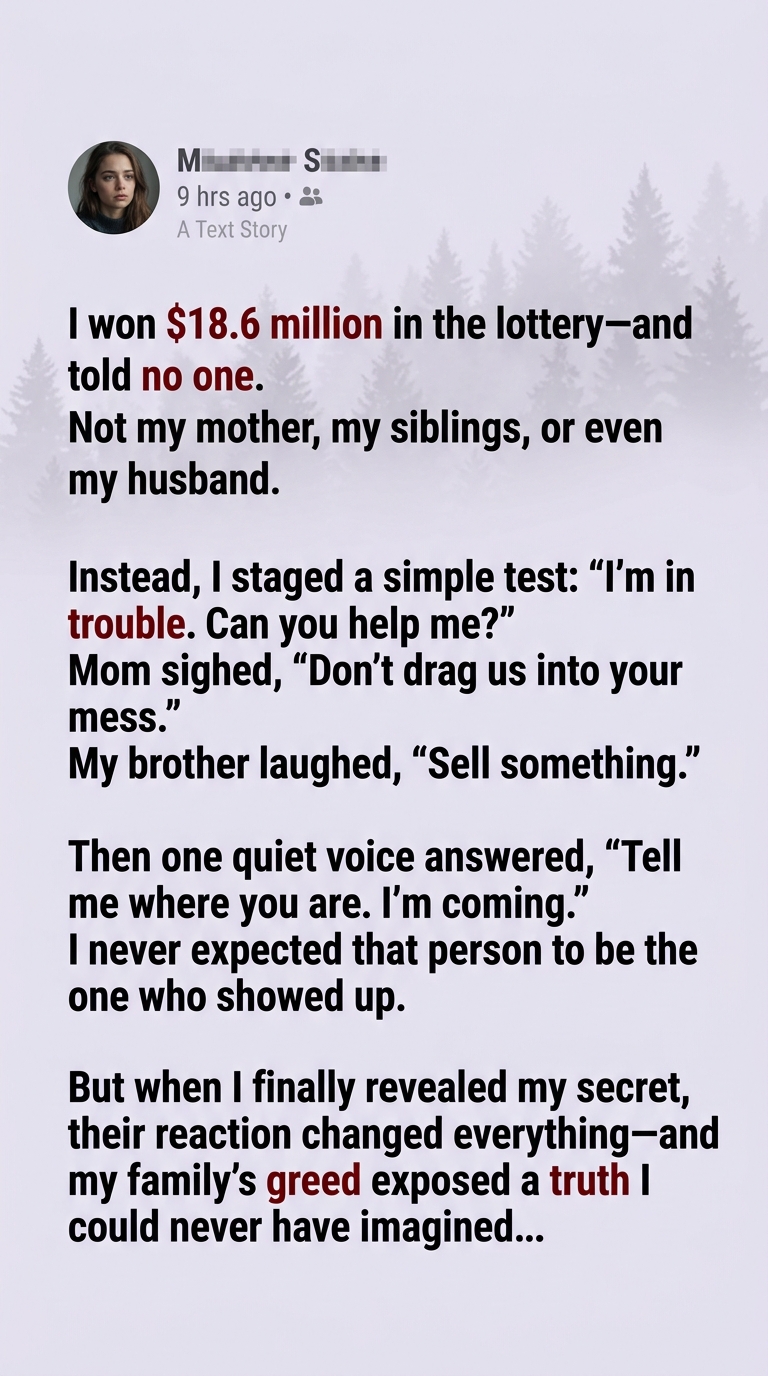
I Won $18.6 Million in the Lottery and Tested My Family in Secret—The One Person Who Showed Up Changed Everything
The morning I discovered I had won $18.6 million in the lottery, I was standing in my kitchen wearing mismatched socks, eating cold toast over the sink.
I checked the numbers three times.
Then a fourth.
My hands began to shake so badly that I had to sit down.
Eighteen million, six hundred thousand dollars.
It was more money than I had ever imagined seeing in my entire life. I could pay off the mortgage, put money away for the future, travel wherever I wanted, and finally stop worrying about every unexpected bill.
But the first thought that came into my mind wasn’t about a new house or a vacation.
It was about my family.
My mother, Patricia, had always told me that family came first. My older brother, Mark, repeated it whenever he needed something. My younger sister, Lauren, used the phrase whenever she wanted me to babysit, lend her money, or rescue her from another bad decision.
And my husband, Eric?
I had spent eight years believing he would stand beside me through anything.
I wanted to believe that the people I loved would be happy for me if something wonderful happened.
But I had seen enough over the years to know that money could change the way people treated you.
So I made a decision.
I would tell no one about the lottery—not even my husband—until I understood who would stand beside me when I had nothing to offer.
I contacted a lawyer and a financial adviser before claiming the prize. I followed their instructions, secured the necessary documents, and made sure I understood the practical and financial consequences before making any promises.
The money was real.
My life had changed.
But I wasn’t ready to let anyone else know.
Instead, I decided to conduct a small experiment.
I would ask my family for help.
Not a huge amount of money. Not anything unreasonable. Just the kind of help a person might need when life suddenly went wrong.
I wanted to know who would care enough to ask what had happened.
Who would listen.
Who would show up.
And who would disappear the moment helping me became inconvenient.
I started with my mother.
She was sitting in her living room when I called. I could hear a television playing in the background.
“Hi, Mom,” I said.
“Hello, sweetheart. Is everything okay?”
Her question almost made me change my mind.
For a moment, I remembered being a little girl, sitting beside her on the couch while she brushed my hair. I remembered believing that my mother could fix anything.
Then I remembered the last time I had asked her for help.
It had been when Eric was between jobs and we were struggling to cover our bills. I had asked if she could watch our daughter for an afternoon so I could take an extra shift.
She had sighed and told me she was too busy.
I pushed the memory away.
“Actually, Mom, I’m having a difficult time. Something unexpected happened, and I’m not sure how I’m going to manage everything. Could you help me?”
There was a pause.
“What kind of trouble?”
“I can’t explain everything over the phone. I just need someone to talk to, and maybe a little help figuring out what to do next.”
My mother sighed so heavily that I pulled the phone away from my ear.
“Oh, sweetheart. Please don’t drag us into your mess. I’m dealing with enough of my own problems.”
I stared at the kitchen wall.
“I’m not asking you to solve everything, Mom. I just thought I could talk to you.”
“Then talk to your husband. He’s supposed to take care of you.”
Before I could answer, she said she had to go and ended the call.
I sat quietly for several minutes.
I had expected disappointment.
I hadn’t expected it to hurt so much.
Still, I wasn’t finished.
My brother Mark was next.
Mark had always considered himself the successful one in the family. He had a good job, a nice car, and an expensive watch he liked to show off at family dinners.
He also had a habit of borrowing money and forgetting to repay it.
When I called, he answered cheerfully.
“What’s up?”
“Mark, I need a favor.”
“What kind of favor?”
“I’m in trouble. Something unexpected happened, and I need a little help. Could you talk to me?”
He laughed.
“You’re in trouble? What did you do this time?”
“Nothing. I’m just dealing with something difficult.”
“Sell something,” he said. “You have plenty of stuff. That old car of yours, maybe. People always have something they can sell.”
I swallowed.
“I wasn’t asking you to give me money. I just wanted some help.”
“Then what do you want me to do? Come over and cry with you?”
He laughed again.
“Look, I’ve got my own problems. You need to figure things out yourself.”
Then he hung up.
I sat with the phone in my hand, wondering how someone who had borrowed thousands of dollars from me over the years could laugh when I said I needed help.
My sister Lauren was even worse.
She didn’t let me finish explaining.
“I’m sorry, but I can’t help you right now,” she said immediately. “I’m trying to get my own life together.”
“I understand. I just wanted someone to talk to.”
“Well, I really can’t deal with negativity today.”
Negativity.
That was the word she used for my asking for help.
I ended the call and stared at the list of names on my screen.
Three people.
Three rejections.
I hadn’t even told them how serious my situation was, yet they had already decided that helping me was too much trouble.
Then I looked at Eric’s name.
My husband.
We had been married for eight years. We had a daughter, Lily, who was six, and a modest home we had worked hard to afford. Eric wasn’t perfect, but I had always believed that if something truly terrible happened to me, he would be the first person to stand beside me.
I almost called him.
But I stopped.
I had spent years telling myself that our marriage was strong because we shared a home, raised a child together, and rarely argued about anything important.
What if I had mistaken routine for love?
What if he loved the life we had built more than he loved me?
I decided I needed one more test.
Before I could make the call, my phone buzzed.
It was a message from an unexpected person.
My aunt’s son, Caleb.
Caleb was my cousin, but we had grown up more like siblings. When we were children, he was the quiet boy who sat beside me during family gatherings and shared his snacks when everyone else ignored us.
He had never been wealthy. He worked as a mechanic and lived in a small apartment on the other side of town. He didn’t own a fancy car or take expensive vacations.
We hadn’t spoken much in the past year because both of us had been busy.
His message read:
Hey, haven’t heard from you in a while. Everything okay?
I stared at it.
Then I typed the same words I had used with the others.
Honestly, no. I’m in trouble, and I don’t know what to do. Could you help me?
His reply came less than a minute later.
Tell me where you are. I’m coming.
I blinked.
No questions about what I had done.
No complaints about his own problems.
No demand for an explanation before deciding whether I deserved help.
Just four simple words.
I sent him my address.
Twenty-five minutes later, a battered blue pickup truck pulled into my driveway.
Caleb stepped out wearing work boots, a faded T-shirt, and the same old jacket he had worn for years. He was carrying a paper bag.
When I opened the door, he looked at my face and immediately frowned.
“Hey. What’s happened?”
I had prepared myself for rejection from my family.
I had prepared myself for excuses.
I hadn’t prepared myself for someone actually showing up.
“I’m okay,” I said automatically.
He gave me a look.
“You texted me that you’re in trouble. I’m not leaving until I know you’re safe.”
Then he held out the paper bag.
“I brought sandwiches. I didn’t know if you’d eaten.”
I stared at the bag, and tears filled my eyes.
It was such a small thing.
A couple of sandwiches from a neighborhood shop.
But after three conversations in which my own family had treated me like an inconvenience, that simple gesture nearly broke me.
Caleb stepped inside.
We sat at the kitchen table, and he waited while I tried to explain.
I told him I was overwhelmed, that I felt alone, and that I had needed someone to talk to.
He didn’t interrupt.
He didn’t tell me I was being dramatic.
He didn’t compare my problems to his own.
When I finally finished, he leaned forward.
“Okay,” he said. “What’s the first thing we need to figure out?”
I stared at him.
“You’d really help me?”
He looked confused.
“Of course. Why wouldn’t I?”
I couldn’t answer.
He sat with me for nearly two hours. He helped me list the things I needed to deal with, offered to take Lily for the afternoon if I needed time to think, and promised to come back the next day.
Before he left, he looked at me seriously.
“And listen. Whatever happened, you don’t have to earn the right to ask for help. You hear me?”
I nodded, unable to speak.
When his truck disappeared down the street, I stood at the window and watched until I could no longer see it.
Then I returned to the kitchen, opened my laptop, and looked at the lottery documents.
For the first time since discovering I had won, I felt certain about something.
I knew who I wanted to share my good fortune with.
But I still had one final decision to make.
I had to tell Caleb the truth.
The following afternoon, I invited him to a quiet café. He arrived straight from work, still wearing his mechanic’s shirt, with a small grease stain near the collar.
He sat down and immediately asked whether I had slept better.
I smiled nervously.
“There’s something I need to tell you.”
His expression grew serious.
“Okay.”
“I wasn’t completely honest yesterday.”
He leaned back.
“Are you in more trouble than you told me?”
“No. It’s the opposite.”
I reached into my bag and took out a folder. Inside were copies of the official lottery confirmation and the documents showing that I had won $18.6 million.
I slid them across the table.
Caleb looked at the first page.
Then he looked at me.
Then he looked back at the page.
“What is this?”
“I won the lottery.”
He blinked.
“What?”
“Eighteen point six million dollars.”
For several seconds, he didn’t move.
Then he pushed the folder back toward me.
“Is this real?”
I nodded.
He looked around the café, then lowered his voice.
“Does anyone know?”
“No. Not my mother, not Mark, not Lauren, and not even Eric.”
Caleb’s face changed.
“You told your husband you were in trouble and didn’t tell him about this?”
“I wanted to understand how everyone would treat me if they thought I needed help. I know it wasn’t a perfect test. But I needed to see who would show up without expecting anything in return.”
He was quiet for a long time.
Finally, he asked, “And what are you going to do now?”
That wasn’t the reaction I expected.
He didn’t ask how much I would give him.
He didn’t ask for a new truck or a house.
He didn’t even ask me to buy him lunch.
He asked what I was going to do.
I started crying.
Caleb reached across the table and held my hand.
“Hey. It’s okay.”
“I thought you’d be excited.”
“I am excited for you,” he said. “But money like that can turn your whole life upside down. You need to protect yourself and think carefully before making promises.”
Then he pushed the folder back toward me.
“And don’t give me a cent just because I came over yesterday.”
I stared at him.
“Why not?”
“Because I didn’t come over for money. I came because you said you needed me.”
That was the moment I knew.
Caleb was the person I had been searching for.
Not because he had done something extraordinary, but because he had done something simple without asking what he would get in return.
I decided I would help him, but not in the way I had imagined at first.
I wouldn’t hand him a pile of money and risk changing our relationship overnight. Instead, I would work with my financial adviser to establish a sensible plan that could help him achieve the future he wanted.
He had spent years talking about opening his own auto repair shop. He was talented, hardworking, and tired of working for people who took advantage of him.
I offered to help him make that dream possible.
He refused at first.
“I can’t take your money.”
“You’re not taking it,” I said. “I’m choosing to invest in someone I trust.”
He still looked uncomfortable.
So I suggested that we work with independent professionals, create a written agreement, and make sure he had a genuine business plan. If he changed his mind, I wouldn’t pressure him.
Eventually, he agreed to discuss it.
But before I could put any of those plans into action, I had to face the people I had deliberately kept in the dark.
I started with my husband.
That evening, Eric came home and found me waiting at the kitchen table.
Lily was spending the night with a friend, so we had the house to ourselves.
“I need to tell you something important,” I said.
He loosened his tie.
“What’s wrong?”
I placed the lottery documents in front of him.
He read the first page.
Then he read it again.
His mouth fell open.
“Is this a joke?”
“No.”
“You won eighteen point six million dollars?”
“Yes.”
He stood up and walked around the kitchen.
“Oh my God. Do you know what this means? We can buy the house we’ve always wanted. We can get a new car. I could finally leave my job!”
I watched him talk.
He was excited, and I understood why. It was a life-changing amount of money.
But he hadn’t asked how I felt.
He hadn’t asked why I had kept the secret.
He hadn’t asked why I had been crying the previous day.
Instead, he was already planning what we could buy.
When he finally sat down, I told him about the calls I had made.
I told him how my mother had refused to get involved, how Mark had laughed, and how Lauren had called my request for help negativity.
Then I told him about Caleb.
Eric frowned.
“You tested everyone?”
“I asked for help. I wanted to see who would listen.”
“And Caleb came over?”
“He brought food and stayed for hours.”
Eric shook his head.
“So what? He was nice to you once, and now you’re going to reward him with money?”
I felt my stomach tighten.
“I haven’t promised him anything.”
“Good. Because if you’re giving money away, we need to discuss it first.”
I looked at my husband.
There it was.
Not concern about me.
Not curiosity about why I had felt so alone.
Control.
“Eric,” I said carefully, “I haven’t decided what to do with the money yet. I’m going to protect it and make a plan. But I need you to understand that I didn’t win this because of anything you did. I need time to think.”
His expression hardened.
“It’s our money. We’re married.”
“We need professional advice about how the prize is treated under the law and how to manage it responsibly. I’m not making decisions based on assumptions.”
He stared at me as if I had betrayed him.
That night, he slept in the guest room.
Over the next week, his behavior changed. He became unusually attentive, offered to do chores he had ignored for years, and began talking about the future in ways he never had before.
At first, I wanted to believe it was genuine.
Then I overheard him on the phone with Mark.
“I’m telling you, this changes everything,” Eric said. “We need to get ahead of it before she starts giving money away.”
I stepped away before he noticed me.
The next day, Mark called me.
His tone was suddenly warm.
“Hey, sis! I was thinking about you. We haven’t caught up in ages.”
I said nothing.
He continued, “Listen, I know things have been tough for you lately. If you need anything, you should have told me.”
I nearly laughed.
A week earlier, he had told me to sell something.
Now he was acting like a concerned brother.
“How did you find out?” I asked.
He went quiet.
“Eric mentioned it.”
Of course.
That evening, my mother called.
“Sweetheart,” she said, her voice overflowing with affection, “why didn’t you tell me about your wonderful news?”
I closed my eyes.
“I wanted to keep it private until I understood what I was going to do.”
“Well, I understand. But we’re family. We should celebrate together.”
Then she added, “Your brother has been having some financial difficulties. Perhaps you could help him get back on his feet. And Lauren has always wanted to buy a home.”
I listened without speaking.
My mother continued making suggestions about how the money could improve everyone’s lives.
Not once did she mention the conversation in which she had told me not to drag her into my mess.
When she finished, I asked a simple question.
“Mom, do you remember what you said when I called you last week and told you I was in trouble?”
She hesitated.
“I don’t know what you’re talking about.”
“You told me not to drag you into my mess.”
“Oh, sweetheart, I didn’t know what was happening!”
“You didn’t ask.”
She fell silent.
For the first time, I heard her struggle to find an answer.
But the most disturbing conversation happened three days later.
I was organizing documents in my home office when I heard Eric speaking quietly in the living room.
He was on the phone with my mother.
I wasn’t trying to eavesdrop, but then I heard my name.
“She’ll calm down,” Eric said. “She always does.”
My mother replied, “You need to make sure she understands that the money belongs to the family.”
Eric laughed softly.
“I’m working on it. Once everything is settled, we can make sure everyone gets a fair share.”
I stood motionless in the doorway.
Then my mother said something that made my blood run cold.
“Your father would never have wanted her to keep that kind of money to herself.”
My father had been dead for nine years.
He had loved me, but my mother had often used his memory to win arguments. She had told me what he supposedly wanted whenever she needed me to do something for the family.
Now she was using him again.
I backed away before either of them saw me.
That night, I couldn’t sleep.
I kept thinking about Caleb, who had arrived at my house with sandwiches and no questions, and the people who were already arguing over money they didn’t own.
Then another thought came to me.
Why had my mother been so certain that my father would want the money distributed among the family?
What exactly did she believe she knew?
The next morning, I called my aunt Denise, my father’s younger sister.
We hadn’t spoken much since his funeral, but I remembered that she had been the one person who challenged my mother when family arguments became cruel.
I asked if we could meet.
When we sat down at her house, I explained the lottery win and the conversations I had overheard.
She listened carefully.
Then I mentioned my mother’s comment about my father.
Aunt Denise’s face went pale.
“Oh,” she whispered.
“What?”
She stared at her hands.
“There’s something about your father that I never told you. I thought it wasn’t my place. But if your mother is using his name to pressure you, you need to know the truth.”
My heart began to race.
“What truth?”
Aunt Denise took a deep breath.
“Your father left you something when he died.”
I stared at her.
“What do you mean?”
“Not money like this. Something much smaller. But it was meant specifically for you.”
She explained that, before his death, my father had given her a sealed letter and asked her to keep it safe until she felt I was old enough to understand it.
She had planned to give it to me after I married, but my mother had insisted that any family documents be kept together. The letter had disappeared from Aunt Denise’s home during a visit, and she had assumed my mother had taken it.
She had never found the courage to confront her.
“What did the letter say?” I asked.
“I never read it. Your father told me it was for you alone.”
My throat tightened.
“Do you think Mom has it?”
“I don’t know. But I remember one thing he told me. He said he wanted you to understand that you didn’t owe your life to anyone simply because they were related to you.”
I sat in silence.
Those words sounded like my father.
He had been gentle but firm, the kind of man who believed helping someone was an act of love, not a debt to be collected later.
Aunt Denise promised to look through her old records one more time. I left her house feeling shaken, but strangely relieved.
For the first time, I understood that my family’s behavior might not have begun with the lottery.
The money had only revealed what was already there.
Two days later, Aunt Denise called me.
She had found a copy of the letter among papers she had stored after my father’s funeral.
She brought it to my house that evening.
The envelope was yellowed with age. My name was written across the front in my father’s handwriting.
I held it for several minutes before opening it.
Inside was a short letter.
My father wrote that he had always worried I would spend my life trying to earn love from people who treated love like a reward. He reminded me that I had been generous since childhood, often giving away what little I had because I wanted everyone to be happy.
He told me that generosity was a beautiful quality, but that it should never become a reason to abandon myself.
Then came the line that made me cry.
If you ever find yourself with more than you need, share it with people who treat your heart carefully. But never let anyone convince you that sharing is the price of belonging.
At the bottom, he had added:
You are allowed to say no, even to family. The people who truly love you will still see you as their daughter, sister, or friend when you cannot give them anything.
I pressed the letter against my chest and cried.
My father had been gone for nine years, yet his words had reached me at the exact moment I needed them.
But the letter raised another question.
Why had my mother kept telling everyone what my father would have wanted, when his actual words seemed to say the opposite?
I didn’t have proof that she had taken the original letter. I wasn’t going to accuse her based on suspicion alone.
But I no longer needed to understand every secret to know what I would do next.
I called a family meeting.
I invited my mother, Mark, Lauren, Eric, and Aunt Denise. Caleb came too, because I wanted at least one person in the room who had shown me kindness without knowing what I could offer in return.
Everyone arrived expecting a celebration.
Mark brought a bottle of expensive wine. Lauren wore a new dress and hugged me as if we had never argued. My mother arrived with a homemade cake and kept calling the lottery win a blessing for the whole family.
Eric put his arm around my shoulders.
I stepped away gently.
Once everyone was seated, I placed a folder on the table.
“I wanted to talk about the money,” I began. “But first, I want to talk about something that happened before anyone knew I had won.”
I described my calls to my mother, Mark, and Lauren. I repeated their words as accurately as I could.
My mother looked uncomfortable.
Mark shrugged.
“I was joking.”
“You told me to sell something when I said I needed help.”
“Because I thought you were exaggerating!”
Lauren stared at the table.
My mother began explaining that she had been stressed and that she couldn’t possibly be expected to solve everyone’s problems.
I let them finish.
Then I turned to Caleb.
“When I asked you for help, you didn’t ask me for money. You didn’t tell me to sell my belongings. You brought me food, sat with me, and helped me figure out what to do next. You didn’t even know I had won anything.”
Caleb looked embarrassed.
“I just wanted to make sure you were okay.”
“Exactly.”
I opened the folder and showed them the lottery confirmation.
“The prize is real. But I’m not going to distribute it because people have suddenly decided that they deserve a share.”
Eric’s face tightened.
“That’s not fair. We’re your family.”
I looked directly at him.
“You are my family. That doesn’t mean I have to surrender every decision I make.”
My mother leaned forward.
“Your father would have wanted us to share this.”
I took out the copy of my father’s letter and placed it on the table.
“I found Dad’s letter.”
The room went quiet.
I read his words aloud.
When I finished, no one spoke for several seconds.
Aunt Denise looked at my mother.
“Patricia, did you ever find the original letter?”
My mother went pale.
“I don’t know what you’re talking about.”
Aunt Denise held her gaze.
“You told me years ago that he hadn’t left anything for anyone. But I remember handing you the family papers after the funeral. I always wondered where that letter went.”
My mother stood up.
“This is ridiculous. We’re not going to dig up the past over a lottery ticket!”
“No,” I said quietly. “We’re talking about the present. We’re talking about how everyone treated me when they thought I had nothing to offer.”
Mark shifted in his chair.
“Fine. So what are you going to do with the money?”
It was the question everyone had been waiting to ask.
I took a breath.
“I’ll protect the prize, follow professional advice, and make decisions carefully. I’ll provide for my daughter and plan for the future. I may choose to help people, but it will be my decision, made without pressure.”
Then I looked at Caleb.
“I also intend to help Caleb explore opening his own repair shop. We’ll do it properly, with a written agreement and independent advice. He’s never demanded anything from me.”
Mark let out a bitter laugh.
“So the mechanic gets rewarded, and your actual family gets nothing?”
Caleb immediately shook his head.
“You don’t have to do that for me. I told you I didn’t want anything.”
“I know,” I said. “That’s why I trust you to help me think it through.”
My mother began crying.
After a moment, she looked up.
“Are you really going to turn your back on your own mother?”
I felt the old reflex rise inside me—the urge to comfort her, apologize, and make everything right.
Then I remembered the words she had used when I asked for help.
Don’t drag us into your mess.
“I’m not turning my back on you,” I said. “I’m setting a boundary. You can have a relationship with me that isn’t based on how much money I give you.”
She looked away.
The meeting ended without a single request for forgiveness.
Mark left angry. Lauren left in tears. My mother walked out with the cake untouched. Eric stayed behind and told me we needed to discuss our marriage.
We did.
The following weeks were difficult. Eric admitted that he had begun thinking of the lottery as a solution to problems he had never wanted to face. He apologized for discussing the money with my family before we had agreed on how to handle it.
I told him that the lottery had exposed a problem much larger than money: I no longer trusted him to put our relationship ahead of his own interests.
We entered counseling, and I kept the financial arrangements separate until I had clear professional advice about my rights and obligations. I refused to let the excitement of winning push me into rushed decisions about my marriage or my family’s future.
My mother eventually sent me a letter of apology. It was short and imperfect, but she acknowledged that she had dismissed me when I needed her.
Mark took longer. He continued insisting that I owed him a share, so I stopped discussing the prize with him. Lauren eventually apologized for calling my request for help negativity. We began rebuilding our relationship slowly, without promises of money.
As for Caleb, we worked with professionals to explore the repair shop. He insisted on contributing his own savings and taking responsibility for running the business. I helped fund the venture under clear terms, and he built it with the same patience and hard work that had brought him to my kitchen that first day.
The shop opened eight months later.
On opening day, Caleb handed me a small framed photograph of my father. It was one I hadn’t seen in years.
“I found this in Aunt Denise’s box,” he explained. “I thought you should have it.”
On the back, in my father’s handwriting, were four words:
Be kind. Stay wise.
I smiled through my tears.
I hadn’t won $18.6 million because I was a better person than anyone else. I hadn’t been chosen to punish my family or reward the people who passed a test.
But I had been given a chance to make decisions differently.
The money gave me choices. The people around me showed me which relationships needed boundaries, which deserved a second chance, and which could only survive if I kept paying for their affection.
I still loved my family.
But I no longer believed love required me to say yes to every demand.
And I never forgot the cousin who came to my door carrying two sandwiches when he believed I had nothing.
Because the most important discovery I made that year wasn’t that I had won $18.6 million.
It was that the person who showed up when I had nothing was the person I could trust when I suddenly had everything.
The lottery changed my bank account. Their reactions changed my life.