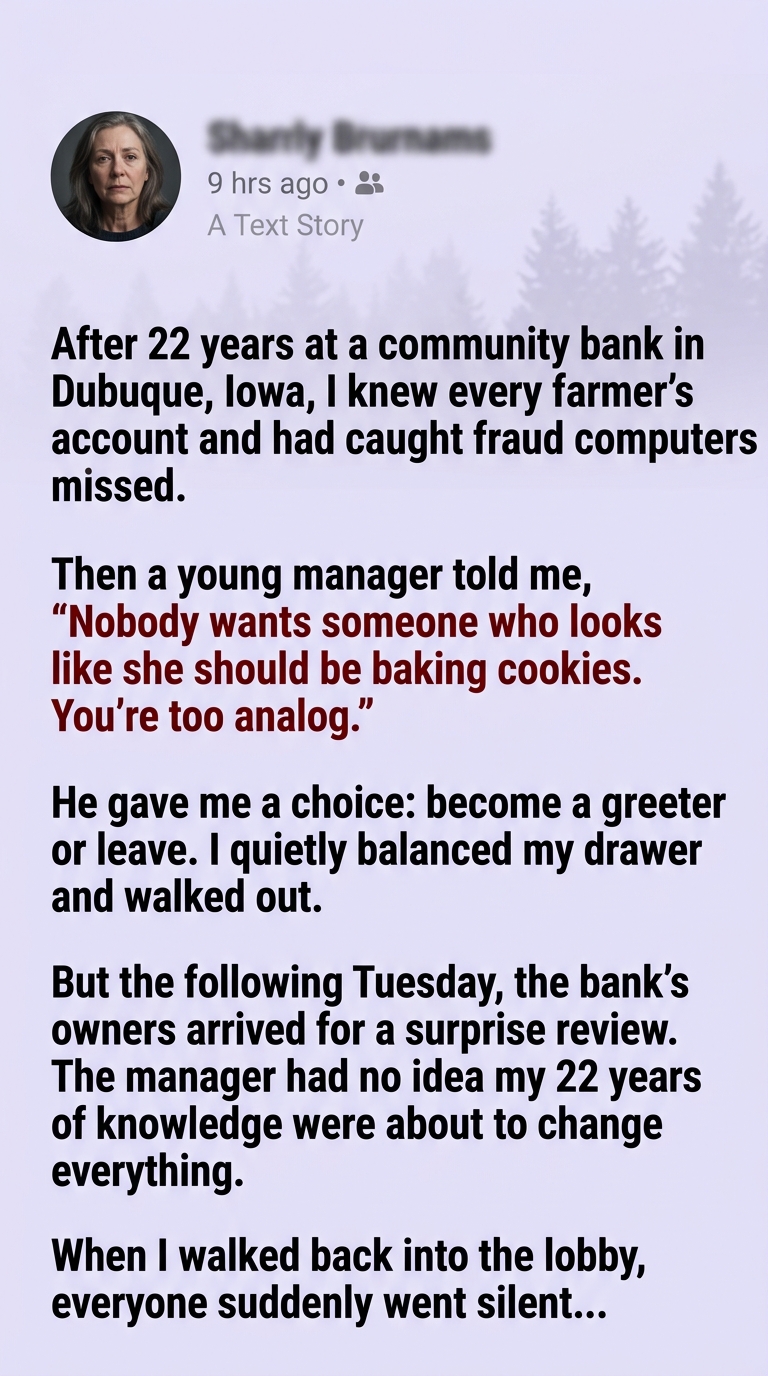
After twenty-two years at the same community bank in Dubuque, Iowa, I thought I knew exactly where I belonged.
I knew every farmer who walked through those doors.
I knew which customers wanted to talk about their crops before discussing their loans.
I knew who always paid early.
Who always paid late.
Who hated online banking.
Who kept emergency cash in a coffee can.
And, more importantly, I knew when something didn’t look right.
Over the years, I’d caught mistakes that computers missed.
A duplicate check.
A suspicious wire transfer.
A forged signature.
A loan application that looked perfect on the screen but didn’t make sense when I remembered the customer’s history.
I wasn’t flashy.
I didn’t wear expensive suits.
I didn’t carry the newest phone.
I still kept a paper notebook beside my keyboard.
But I knew my customers.
And they trusted me.
Then everything changed when a new manager named Tyler arrived.
He was thirty-one.
He had an MBA, a perfect haircut, and a habit of talking about “modernizing the customer experience.”
Within three months, he had replaced half the old procedures.
Paper forms disappeared.
Employees were told to stop making personal notes about customers.
Everything had to go through the computer system.
One morning, I questioned a $480,000 agricultural loan that had suddenly been approved.
The numbers looked fine.
But I recognized the borrower.
He had been struggling for months.
I told Tyler something wasn’t right.
He smiled.
“The system approved it.”
“The system doesn’t know him.”
Tyler sighed.
“That is exactly the problem with people like you.”
I stared at him.
“People like me?”
“People who trust instincts over data.”
I said nothing.
Two weeks later, he called me into his office.
He closed the door.
Then he leaned back in his chair.
“You’ve been here a long time.”
“Twenty-two years.”
“Exactly.”
He smiled awkwardly.
“But the bank is changing.”
I waited.
“We need younger energy.”
I felt my stomach tighten.
Then he said the sentence I’d never forget.
“Nobody wants someone who looks like she should be baking cookies. You’re too analog.”
I stared at him.
He continued.
“We can move you to the lobby.”
“As what?”
“A greeter.”
I almost laughed.
“A greeter?”
“Or you can take a severance package and leave.”
I looked at the young man sitting behind the desk I had once trained someone to use.
Twenty-two years.
No warning.
No performance issue.
No misconduct.
Just suddenly too old.
Too slow.
Too analog.
I stood.
“Do I need to decide today?”
“End of business.”
I nodded.
“Then I already have.”
I went back to my desk.
I balanced my drawer.
Perfectly.
I organized my files.
I cleaned out my desk.
Then I walked out of the bank.
I didn’t cry.
I didn’t argue.
I didn’t tell anyone what I thought of Tyler.
I simply went home.
For the first time in twenty-two years, I didn’t set an alarm for work.
I expected to feel useless.
Instead, I felt strangely free.
But I didn’t know what was happening inside the bank.
Three days later, Tyler’s world started falling apart.
It began with a phone call.
The bank’s owners had scheduled a surprise review.
Tyler wasn’t worried.
He had insisted for months that everything was computerized and efficient.
He even bragged about how much money the new system was saving.
Then the owners arrived.
They started checking accounts.
Agricultural loans.
Commercial accounts.
Wire transfers.
Old customer records.
Within an hour, one of the owners asked a question.
“Who approved this loan?”
Tyler checked the computer.
“I did.”
The owner frowned.
“Why?”
“Because the system approved it.”
The owner looked at him.
“That’s not an answer.”
Then another issue appeared.
A series of small transfers had been made from dormant accounts.
Each one was below the threshold that triggered an automatic alert.
The system hadn’t flagged them.
But together, they totaled nearly $300,000.
Tyler stared at the screen.
“That can’t be right.”
The owner looked at the compliance officer.
“How long has this been happening?”
Nobody knew.
Then someone remembered me.
An older employee said quietly,
“If she were here, she’d know.”
Tyler looked annoyed.
“Who?”
“Her.”
The owner turned.
“Where is she?”
Tyler hesitated.
“She quit.”
“Why?”
Nobody answered.
Finally, the employee said,
“She was told she was too analog.”
The room went silent.
The owners immediately asked to see my old customer notes.
Tyler protested.
“She kept paper notes?”
“She did.”
They found my notebook.
I had recorded something that computers never could.
Patterns.
Names.
Dates.
Behaviors.
I had written:
“Watch account 1842. Customer’s normal deposits are seasonal. Recent transfers don’t match his business.”
Another note:
“Check wire activity connected to account 7719. Customer has never sent money out of state.”
And another:
“Loan applicant’s income is inconsistent with previous three years.”
The owners looked at each other.
Then they asked Tyler one question.
“Where is she?”
That afternoon, I was at home making coffee when my phone rang.
I almost didn’t answer.
It was the bank.
“Mrs. Carter?”
“Yes?”
“This is one of the owners. Could you come in?”
My stomach tightened.
“Why?”
“There’s something we’d like to discuss.”
I almost said no.
Then I remembered the farmers.
The customers.
The people who had trusted me for twenty-two years.
So I went.
When I walked through the bank doors, everyone stopped talking.
The tellers looked at me.
The loan officers looked at me.
Tyler stood behind the counter.
His face had gone pale.
One of the owners walked toward me.
“Thank you for coming.”
I nodded.
He turned to the staff.
“This woman was one of the best fraud detectors this bank ever had.”
Tyler looked uncomfortable.
The owner continued.
“We’ve spent the entire morning discovering problems she warned us about months ago.”
Then he handed me a folder.
Inside were copies of my handwritten notes.
Every one of them had turned out to be important.
I looked at Tyler.
He couldn’t meet my eyes.
The owner said,
“We want you back.”
I smiled.
“Doing what?”
He hesitated.
“Whatever you think you should be doing.”
I looked around the lobby.
Then I said,
“I don’t want to be a greeter.”
The owner smiled.
“I didn’t think you did.”
I wanted something different.
I asked for a position in fraud prevention and customer security.
I wanted authority to investigate unusual activity before computers automatically approved it.
I wanted to train younger employees to understand that data was useful—but people mattered too.
The owners agreed.
But there was one more change.
Tyler was removed as manager.
Not fired immediately.
Instead, he was transferred to a compliance position where he had to learn the very systems he’d trusted more than people.
A week later, I returned to work.
My old desk was gone.
My office was different.
And on the wall was a new sign:
CUSTOMER SECURITY & FRAUD PREVENTION
My name was underneath it.
The first farmer who came in that morning smiled when he saw me.
“I knew they’d bring you back.”
I laughed.
“You did?”
He nodded.
“You always noticed things nobody else did.”
I looked around the lobby.
For twenty-two years, I had thought my greatest skill was remembering people’s names.
I was wrong.
My greatest skill was remembering their stories.
And that was something no computer could replace.
Months later, the bank uncovered a much larger fraud scheme.
It had been operating quietly for years.
The people responsible had counted on automated systems.
They never counted on someone who remembered what “normal” looked like.
When the investigation ended, the bank’s owners called me into a meeting.
They offered me a large promotion.
I accepted.
But I also asked for something else.
A scholarship program for young employees who wanted careers in banking but couldn’t afford college.
The owners agreed.
Tyler eventually apologized to me.
He stood awkwardly in my office.
“I was wrong,” he said.
I looked at him.
“You were.”
He nodded.
“I thought technology made people like you unnecessary.”
I smiled.
“Technology is supposed to help people. Not replace judgment.”
He nodded.
Then he left.
I turned back to my computer.
Beside it sat the same paper notebook I’d carried for twenty-two years.
I opened it to a fresh page.
At the top, I wrote:
People still matter.
And underneath it:
Never forget that.
Because the woman they had dismissed as “too analog” had spent twenty-two years learning something their computers never could.
Sometimes the most valuable information in a bank isn’t stored in a database.
Sometimes it’s stored in someone’s memory.
And sometimes, the person they think is outdated is the one person standing between them and disaster.