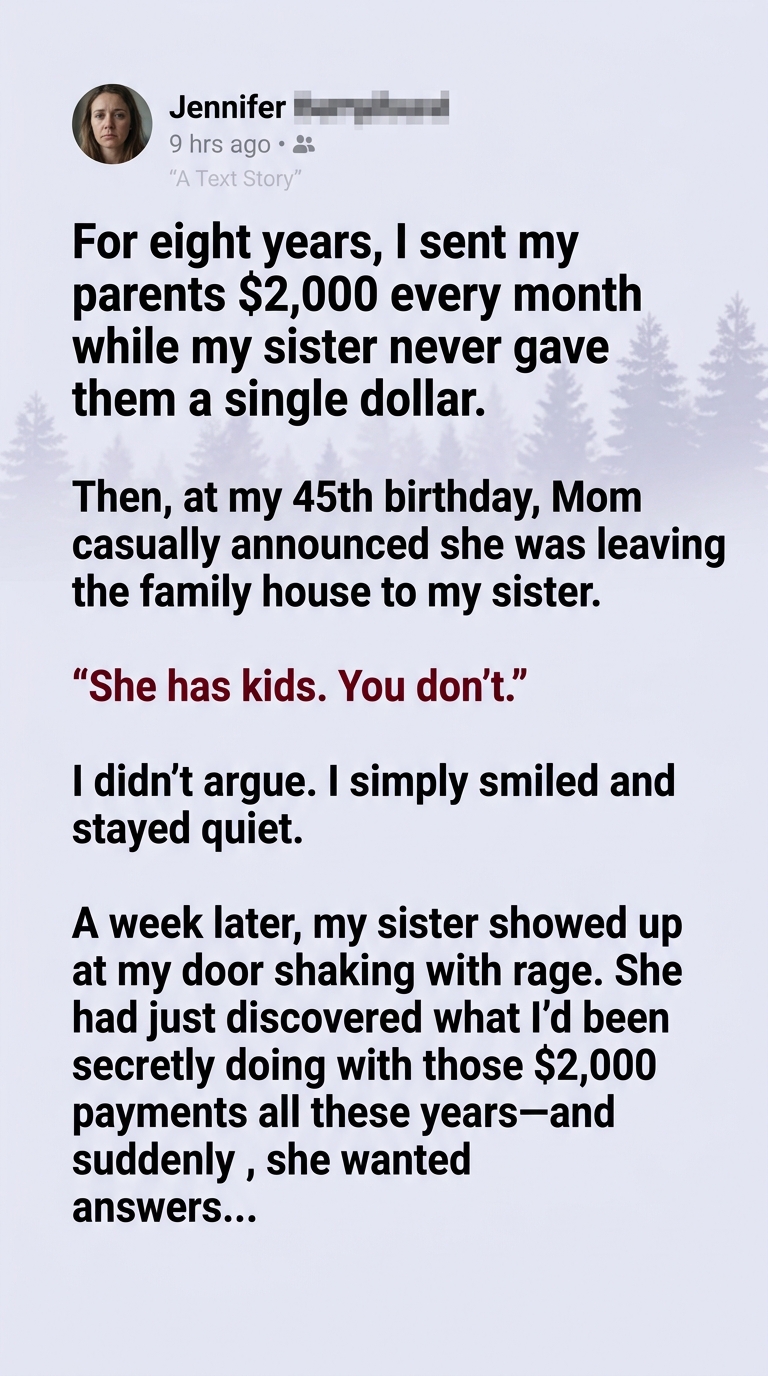
For eight years, I sent my parents $2,000 every month.
No matter what was happening in my own life, I never missed a payment.
When I changed jobs, I still sent it.
When my car broke down, I still sent it.
When I had a difficult year financially, I cut my own expenses before I ever considered cutting theirs.
My sister never sent them a dollar.
Not once.
She always had an excuse.
“Kids are expensive.”
“Things are tight right now.”
“You make more than I do.”
My parents never pressured her.
They never asked her for help.
Instead, they looked at me as if my support was simply my responsibility.
I didn’t complain.
I loved my parents.
And there was another reason I kept sending the money.
One my sister didn’t know.
For years, Mom had talked about keeping the family house.
It wasn’t a mansion, but it had been in our family for decades.
My father had grown up there.
I had learned to ride a bicycle in that driveway.
My sister and I had shared a bedroom upstairs.
Whenever Mom talked about the future, she always said,
“Someday, this house will belong to both of you.”
I never expected anything.
I simply believed her.
Then I turned forty-five.
My parents organized a small birthday dinner.
My sister came with her two children.
Everyone was laughing until Mom raised her glass.
“I have an announcement.”
I smiled.
Mom looked at my sister.
“I’m leaving the family house to her.”
I thought I had misheard.
She continued.
“She has children. You don’t.”
The room became strangely quiet.
My sister looked at me.
I looked at Mom.
For eight years, I’d sent my parents $2,000 every month.
That’s $192,000.
Nearly two hundred thousand dollars.
And apparently, none of it mattered.
I could have reminded them.
I could have asked why.
I could have demanded fairness.
Instead, I smiled.
“That’s wonderful, Mom.”
My sister smiled too.
She looked almost embarrassed by how happy she was.
Dad didn’t say anything.
I finished my dinner.
I went home.
And I didn’t send the next $2,000.
Or the month after that.
I didn’t announce it.
I didn’t threaten anyone.
I simply stopped.
A week later, my sister showed up at my house.
She was furious.
She didn’t even say hello.
“What did you do?”
I stared at her.
“Excuse me?”
“You know exactly what you did.”
She threw a folder onto my kitchen table.
Inside were copies of bank statements.
I recognized them immediately.
My parents’ account.
Then she pulled out another document.
A mortgage statement.
Then another.
An investment account.
I looked at her.
“What are you talking about?”
She slammed her hand on the table.
“The $2,000.”
I said nothing.
She started pacing.
“I thought you were just giving Mom and Dad money.”
“I was.”
“No!”
She pointed at me.
“You weren’t.”
I waited.
She finally said,
“You were paying off their mortgage.”
I nodded.
“Partly.”
Her face turned red.
“You paid off almost the entire house?”
“Yes.”
“Why?”
“Because Dad asked me to help.”
She stared at me.
“Dad told you?”
I nodded.
“Six years ago, he told me they were behind on the mortgage.”
I explained that their monthly payment had become too difficult after Dad’s business slowed down.
I offered to help.
At first, I paid the mortgage directly.
Later, Dad asked me to send the money to their account because he wanted to manage the rest of their expenses.
But I had kept every receipt.
Every transfer.
Every mortgage statement.
Every payment.
And there was something else.
The house wasn’t worth what my sister thought it was.
Because the mortgage had been almost completely paid off.
My sister sat down.
“So the house is basically paid for because of you?”
I nodded.
She looked at me.
“But Mom gave it to me.”
“Yes.”
Her voice became quieter.
“Then why did you stop sending the money?”
I smiled.
“Because my payments were never supposed to be a lifetime obligation.”
She stared at me.
I opened a drawer and pulled out a folder.
Inside was the original agreement I’d made with my parents.
It wasn’t a legal ownership contract.
It was simply a written acknowledgment.
My parents had signed it.
It said that every payment I made toward the mortgage was considered financial assistance toward preserving the family home.
At the bottom, Dad had written:
“When the mortgage is paid off, the house belongs to the family—not to the person who paid it.”
My sister read it twice.
Then she looked at me.
“Mom didn’t tell you she was giving me the house?”
“No.”
“She didn’t ask you?”
“No.”
“Then why didn’t you tell her about this?”
I smiled sadly.
“Because I wanted to see whether she remembered.”
“Remembered what?”
“That the house was supposed to belong to both of us.”
My sister’s anger slowly disappeared.
“What happened when you stopped paying?”
I didn’t answer.
She already knew.
The mortgage company had contacted Mom and Dad.
For the first time in eight years, they had to cover the payment themselves.
And they couldn’t.
My sister looked down.
“That’s why Mom called me.”
I nodded.
“She wants me to help.”
“And are you?”
My sister laughed bitterly.
“With what money?”
I looked at her.
She had never paid anything toward the house.
She had never asked what the mortgage balance was.
She had never cared.
She had simply assumed the house would be hers.
Then she asked the question I knew was coming.
“Why didn’t you ever tell me?”
I thought about it.
“Because you never asked.”
She looked away.
For several minutes, neither of us spoke.
Finally, she whispered,
“I was jealous of you.”
I looked at her.
“What?”
“You always seemed responsible. Mom and Dad trusted you. They called you when something went wrong.”
She wiped her eyes.
“I thought they loved you more.”
I shook my head.
“They didn’t love me more.”
“Then why did you do all of this?”
“Because someone had to.”
She started crying.
Then she said something I never expected.
“I thought you were sending them money because you wanted their approval.”
I smiled.
“Maybe I did, at first.”
She looked up.
“But after Dad got sick, it wasn’t about approval anymore.”
My sister went quiet.
She had forgotten something.
Three years earlier, Dad had suffered a serious health problem.
I had paid his medical bills.
I had never told anyone.
Not even her.
She looked at me.
“You paid those too?”
I nodded.
Her eyes filled with tears.
“Why didn’t you tell me?”
“Because I wasn’t keeping score.”
That sentence broke something in her.
She began sobbing.
“I’ve been angry at you for years.”
“I know.”
“I thought you were trying to make me look bad.”
“I wasn’t.”
“I thought Mom and Dad would leave you everything anyway.”
I looked at her.
“And now?”
She whispered,
“Now I realize you were the reason they still had anything to leave.”
A few days later, Dad called me.
His voice sounded tired.
“I owe you an apology.”
I didn’t say anything.
He continued.
“Your mother shouldn’t have said what she said on your birthday.”
“No.”
“She was thinking about your sister’s children.”
“I understand.”
“But we forgot something.”
“What?”
He took a breath.
“We forgot about you.”
I closed my eyes.
Those four words hurt more than anything else.
Not because of the house.
Not because of the money.
Because they were true.
I had spent eight years proving I would be there.
And somewhere along the way, they had stopped seeing it as love and started seeing it as something they were entitled to.
Dad said they were going to sell the house.
I was surprised.
“Why?”
“Because neither of us can afford it anymore.”
I paused.
Then I asked,
“Do you want me to keep paying?”
He immediately said,
“No.”
“Good.”
Silence.
Then Dad said,
“You’ve done enough.”
A month later, the house was sold.
The proceeds were enough to pay off the remaining expenses and secure a modest place for my parents.
My sister received nothing from the house.
Neither did I.
And strangely, I was okay with that.
I didn’t want the house anymore.
I wanted my parents to understand something they should have understood years earlier.
Love isn’t an invoice.
It isn’t a payment that earns you a bigger share of the inheritance.
And it certainly isn’t something you owe your children simply because one of them has children.
My sister eventually apologized.
Not for losing the house.
For never noticing what I’d been doing.
We started talking again.
Slowly.
Honestly.
And one evening, she asked me,
“Do you regret the $192,000?”
I thought about it.
Then I smiled.
“No.”
She looked surprised.
“Why?”
“Because it kept Mom and Dad safe when they needed help.”
Then I added,
“But I’ll never confuse helping someone with being responsible for them again.”
My sister nodded.
And for the first time in years, she understood.
I hadn’t stopped loving my family.
I had simply stopped allowing them to mistake my love for an unlimited bank account.
And that was the most valuable thing those $2,000 payments ever bought me:
the courage to finally say enough.