I had worked for the same company for nine years.
Nine years.
I had started when the office was half the size it was now.
I had trained new employees.
I had stayed late when projects were behind.
I had answered emails on weekends.
And whenever someone asked who knew the company inside and out, my name was usually the first one mentioned.
I never expected special treatment.
I just expected to be paid fairly.
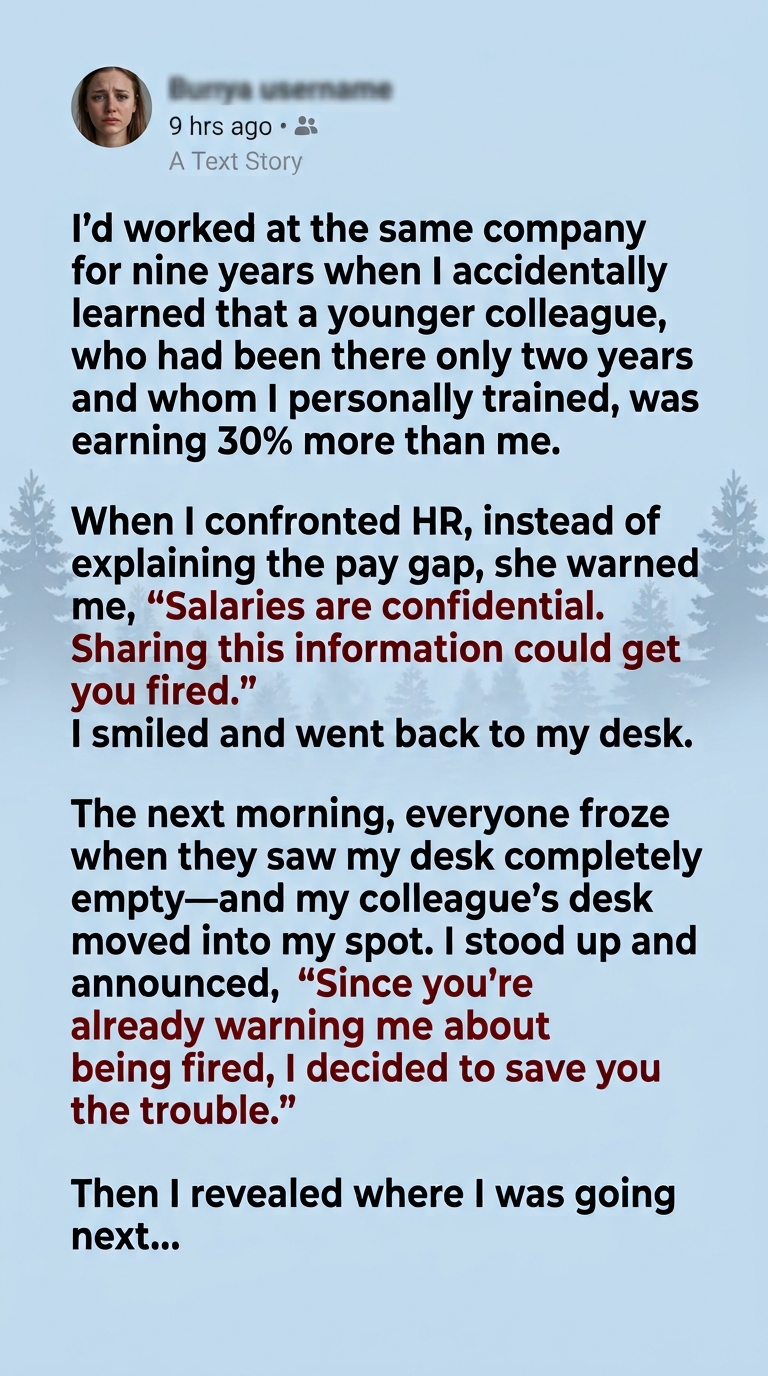
Then one afternoon, during lunch, a younger colleague accidentally mentioned her salary.
At first, I thought I had heard her wrong.
She had been with the company for two years.
I had personally trained her.
And she was earning 30% more than me.
I stared at her.
“Are you sure that’s your annual salary?”
She nodded.
“Yeah. Why?”
I smiled.
“Nothing.”
But my stomach was turning.
That afternoon, I pulled up my employment records.
My salary history.
My performance reviews.
My bonuses.
My responsibilities.
Everything.
I had consistently received excellent evaluations.
Three years earlier, my manager had written:
“One of our most reliable and knowledgeable employees.”
Another review said:
“She regularly performs above the expectations of her position.”
Yet somehow, the woman I had trained was making substantially more than I was.
The next morning, I scheduled a meeting with HR.
I walked into the office with a folder.
“I’d like to discuss my compensation.”
The HR manager smiled politely.
“Of course.”
I showed her my salary history.
Then I showed her the responsibilities I’d taken on over the years.
Finally, I explained the pay difference.
“I’m not asking for anything unreasonable,” I said. “I’d simply like to understand how someone with two years of experience is earning thirty percent more than someone who has been here nine years.”
Her smile disappeared.
She leaned back.
“Salaries are confidential.”
“I understand.”
“Employees aren’t supposed to discuss compensation.”
“I didn’t ask her what she made.”
She looked at me.
“Regardless, sharing salary information could get you fired.”
I stared at her.
For a moment, I couldn’t believe what I was hearing.
I hadn’t demanded an explanation.
I hadn’t threatened anyone.
I had simply asked why my compensation didn’t match my experience and responsibilities.
Instead of answering, she had threatened me.
So I smiled.
“Thank you.”
She looked confused.
“That’s all?”
“That’s all.”
I walked back to my desk.
I didn’t complain.
I didn’t tell my coworkers.
I didn’t send angry emails.
I simply opened my laptop.
And made three phone calls.
The first was to a company I had interviewed with six months earlier.
The second was to a former manager who had recently offered me a position.
The third was to an attorney.
By the end of the afternoon, I had everything I needed.
A new job.
A substantial raise.
Better benefits.
And a start date.
I went home that evening and barely slept.
Not because I was angry.
Because I was finally excited.
The next morning, I arrived at work early.
But something was different.
My desk was empty.
Completely empty.
My chair was gone.
My computer was gone.
Even the little plant I’d kept there for seven years was gone.
I stood in the middle of the office staring at the empty space.
Then my younger colleague walked in.
She stopped.
“What happened?”
Before I could answer, the office manager appeared.
“Management decided to reorganize the department.”
Then she pointed to my colleague.
“Your desk is moving here.”
My colleague looked uncomfortable.
“But this is—”
“It’s fine,” I said.
Everyone was staring at me.
I walked to the center of the office.
The HR manager came out of her office.
“What are you doing?”
I smiled.
“You told me yesterday that discussing salaries could get me fired.”
She crossed her arms.
“Yes.”
I nodded.
“Then I decided to save you the trouble.”
The room went completely silent.
I reached into my bag and pulled out an envelope.
“My resignation.”
Someone gasped.
My manager looked stunned.
“You can’t be serious.”
“I’ve never been more serious.”
Then I placed another document on the table.
“My new employment contract.”
My manager picked it up.
His eyes widened.
“You’re leaving?”
“Yes.”
“For who?”
I looked around the room.
“The company that offered me this position is one of your biggest competitors.”
Silence.
My younger colleague looked at me.
“You already had another offer?”
“I’ve had several.”
My manager stared at me.
“Why didn’t you tell me?”
I almost laughed.
“Because I thought I was building my future here.”
Then I looked at the HR manager.
“Yesterday, you reminded me that employees can be replaced.”
She said nothing.
I continued.
“So I decided to find out whether I could replace this company.”
My manager suddenly became nervous.
“Wait.”
He pulled me aside.
“Let’s talk privately.”
“We’ve been talking privately for nine years.”
He lowered his voice.
“We can fix this.”
I shook my head.
“You could have fixed it yesterday.”
He didn’t answer.
Then he said something I’ll never forget.
“How much would it take to keep you?”
I looked at him.
“That’s the wrong question.”
He frowned.
“What’s the right one?”
“Why did you need me to threaten to leave before you were willing to pay me what I was worth?”
He had no answer.
Then my younger colleague walked over.
She looked uncomfortable.
“Can I talk to you?”
We stepped into the hallway.
“I’m sorry,” she said.
“For what?”
“I didn’t know you were being paid less.”
“You didn’t do anything wrong.”
She hesitated.
“I also didn’t know I was making that much more.”
I smiled.
“That’s why transparency matters.”
She nodded.
Then she whispered,
“They’re already asking me to take over your projects.”
I laughed softly.
“Good luck.”
She smiled sadly.
“Honestly, I’m not sure I can do them without you.”
I looked back at the office.
For years, I had thought leaving would feel terrifying.
Instead, it felt peaceful.
I walked back to my desk—well, what used to be my desk.
I collected the last few personal items I’d left behind.
The little plant.
A photograph.
A coffee mug.
Nine years of my life fit into one box.
As I walked toward the exit, my manager called after me.
“Are you really willing to throw away nine years?”
I stopped.
Then I turned around.
“I’m not throwing away nine years.”
I looked at the empty desk.
“I’m taking nine years of experience with me.”
He went silent.
I left.
Three months later, I started my new job.
My salary was 42% higher than what I’d been making.
Not thirty percent.
Forty-two.
I had better benefits.
More responsibility.
And, for the first time in years, I had a manager who actually asked what I wanted to accomplish instead of assuming I’d stay forever.
But the best part came six months later.
My former colleague called me.
“Are you busy?”
“Not really.”
She laughed.
“I just resigned.”
I smiled.
“Why?”
“Because they never fixed the pay problem.”
She told me several employees had started comparing compensation.
People discovered enormous differences between employees doing nearly identical work.
Some had been there for years.
Others had been hired recently at much higher salaries.
The company suddenly had a retention problem.
My former manager tried to convince everyone it was “market adjustment.”
Nobody believed him.
Eventually, HR introduced a salary review process.
They corrected several pay disparities.
But it was too late for me.
I didn’t leave because I hated the company.
I left because they showed me exactly how little they valued me.
And that taught me something I wish I’d understood years earlier:
Your loyalty is valuable—but it should never become an excuse for someone else to underpay you.
The morning my desk disappeared, everyone thought they were watching an employee get pushed out.
They didn’t realize they were watching an employee walk toward something better.
And when my former manager asked why I hadn’t told him I was leaving sooner, I finally gave him the only answer that mattered.
“Because you didn’t need to know where I was going. You only needed to know what you were losing.”