I still remember the look on my daughter’s face when I said it.
She was 14.
It was her birthday.
There was a cake on the table, candles waiting to be lit, and a few presents I’d wrapped that morning.
She had asked me a question I’d heard before.
“Why did you adopt me?”
I was tired.
Angry.
And cruel.
Instead of giving her the answer she deserved, I said:
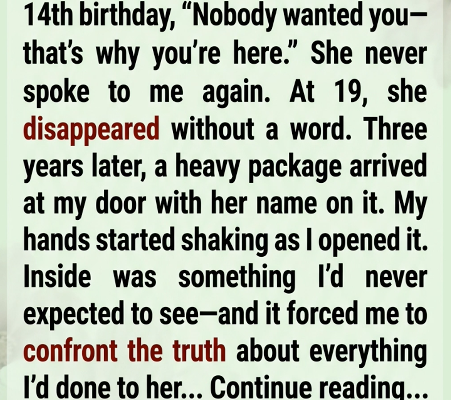
“Nobody wanted you. That’s why you’re here.”
The room went silent.
Her face changed.
She didn’t cry.
She simply looked at me for several seconds, then quietly blew out the candles.
That was the last birthday she ever celebrated with me.
The next morning, she barely spoke.
After school, she stayed in her room.
For weeks, she became quieter.
I’d tell myself she was going through a teenage phase.
I convinced myself she’d get over it.
She didn’t.
At 19, she disappeared.
No goodbye.
No note.
Nothing.
I called her phone.
Disconnected.
I contacted her friends.
Nobody knew where she had gone.
Or perhaps they knew and simply didn’t want to tell me.
I spent years wondering where I’d failed.
But I rarely allowed myself to think about that birthday.
Because somewhere inside, I knew exactly what I’d done.
Three years after she disappeared, a package arrived at my door.
There was no return address.
Just my daughter’s name written across the label.
My hands started shaking.
I carried the box inside.
It was surprisingly heavy.
I opened it carefully.
The first thing I saw was an old photograph.
It showed my daughter as a little girl.
She was sitting on my lap.
We were both smiling.
I remembered the moment.
I had almost forgotten what it felt like to be that happy together.
Beneath the photograph was a sealed letter.
And underneath that was something that made my heart stop.
A small hospital bracelet.
My daughter’s name was printed on it.
But the date wasn’t her adoption date.
It was the date of her birth.
I opened the letter.
The first sentence said:
“Mom, you once told me nobody wanted me.”
I had to sit down.
She continued:
“For years, I believed you.”
Then:
“I finally found out that wasn’t true.”
My hands began trembling.
She had spent the years after leaving trying to discover where she came from.
Eventually, she’d located the maternity hospital where she’d been born.
She found archived records.
And then she discovered something I’d never known.
Her biological mother hadn’t abandoned her.
She had been 16 years old, frightened, and seriously ill after giving birth.
She had wanted to keep her baby.
But her own parents had arranged the adoption.
The adoption paperwork described it as voluntary.
The truth was more complicated.
I read the next page.
My daughter’s biological mother had been searching for her too.
She had never stopped.
She had kept photographs.
Birthday cards.
A lock of her baby’s hair.
And one letter she had written to my daughter when she was only a few months old.
The letter had never been delivered.
My daughter eventually found it in her biological grandmother’s belongings.
It said:
“I didn’t give you away because I didn’t want you.”
“I gave you away because everyone told me I wasn’t capable of keeping you.”
I covered my mouth.
Then I saw why my daughter had sent me the package.
Inside was a second photograph.
A young woman holding a newborn baby.
The woman was crying.
But she was smiling.
On the back, someone had written:
“She wanted to name her Emma.”
My daughter’s name wasn’t Emma.
I’d chosen her name after adoption.
I suddenly realized how much of her history I’d erased without even meaning to.
I’d told her she wasn’t wanted because I couldn’t give her a better answer.
But there had always been another story.
A mother who wanted her.
A family situation that had taken her away.
And a little girl who had spent years wondering whether anyone had ever chosen her.
Then I found one final envelope.
It contained a copy of a letter my daughter had written to her biological mother.
The first line said:
“I’m safe now.”
Then:
“I was adopted by someone who loved me.”
I stopped reading.
The next line hurt even more:
“But sometimes she made me feel like she regretted choosing me.”
I put the letter down.
For the first time, I understood what my daughter had carried all those years.
I had loved her.
But I’d made her feel unwanted.
Those two things could exist at the same time.
And my love didn’t erase the damage I’d caused.
The final page of my daughter’s letter was addressed directly to me.
It said:
“I don’t know why you said those words on my birthday.”
“Maybe you were angry.”
“Maybe you were tired.”
“Maybe you wanted to hurt me.”
“Whatever the reason, I believed you.”
Then:
“I spent five years thinking I was the child nobody chose.”
“I finally learned that isn’t true.”
“My biological mother wanted me.”
“You chose me.”
“And I need you to understand that choosing me should have been enough.”
I couldn’t stop crying.
Then came the sentence that forced me to confront everything.
“The reason I’m sending this isn’t to punish you.”
“It’s so you can finally understand why I left.”
She explained that she’d needed to get away from the person who had made her believe her existence was a burden.
She had built a life on her own.
She had gone to college.
Found work.
Made friends.
And eventually reconnected with her biological mother.
They had a relationship now.
Not perfect.
Not simple.
But real.
At the bottom of the package was a note.
It said:
“I’m not asking you to find me.”
“I’m not asking you to apologize.”
Then:
“I’m asking you to stop telling yourself that you were a good mother simply because you loved me.”
I stared at those words for a long time.
She was right.
Love isn’t an excuse for cruelty.
Adoption isn’t a debt a child owes you.
And being chosen doesn’t give a parent permission to remind a child that they were once unwanted.
I spent the next several months thinking about that birthday.
The cake.
The candles.
Her question.
“Why did you adopt me?”
There had been so many possible answers.
I could have said:
“Because I saw you and knew you belonged in our family.”
“I wanted to be your mother.”
“I loved you.”
Instead, I chose the cruelest sentence I could have chosen.
“Nobody wanted you.”
A child remembers words like that.
Especially when they come from the person they’re supposed to trust most.
Eventually, I found an address for my daughter.
I didn’t show up.
I didn’t demand to see her.
I wrote a letter.
I told her I was sorry.
Not “sorry you misunderstood.”
Not “sorry if I hurt you.”
Just:
“I was wrong.”
I told her she never owed me gratitude for adopting her.
She never owed me forgiveness.
And she certainly never owed me a relationship.
I told her that being her mother had been a privilege, not a favor she needed to repay.
Then I mailed the letter.
And waited.
Months later, I received a postcard.
There was no return address.
It simply said:
“I read your letter.”
Then:
“I’m not ready yet.”
At the bottom was one more sentence.
“But thank you for finally telling me that I was wanted.”
I cried when I read it.
It wasn’t forgiveness.
Not yet.
But it was something.
A door that wasn’t completely closed.
I kept the package exactly as she had sent it.
The photograph.
The hospital bracelet.
The letters.
Everything.
Not because I wanted to punish myself.
Because I never wanted to forget the lesson.
My daughter had spent years believing nobody wanted her.
The truth was that at least one person had wanted her desperately.
Her biological mother.
And another person had chosen to raise her.
Me.
But I had taken that beautiful truth and twisted it into something ugly.
I had made her feel like adoption was evidence that she was unwanted.
When it should have been proof of the opposite.
I don’t know whether my daughter will ever come home.
Maybe she won’t.
Maybe we’ll rebuild our relationship slowly.
Maybe we’ll only exchange letters.
I’ve learned not to demand an ending from someone whose trust I broke.
But I know this:
I cannot undo the words I said when she was 14.
I cannot return the birthdays she spent believing them.
I cannot erase the years she spent wondering whether she was a burden.
What I can do is finally tell the truth.
She was never unwanted.
She was never a burden.
And being adopted was never something she should have been ashamed of.
The shame belonged to the adult who used her deepest insecurity against her.
That adult was me.
When I first opened that heavy package three years after my daughter disappeared, I thought I would find an accusation.
Instead, I found a hospital bracelet, photographs, letters, and the truth about a young mother who had loved her baby but hadn’t been allowed to keep her.
I also found the truth about myself.
I had spent years telling myself that I had saved a little girl.
But that wasn’t the whole story.
She had given me the chance to become a mother.
And on her 14th birthday, I made that gift feel like a punishment.
My daughter left because she needed to discover that she had always been worthy of love.
And when she finally did, she sent me the evidence.
The last line of her letter said:
“Mom, I spent years believing nobody wanted me.”
“Please spend the rest of your life remembering that I was never the unwanted child.”
“I was the child you were lucky enough to be chosen to raise.”