The first time I saw my mother behind prison glass, I was fourteen years old.
She picked up the telephone.
So did I.
For nearly a minute, neither of us spoke.
Finally she smiled.
“You’ve grown.”
I didn’t answer.
The newspapers had already convinced me I knew exactly who she was.
The woman who murdered my father.
The woman who destroyed our family.
The woman the jury had sentenced to death.
I wasn’t there to forgive her.
I was there because my aunt insisted I’d regret never seeing her again.
Before the visit ended, my mother pressed her hand against the glass.
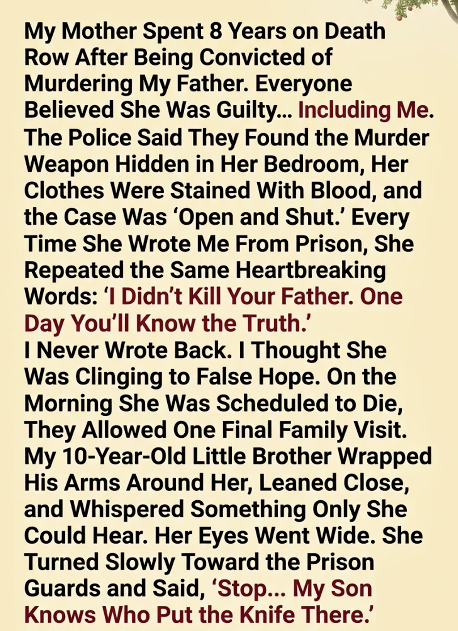
“I didn’t kill your father.”
“One day you’ll know the truth.”
I hung up without saying a word.
According to the police, the case had been simple.
My father was found stabbed to death in our kitchen.
The murder weapon—a large chef’s knife—was recovered from a storage box in my mother’s bedroom closet.
Her clothing contained blood matching my father’s DNA.
Neighbors reported hearing them arguing earlier that evening.
The prosecutor called it an “open-and-shut case.”
The jury agreed.
Every television station repeated the same story.
My mother had murdered her husband during a violent argument.
Case closed.
Only one person never changed her story.
My mother.
Every letter she sent over the next eight years ended exactly the same way.
“I didn’t kill your father.”
“I love you.”
“One day you’ll know the truth.”
I never answered.
Not once.
Each envelope remained unopened in a cardboard box in my closet.
My younger brother, Noah, was only two when our father died.
He barely remembered life before prison visits.
Unlike me, he visited our mother regularly with our aunt.
He always came home saying the same thing.
“Mom tells the truth.”
I dismissed it.
“You’re too young to understand.”
Maybe I was the one who didn’t.
Eight years later, the execution date was set.
The prison notified our family that we could have one final visit.
I almost didn’t go.
Then something inside me whispered that if I refused this last chance, I’d never be able to ask another question for the rest of my life.
The visitation room was quiet.
No glass this time.
Just a plain table.
Two correctional officers.
A prison chaplain.
My mother looked older than her age.
Gray streaks crossed her hair.
Deep lines surrounded her eyes.
But when she smiled at us…
I saw the woman who used to braid my hair before school.
For a few minutes we talked about ordinary things.
The weather.
My job.
Noah’s grades.
No one mentioned tomorrow.
When the visit was almost over, Noah—now ten years old—walked over and hugged her tightly.
He leaned close and whispered something only she could hear.
I watched my mother’s expression change instantly.
Her eyes widened.
She looked toward the officers.
“Please…”
“You have to stop.”
Everyone froze.
“My son knows who put the knife in my room.”
The room fell silent.
One of the officers immediately called the prison warden.
The execution was temporarily delayed while officials determined whether there was credible new information.
Within hours, investigators interviewed Noah.
At first, I couldn’t understand how a ten-year-old could possibly know anything about a crime that had happened eight years earlier.
Then Noah explained.
A week earlier, while helping our elderly aunt clean the attic, he’d found an old cassette recorder inside one of our father’s boxes.
Curious, he’d played it.
The tape contained recordings our father had made while testing a small voice recorder he used for work.
Most of it was ordinary.
Family conversations.
Shopping lists.
Random notes.
Then, near the end…
There was one recording from the night he died.
The quality was poor.
Voices faded in and out.
But investigators could distinguish several things.
My parents arguing.
A loud crash.
Another man’s voice.
My father shouting,
“What are you doing here?”
Then silence.
The recording ended abruptly.
The existence of an unidentified third voice raised immediate questions that had never been explored during the original investigation.
The state court granted a stay of execution.
Not because my mother had been declared innocent.
But because the new evidence warranted further review.
The conviction was no longer beyond question.
Over the following months, defense attorneys and prosecutors jointly requested additional forensic testing using techniques unavailable at the time of the original trial.
The knife, clothing, and other preserved evidence were reexamined.
Investigators also reviewed old witness statements that had received little attention years earlier.
One overlooked detail changed everything.
A partial fingerprint recovered from the knife handle had originally been considered too incomplete for identification.
Advances in forensic analysis now allowed experts to compare it more accurately.
It did not belong to my mother.
It matched a man with a lengthy criminal history who had worked briefly with my father years before.
Further investigation revealed he had been attempting to extort money from my father over a financial dispute.
He had died several years earlier in an unrelated incident.
The case against him could never be tried.
But the evidence dramatically altered the understanding of what had happened that night.
The blood on my mother’s clothing was consistent with someone trying to help an injured spouse after the attack.
Not necessarily with being the attacker.
The prosecution acknowledged that, in light of the new evidence, confidence in the original conviction had been undermined.
The court vacated the conviction.
After eight years on death row…
My mother walked out of prison.
The hardest part wasn’t rebuilding her life.
It was rebuilding ours.
One afternoon, I finally opened the box of letters I’d refused to read.
The first one began,
“I know you’re angry.”
“You have every right to be.”
“But I hope one day you’ll give yourself permission to ask questions before accepting someone else’s answers.”
Every letter ended the same way.
“I love you.”
Not once did she criticize me for believing the verdict.
Not once did she ask why I never wrote back.
Months later, I apologized.
“I failed you.”
She gently shook her head.
“You were a child.”
“You trusted the adults around you.”
“I should have trusted you.”
She reached across the table and held my hand.
“We both lost eight years.”
“Let’s not lose another one.”
People often ask me what lesson I took from everything that happened.
It’s not that every conviction is wrong.
Most are not.
It’s not that every person who claims innocence is telling the truth.
Some are, and some are not.
My lesson is simpler.
Certainty can be dangerous when it leaves no room for questions.
Justice is strongest when it remains willing to examine new evidence with honesty and humility.
The day my mother walked free, she didn’t celebrate.
She simply stood outside the prison gates, closed her eyes, and took a long breath.
Then she looked at Noah and smiled.
“The truth,” she whispered, “may arrive late.”
“But it’s always worth waiting for.”