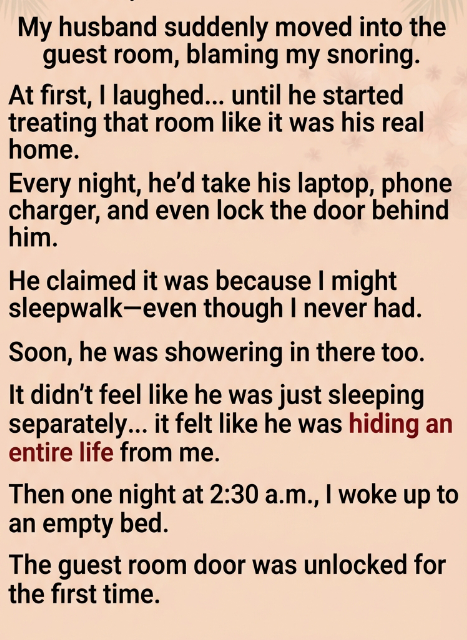
When my husband first suggested sleeping in the guest room, I honestly thought he was joking.
We had been married for twenty-nine years.
We’d survived raising two children, job losses, my father’s illness, and his back surgery.
Sleeping in separate rooms had never even crossed our minds.
Then one evening, after rubbing his tired eyes, he quietly said,
“Babe… I love you.”
“But your snoring has gotten really bad.”
I laughed.
“I don’t snore.”
He smiled apologetically.
“You do.”
“I’m exhausted.”
“I just want to see if sleeping separately helps.”
It seemed reasonable.
I even joked that maybe we’d appreciate each other more after a little space.
For the first few nights, everything felt normal.
He carried a pillow into the guest room.
Closed the door.
Went to sleep.
Then things began changing.
Every evening, he’d carry his laptop in there.
His phone charger.
A stack of folders from work.
A small desk lamp.
One weekend he moved his favorite coffee mug into the room.
Then his shaving kit.
Then fresh towels.
One morning I noticed he’d started keeping clean clothes in the closet.
“What are you doing?” I laughed.
“Moving in?”
He smiled awkwardly.
“It’s just easier.”
A week later, I heard the lock click.
The guest room door had never been locked before.
When I asked why, he shrugged.
“I read that some people sleepwalk without realizing it.”
I stared at him.
“I’ve never sleepwalked.”
“I know.”
“I just sleep better knowing the door’s locked.”
The explanation made no sense.
But I let it go.
Then he started showering in the guest bathroom.
Charging every device in there.
Even eating breakfast at the small desk before work.
It no longer felt as though he slept in the guest room.
It felt as though he lived there.
I began wondering all the terrible things spouses wonder.
Was he having an online affair?
Gambling?
Hiding debt?
Planning to leave?
Every innocent explanation seemed less believable than the last.
One night I even stood outside the door after he’d gone to bed.
I could hear him talking.
Very softly.
Then silence.
When I asked the next morning who he’d been speaking to, he answered immediately.
“No one.”
“You must’ve heard the television.”
There was no television in the guest room.
My stomach twisted.
For nearly two months, I lived with growing suspicion.
I hated the person I was becoming.
Checking credit card statements.
Watching his expressions.
Wondering if every late smile at his phone meant another secret.
Then came the night that changed everything.
I woke around 2:30 a.m.
The house was unusually quiet.
His side of my bed was, of course, empty.
I walked toward the guest room.
Something felt different.
The door wasn’t locked.
For the first time in weeks.
I gently turned the handle.
It opened without a sound.
The room was dimly lit by a small desk lamp.
My husband sat at the desk wearing headphones.
His laptop was open.
He hadn’t noticed me.
I prepared myself for the worst.
Another woman.
Secret bank accounts.
Divorce papers.
Instead…
I saw dozens of photographs covering the wall.
Pictures of me.
From every stage of our marriage.
Our wedding day.
Holding our newborn daughter.
Laughing while covered in flour after a disastrous attempt at homemade bread.
Dancing barefoot in the kitchen.
Gardening.
Reading on the porch.
Growing older together.
Beside the photographs sat notebooks.
Stacks of handwritten pages.
An old cassette recorder.
And a microphone.
I accidentally gasped.
He turned.
Pulled off the headphones.
His face went completely pale.
“I can explain.”
I looked around the room.
“What is all this?”
He closed the laptop slowly.
Then buried his face in his hands.
Three months earlier, he’d been diagnosed with early-stage Parkinson’s disease.
I felt the air leave my lungs.
“What?”
He nodded quietly.
“The tremors started in my left hand.”
“I thought it was stress.”
“The neurologist confirmed it.”
I sat down without realizing it.
“Why didn’t you tell me?”
He looked at the photographs.
“Because I wasn’t ready.”
The guest room hadn’t become his refuge from my snoring.
It had become his refuge from his fear.
He opened one of the notebooks.
Every page contained memories.
The date we met.
Our honeymoon.
Funny stories about our children.
Recipes I’d taught him.
Vacations.
Inside jokes.
Tiny details most people would never think to record.
“I’ve been writing everything down.”
“Why?”
He swallowed.
“The doctor said most people with Parkinson’s never develop dementia.”
“But some do.”
“I became terrified I’d forget pieces of our life.”
He opened another folder.
Inside were video recordings.
Hundreds of them.
Me watering flowers.
Laughing during board games.
Reading bedtime stories to our grandchildren.
Cooking dinner.
“Every night after you fell asleep…”
“…I’d organize them.”
“I wanted a place where our whole life lived.”
My eyes filled with tears.
“The headphones?”
“I’ve been recording myself.”
He pressed play on one audio file.
His voice filled the room.
If you’re listening to this someday, and my memory isn’t what it used to be… this is your wife.
Her name is Laura.
She likes extra cinnamon in her oatmeal.
She laughs with her whole shoulders.
She pretends she doesn’t like old country songs, but she knows every word.
I couldn’t stop crying.
He continued.
“I recorded one every night.”
“So if I ever forget…”
“…maybe I could learn you all over again.”
I looked at the locked door.
“The lock?”
He smiled sadly.
“I didn’t want you walking in while I was crying.”
The shower?
“My medications sometimes make me nauseated.”
“I didn’t want you worrying.”
The laptop?
“I’ve been scanning every photograph we own.”
The coffee mug?
“I was spending hours in here.”
The phone charger?
“I often stayed up until sunrise.”
Every suspicious clue I’d collected suddenly became evidence of something entirely different.
Not betrayal.
Preparation.
Fear.
Love.
“I thought you were hiding another life.”
He reached for my hand.
“I was.”
“The life I was trying to save.”
The next morning, we canceled every plan we had.
We spent the entire day talking.
No more secrets.
No more pretending.
That weekend we transformed the guest room together.
The photographs stayed.
The notebooks stayed.
The recordings stayed.
But we added something else.
A second chair.
Every evening after dinner, we sat there together.
Sometimes organizing old photographs.
Sometimes recording stories for our grandchildren.
Sometimes simply laughing about memories before either of us forgot the little details.
Months later, I asked him one question that had been lingering in my heart.
“Why were almost all the pictures of me?”
He smiled.
“Because I see myself every day.”
“I was afraid one day I might stop recognizing the woman who gave me the best life I could’ve ever hoped for.”
Years have passed since that night.
The diagnosis changed many things.
It didn’t change us.
The guest room is still there.
The door is never locked anymore.
Sometimes we sleep in separate rooms when one of us snores.
Sometimes we don’t.
But every night before bed, we spend a few minutes in that little room, adding another page, another photograph, another memory.
Because my husband taught me something I’ll carry for the rest of my life.
The greatest love stories aren’t written only in the years we remember perfectly.
They’re written in the effort we make to keep remembering each other, no matter what tomorrow brings.
And every time I look at that once-mysterious guest room, I no longer see a place where my husband hid from me.
I see the room where he quietly fought to make sure that, even if illness someday stole pieces of his memory, it would never steal the story of our life together.