When my husband, Robert, passed away after thirty-seven years of marriage, the silence became the hardest part.
People often think grief is loud.
It’s not.
It’s the quiet that hurts the most.
The empty chair across the breakfast table.
The second coffee mug you stop reaching for.
The sound of the garage door that no longer opens at six o’clock every evening.
For months, I tried to convince myself I was managing just fine.
I paid the bills.
I watered the flowers Robert had planted.
I smiled politely whenever neighbors asked how I was doing.
“I’m alright,” I always answered.
It was easier than telling the truth.
The truth was that even simple things had become exhausting.
Mowing the lawn felt impossible.
Dragging the trash bins to the curb left my back aching.
Changing a lightbulb suddenly seemed like climbing a mountain.
One Saturday morning, a neighbor recommended a local teenager named Caleb.
“Quiet kid,” she said.
“But dependable.”
The following weekend, an old pickup truck stopped in front of my house.
A tall, skinny boy climbed out carrying a worn lawn mower.
He couldn’t have been older than sixteen.
“Mrs. Harper?”
“Yes.”
“I’m Caleb.”
“I can start whenever you’re ready.”
There wasn’t much else to the conversation.
He mowed the lawn carefully, trimmed the edges, swept the driveway clean, accepted his payment with a polite “Thank you,” and left.
The next week, he returned at exactly the same time.
Then the next.
Always on time.
Always respectful.
Always quiet.
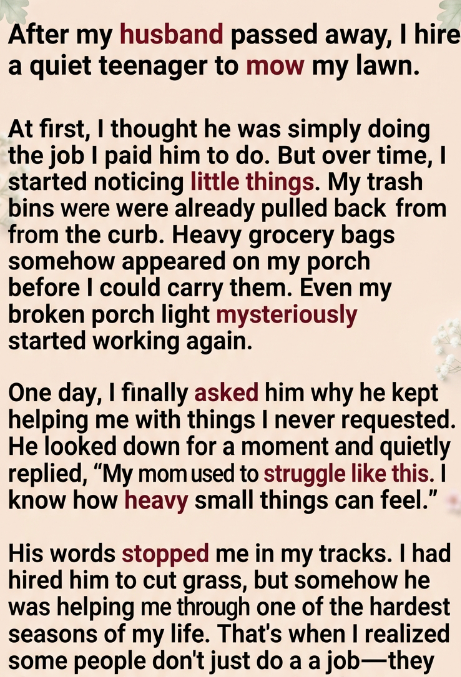
At first, I assumed he was simply doing what I’d hired him to do.
Then little things started happening.
One Tuesday evening, I noticed my trash bins had already been pulled back from the curb.
I figured a neighbor had done it.
A few days later, I struggled with several grocery bags.
By the time I unlocked my front door, they were already sitting neatly on my porch.
I turned around.
Caleb was walking back across the yard.
“You didn’t have to do that,” I called.
He smiled slightly.
“They looked heavy.”
Before I could thank him, he climbed into his truck and drove away.
The following week, my porch light stopped working.
I bought a new bulb but couldn’t figure out why it still wouldn’t turn on.
The next morning, it worked perfectly.
There was no note.
No mention of it.
Only later did I notice a small replacement switch tucked neatly into the trash can.
He’d quietly fixed it.
When autumn arrived, leaves began covering my front walkway.
One afternoon I looked outside to find Caleb raking them into neat piles.
“It isn’t even mowing season anymore,” I said.
He shrugged.
“I was nearby.”
Every time I tried paying him extra, he politely refused.
“It’s okay.”
One rainy afternoon, after he finished cleaning the gutters, I finally stopped him before he reached his truck.
“Caleb.”
He turned.
“Can I ask you something?”
“Sure.”
“Why do you keep helping me with things I never ask you to do?”
He looked down at his work gloves for several seconds.
Then he answered quietly.
“My mom used to struggle like this.”
I waited.
“When my dad left, she worked two jobs.”
“I’d come home from school and find her trying to carry groceries, mow the yard, fix broken things…”
He swallowed.
“I remember wishing someone would notice.”
“Most people didn’t.”
“So now…”
“…when I notice…”
“…I just help.”
His words caught somewhere deep inside me.
I wasn’t crying because of the groceries.
Or the lightbulb.
Or the trash bins.
I was crying because someone had quietly seen how hard life had become without making me feel embarrassed about it.
From that day forward, our conversations became a little longer.
I learned Caleb loved history.
Wanted to study engineering.
Worked weekends to help his mother pay bills.
One afternoon I asked if he’d stay for lunch.
At first he hesitated.
Then he accepted.
Over grilled cheese sandwiches and tomato soup, we talked for nearly two hours.
He reminded me so much of my grandson, who lived three states away.
Not because they looked alike.
Because they listened the same way.
Over the next year, Caleb became part of my routine.
He never crossed boundaries.
He never expected anything beyond the work I hired him to do.
But somehow he always appeared when something needed doing.
When winter came, my driveway was mysteriously shoveled before sunrise.
When spring returned, flowers bloomed in garden beds I hadn’t had the energy to tend.
He always insisted,
“I was already here.”
The summer before his senior year of high school, he stopped by looking unusually nervous.
“I got accepted.”
“Accepted where?”
“The state university.”
His eyes lit up for the first time since I’d known him.
“But…”
“The tuition’s still a lot.”
That evening, after he left, I opened the cedar chest where Robert and I had kept our savings for “something meaningful.”
Years earlier, we’d promised each other that if we ever had the chance to help a young person build a better future, we’d do it.
The next week, I invited Caleb and his mother over for dinner.
After dessert, I handed him a small envelope.
Inside was a scholarship check.
Not enough to cover everything.
But enough that he could begin college without taking on another job during his first semester.
He stared at the paper.
“I can’t accept this.”
I smiled.
“You already have.”
“What do you mean?”
“You’ve been paying me back for months.”
“I have?”
“Every time you carried groceries.”
“Every trash bin.”
“Every lightbulb.”
“You reminded me that kindness still exists.”
His mother quietly wiped away tears.
Years later, Caleb graduated with an engineering degree.
He was the first person in his family to finish college.
At his graduation party, he introduced me to everyone simply as,
“This is Mrs. Harper.”
Then he smiled.
“The woman who believed in me before I believed in myself.”
I laughed.
“No.”
“You had that backwards.”
Because the truth was, I hired a teenager to mow my lawn.
Instead, he helped restore something far more important than my yard.
He reminded a grieving widow that compassion isn’t measured by grand gestures.
Sometimes it’s a porch light quietly repaired.
A trash bin returned to the garage.
A heavy bag carried without being asked.
Or a simple sentence spoken by someone who understands exactly how heavy the smallest things can feel.
And sometimes, the people who change our lives don’t arrive with speeches or promises.
They arrive with work gloves, a lawn mower, and a heart that remembers what it once needed most.