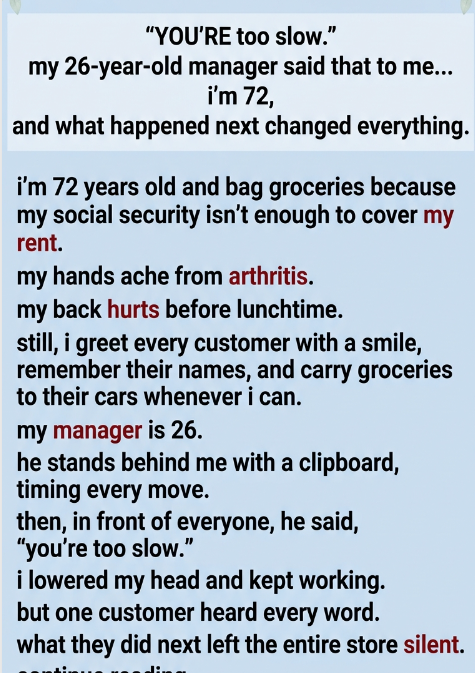
At seventy-two years old, I never imagined I’d be bagging groceries.
I’d worked for forty-three years in a machine shop before it closed.
My pension disappeared when the company went bankrupt.
My Social Security check covered most of my bills—but not all of them.
So I found work at the neighborhood grocery store.
It wasn’t glamorous.
But it was honest.
My hands ached from arthritis.
My back reminded me of my age before noon every day.
Even so, I greeted every customer by name whenever I could.
I remembered whose husband was recovering from surgery.
Which little boy loved dinosaur stickers.
Which elderly couple needed help loading groceries into their trunk.
People often told me I reminded them of their grandfather.
That meant more than they probably realized.
My manager, Tyler, was twenty-six.
He believed everything could be measured with a stopwatch.
He carried a clipboard everywhere.
Every bag.
Every customer.
Every minute.
Nothing escaped his attention.
One Saturday afternoon, the checkout lanes were packed.
I carefully placed eggs on top of the bread and separated cleaning products from fresh vegetables.
Just as I’d always been taught.
Tyler walked behind me, glanced at his timer, and sighed loudly.
“In front of everyone,” he said,
“You’re too slow.”
The line went quiet.
I felt every pair of eyes on me.
I lowered my head.
“I’m doing my best.”
He shook his head.
“Your best isn’t fast enough.”
Before I could answer, the customer standing at the register spoke.
“No.”
Everyone turned toward her.
She looked to be in her early fifties.
She placed a hand on my shoulder.
“He’s not slow.”
“He’s careful.”
Tyler crossed his arms.
“We have performance standards.”
She smiled politely.
“I understand.”
Then she reached into her purse and handed him a business card.
The color drained from his face.
He read it twice.
The woman introduced herself.
“My name is Linda Harris.”
“I’m the regional vice president.”
The entire front end of the store became silent.
“I wasn’t here for an inspection,” she continued.
“I was buying groceries for my father.”
“But I just watched one of your employees humiliate another employee in front of customers.”
She turned toward me.
“Sir, how long have you worked here?”
“Almost six years.”
“And have you always helped customers to their cars?”
“If they need me.”
She nodded.
“I noticed.”
She looked back at Tyler.
“I also noticed that every customer in this line smiled when he greeted them.”
An older gentleman waiting behind Linda raised his hand.
“He helped my wife after her hip surgery.”
Another woman added,
“He carries my groceries every Tuesday.”
A young mother spoke next.
“My son waits for his dinosaur stickers.”
Soon, people throughout the checkout area began sharing their own stories.
How I’d helped them reach heavy items.
Walked them through the rain.
Carried groceries without ever being asked.
Remembered birthdays.
Asked about sick family members.
Tyler stood speechless.
Linda quietly said,
“Speed matters.”
“But kindness matters too.”
She asked me one final question.
“If you weren’t rushing to beat a timer, how long would it take to bag groceries correctly?”
I smiled.
“About twenty extra seconds.”
She laughed softly.
“I think our customers can spare twenty seconds.”
The following week, Linda returned.
Not to fire anyone.
To hold a meeting.
The store introduced new customer-service training that balanced efficiency with care.
Performance reviews would no longer focus only on speed.
They would also include customer feedback, teamwork, and professionalism.
Tyler approached me after the meeting.
“I owe you an apology.”
I looked at him.
“I thought managing people meant pushing them harder.”
“I forgot it also means respecting them.”
I accepted his apology.
Over the next year, he changed.
He stopped carrying the clipboard through the checkout lanes.
Instead, he started helping bag groceries during busy hours.
One afternoon, he quietly asked me,
“How do you remember everyone’s names?”
I smiled.
“I pay attention.”
He nodded.
“I’m trying to learn that.”
A few months later, our store received the company’s highest award for customer satisfaction.
Linda attended the celebration.
During her speech, she pointed toward me.
“This store reminded us that the fastest service isn’t always the best service.”
“People rarely remember how quickly you bagged their groceries.”
“They remember how you made them feel.”
I retired the following spring.
On my last day, customers filled an entire bulletin board with handwritten notes.
One simply read:
“You never made me feel like just another customer.”
I still keep that card in my desk drawer.
Because after all these years, I’ve learned something important.
Growing older may slow your hands.
It may slow your steps.
But kindness never becomes outdated.
And the people who truly understand the value of work know that character can never be measured with a stopwatch.