When my husband, Daniel, died in a car accident, my entire world collapsed.
He was only thirty-eight.
Our daughter, Audrey, had just turned seven.
At first, Daniel’s wealthy parents promised they would always help us.
“We’re family,” my mother-in-law, Patricia, said at the funeral.
But those promises disappeared within months.
The financial help stopped.
The phone calls became rare.
Birthday invitations vanished.
Eventually, it felt as though Audrey and I had become strangers to them.
I took every job I could find.
Morning shifts at a grocery store.
Evening office cleaning.
Weekend catering.
Finally, I accepted a full-time position as a janitor at a prestigious private school.
The pay was steady.
The health insurance mattered.
And every afternoon, I was home before Audrey finished school.
I never felt ashamed of honest work.
But Daniel’s family did.
Whenever they asked what I did, their expressions changed.
“Oh,” Patricia would say.
“You clean bathrooms now.”
As if those three words defined my entire worth.
One spring, Patricia invited us to Easter dinner.
I almost declined.
But Audrey missed her grandparents.
So we went.
Their dining room looked exactly as I remembered—fine china, crystal glasses, expensive flowers.
During dessert, Patricia smiled sweetly.
“So…”
She looked directly at me.
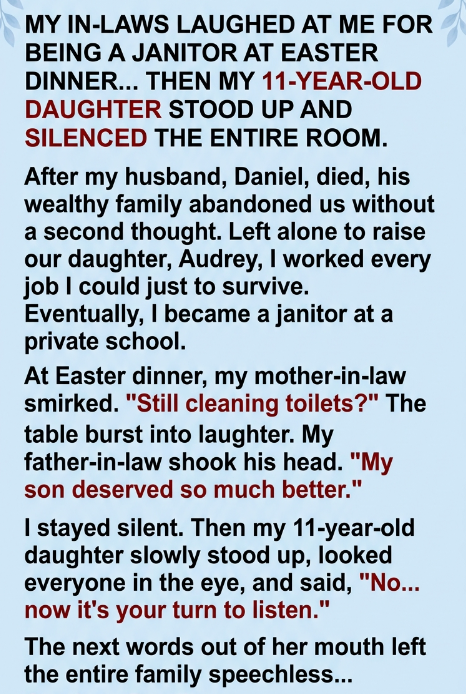
“Still cleaning toilets?”
Several people laughed.
My father-in-law took a sip of wine.
“My son worked so hard to build a good life.”
“He deserved so much better.”
More laughter.
Someone quietly added,
“What a waste of his education.”
I looked down at my plate.
Not because I was embarrassed.
Because I didn’t want Audrey to see how much it hurt.
Then I heard a chair scrape across the floor.
Audrey stood up.
She was only eleven.
But in that moment, she looked taller than anyone else in the room.
She looked directly at her grandmother.
“No.”
The room fell silent.
She took a deep breath.
“Now it’s your turn to listen.”
No one interrupted.
“My mom gets up before sunrise every day.”
“She works until her hands hurt.”
“She comes home and still helps me with homework.”
“She never misses my soccer games.”
“She reads to me every night.”
She turned toward her grandfather.
“You say Grandpa deserved better?”
“My dad used to tell me something before he died.”
Everyone froze.
“He said if anything ever happened to him, Mom would be the strongest person I’d ever know.”
Tears filled my eyes.
Audrey continued.
“You laugh because she cleans your messes.”
“But every classroom she cleans is where kids learn.”
“Every hallway she mops keeps students safe.”
“Every bathroom she scrubs is one someone else was too proud to clean.”
She looked around the table.
“You think she’s embarrassing?”
“I’m proud that my mom does honest work.”
“What should embarrass you is making fun of someone who works harder than anyone here.”
No one spoke.
Not a single word.
Even the children at the table stared quietly.
Finally, Audrey reached into her backpack.
“I brought something.”
She placed a folded piece of paper in front of Patricia.
It was a school essay titled:
“My Hero.”
Patricia unfolded it.
The first sentence read:
“My mom cleans floors so I can chase my dreams.”
By the time she reached the last page, tears were running down her face.
She looked at me.
“I… didn’t know.”
I answered quietly.
“You never asked.”
We left without finishing dessert.
As we walked to the car, Audrey slipped her hand into mine.
“I’m sorry if I embarrassed you.”
I smiled through tears.
“You didn’t embarrass me.”
“You gave me the proudest moment of my life.”
Three months later, something unexpected happened.
The headmaster at the private school where I worked called me into his office.
“I’ve been hearing wonderful things about you.”
Apparently, several teachers had noticed how I stayed after my shift ended to help students who were struggling, organize donated school supplies, and quietly buy lunches for children whose parents couldn’t afford them.
One of those teachers had recommended me for a newly created position as the school’s family support coordinator.
It came with better hours, a private office, full benefits, and nearly double my previous salary.
When I told Audrey, she hugged me so tightly I could barely breathe.
“I knew someone would notice.”
Months later, Patricia asked if we would meet for lunch.
She apologized.
Not with excuses.
Not with explanations.
Just an apology.
“I confused wealth with worth.”
“I was wrong.”
I accepted her apology.
But trust takes much longer to rebuild than words.
Today, I still keep Audrey’s essay in a frame above my desk.
Whenever life gets difficult, I read the last line.
“Some people wear suits to work. My mom wears gloves and carries a mop. Either way, she spends every day making the world better for someone else.”
I’ve received promotions.
Awards.
Raises.
But nothing I’ve ever earned has meant more to me than hearing my daughter stand in a room full of adults and remind them of something they had forgotten.
There is no shame in honest work.
The only shame is looking down on the people who do it.