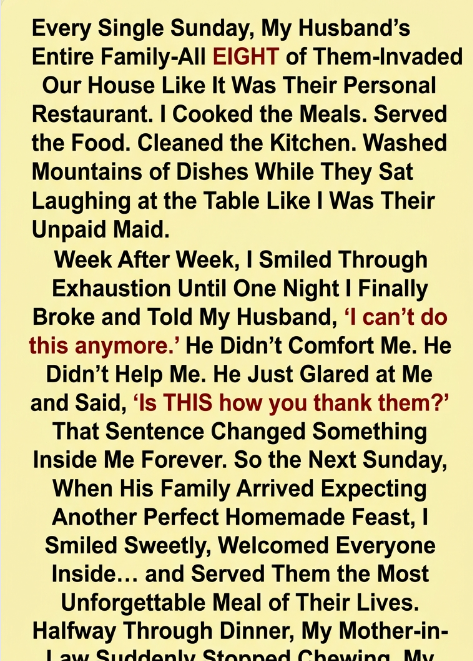
Every single Sunday, my house stopped feeling like my home.
By eleven in the morning, my husband’s parents, his two brothers, their wives, and their three teenage children would arrive carrying nothing but their appetites.
Eight guests.
Every week.
Without fail.
I cooked everything.
Roast chicken.
Lasagna.
Homemade bread.
Fresh salads.
Desserts from scratch.
While they laughed in the living room watching football, I stood in the kitchen for five or six hours.
By the time dinner ended, they leaned back in their chairs talking and joking while I scraped plates, loaded the dishwasher, washed oversized pots by hand, and wiped down every counter.
Not once in seven years did anyone ask,
“Can I help?”
My husband certainly never did.
He’d kiss his mother on the cheek, grab a drink, and disappear into the family conversation as if dinner had magically appeared on the table.
One Saturday night, I finally reached my limit.
“I can’t keep doing this,” I told him quietly.
“I’m exhausted.”
He barely looked up from his phone.
“Our house is the only one big enough.”
“I know.”
“But why does all the work have to be mine?”
That’s when he said the sentence that changed everything.
“My family helped us buy this house.”
“Is this how you thank them?”
I stared at him.
Not because I was angry.
Because I suddenly understood exactly how little he valued everything I did.
I didn’t argue.
I simply smiled.
“You’re right.”
The next Sunday morning, I woke up unusually calm.
I cooked every dish they loved.
The roast came out perfectly.
The potatoes were golden.
Dessert looked beautiful.
When everyone arrived, they complimented the smell filling the house.
My mother-in-law smiled proudly.
“I knew you’d spoil us.”
“Oh, absolutely,” I replied.
Dinner began exactly as always.
Everyone filled their plates.
Laughed.
Complimented the food.
Halfway through the meal, my mother-in-law suddenly stopped chewing.
She frowned.
“What is this?”
She had found a folded piece of paper beneath her dinner plate.
Then everyone noticed the same thing.
Every plate had an envelope underneath it.
My husband laughed awkwardly.
“What are these?”
I stood up.
“They’re this week’s dessert.”
Curious, everyone opened their envelopes.
Inside each one was an itemized invoice.
Sunday Dinner Labor Statement
Meal planning: 2 hours.
Shopping: 2 hours.
Cooking: 5 hours.
Serving.
Cleaning.
Laundry.
Dishwashing.
Kitchen sanitizing.
Total labor:
12.5 hours.
Hourly rate:
$25.
Balance due:
$312.50.
Each envelope showed a different amount based on how many meals each household had enjoyed over the past year.
My father-in-law looked stunned.
“Is this some kind of joke?”
I smiled politely.
“No.”
“It’s simply a record of work that everyone assumed was free.”
My husband slammed his envelope onto the table.
“You’ve embarrassed everyone.”
I calmly looked around the room.
“Have I?”
“Or have I finally made invisible work visible?”
No one answered.
I continued.
“For seven years…”
“…I’ve hosted more than three hundred Sunday dinners.”
“I’ve cooked over two thousand individual meals.”
“I’ve spent thousands of hours making sure everyone felt welcome.”
“I’ve never asked for money.”
“I only wanted appreciation.”
I looked directly at my husband.
“I asked for help once.”
“You told me I owed your family because they helped us buy this house.”
Then I placed one final envelope in the center of the table.
It was addressed to everyone.
Inside was a calendar.
Beginning the following Sunday, every family was assigned one week to host dinner.
My mother-in-law frowned.
“But our kitchen isn’t big enough.”
I smiled.
“Neither was mine.”
One of my sisters-in-law quietly laughed.
Then another.
Finally, my youngest brother-in-law spoke.
“You know…”
“…she’s right.”
He turned toward my husband.
“We’ve taken this for granted.”
My mother-in-law tried to protest.
But before she could, my father-in-law surprised everyone.
He slowly folded his invoice and slipped it into his pocket.
“I should’ve noticed years ago.”
He looked at me.
“I’m sorry.”
Then he stood up, carried his own plate to the kitchen, and began washing it.
For the first time in seven years…
Someone followed him.
Then another.
Within minutes, the kitchen was full.
One person dried dishes.
Another packed leftovers.
Someone wiped counters.
Even the teenagers joined in.
Only my husband remained seated.
Later that evening, after everyone had left, he quietly asked,
“Was this really necessary?”
I nodded.
“No.”
“What was necessary…”
“…was for someone to notice before I stopped feeling at home in my own house.”
The following Sunday, dinner wasn’t at our house.
It was at my brother-in-law’s.
The food wasn’t perfect.
The roast was overcooked.
Dessert came from a bakery.
No one cared.
Because everyone brought something.
Everyone cleaned.
Everyone laughed.
Together.
Months later, my mother-in-law admitted something I’d never expected.
“I honestly thought you enjoyed doing all of it.”
I smiled gently.
“I enjoyed feeding people.”
“I didn’t enjoy being invisible.”
Today, Sunday dinners still happen.
Just not in my kitchen every week.
Looking back, I realized I never wanted revenge.
I never wanted anyone to feel guilty.
I simply wanted the people I loved to understand one simple truth.
A meal isn’t made by magic.
Someone plans it.
Someone cooks it.
Someone cleans up afterward.
And sometimes…
The most unforgettable thing you can serve at the dinner table…
…is a lesson in gratitude.