The day my parents threw me out, I was sixteen years old.
They didn’t yell.
They didn’t cry.
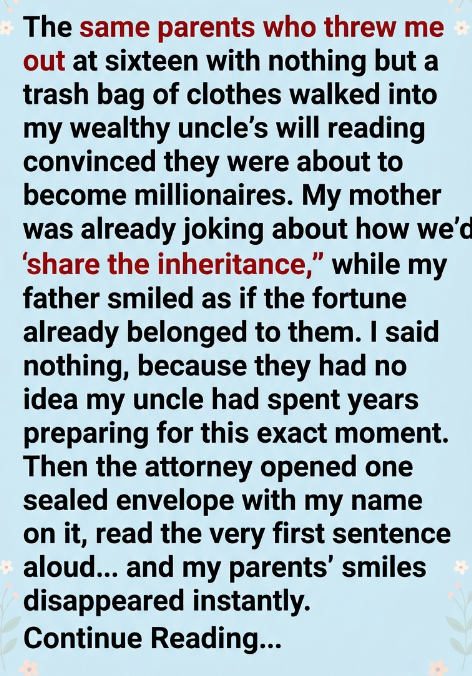
My mother stuffed my clothes into a black trash bag, handed it to me, and pointed toward the front door.
“If you think you’re old enough to make your own decisions,” she said, “then you can figure life out yourself.”
My father didn’t stop her.
He didn’t even look at me.
I spent that night sleeping on a friend’s couch.
The next afternoon, my great-uncle Robert found out what had happened.
He drove two hours without calling first.
When he saw me carrying that trash bag, he hugged me so tightly I could barely breathe.
“You don’t ever have to earn a place in my home,” he whispered.
“You already have one.”
From that day forward, he became the closest thing I ever had to a parent.
He helped me finish high school.
Paid for community college.
Cheered louder than anyone when I started my own construction company.
Meanwhile, my parents barely contacted me.
Birthdays were forgotten.
Holidays came and went.
The only time they reached out was when they needed money.
Eventually, I stopped answering.
Twenty-two years passed.
Then Uncle Robert died peacefully at eighty-six.
His attorney invited the family to the reading of the will.
When I walked into the conference room, my parents were already there.
My mother wore expensive jewelry she’d never had before.
My father laughed with my cousins as if the money had already been divided.
The moment they saw me, my mother smiled.
“Well, look who finally showed up.”
She leaned toward another relative and whispered loudly enough for everyone to hear,
“We’ll all be sharing the inheritance anyway.”
I simply nodded and took a seat.
There was nothing to argue about.
The attorney cleared his throat and opened the file.
Several small gifts were read first.
Donations to charities.
Scholarships.
A few sentimental items for distant relatives.
Then he paused.
“There is one sealed letter addressed specifically to Mr. Daniel Carter.”
He looked directly at me.
My parents exchanged confused glances.
The attorney broke the seal and began reading aloud.
“To my nephew Daniel…”
“If you’re hearing these words, then I hope you finally understand something I’ve tried to teach you for most of your life.”
“Family isn’t determined by blood.”
“It’s determined by who stays when everyone else walks away.”
The room fell completely silent.
The attorney continued.
“The people who abandoned you at sixteen may be sitting in this room expecting generosity from me.”
“I owe them none.”
My mother’s smile disappeared.
My father slowly leaned forward.
“When they forced a frightened boy out of their home with nothing but a trash bag…”
“…they unknowingly gave me the greatest gift of my life.”
“They gave me a son.”
I felt tears burning behind my eyes.
The attorney reached the final page.
“Therefore, I leave my primary residence, my investment portfolio, my business holdings, and the remainder of my estate to Daniel.”
Gasps filled the room.
My mother shot to her feet.
“This is ridiculous!”
“There must be some mistake!”
The attorney calmly slid another document across the table.
“There isn’t.”
“It also appears Mr. Robert anticipated this reaction.”
He opened a second envelope.
Inside was a notarized statement.
“If anyone contests this will solely because they expected money…”
“…they shall immediately forfeit the modest gifts I have already left them.”
My parents each had been left exactly one dollar.
Nothing more.
My father exploded.
“You manipulated him!”
“You turned him against us!”
The attorney quietly adjusted his glasses.
“Actually…”
“Your brother left behind several journals.”
“He documented your relationship with Daniel over more than twenty years.”
He placed one journal on the table.
Inside were handwritten entries.
Every birthday my parents forgot.
Every graduation they skipped.
Every Christmas Uncle Robert spent making sure I never felt alone.
There were photographs.
Receipts.
Letters.
Even copies of birthday cards he’d mailed me after learning my parents hadn’t called.
No one said another word.
A week later, my parents came to my office.
For the first time in years, they apologized.
Not for throwing me out.
Not for ignoring me.
For losing the inheritance.
My mother reached across my desk.
“We’re still family.”
I looked at her quietly.
“No.”
“We’re related.”
“There’s a difference.”
My father asked if we could start over.
I thought about Uncle Robert for a long moment.
Then I answered honestly.
“Starting over requires acknowledging where things began.”
“You’ve never apologized for the day you ended my childhood.”
They left without another word.
Months later, I used part of the inheritance to establish a scholarship for teenagers who had been abandoned or forced out of their homes.
I named it after Uncle Robert.
At the dedication ceremony, the attorney who had read the will found me afterward.
He smiled.
“Your uncle once told me something I’ll never forget.”
“What was that?”
“He said…”
“The greatest inheritance isn’t money.”
“It’s becoming the person someone believed you could be.”
Looking back, I thought the biggest surprise that day would be the size of Uncle Robert’s fortune.
I was wrong.
The greatest gift wasn’t what he left me.
It was proving that the people who choose to love you…
…can become far more important than the ones who simply share your last name.