My daughter left me a voicemail that sounded almost cheerful.
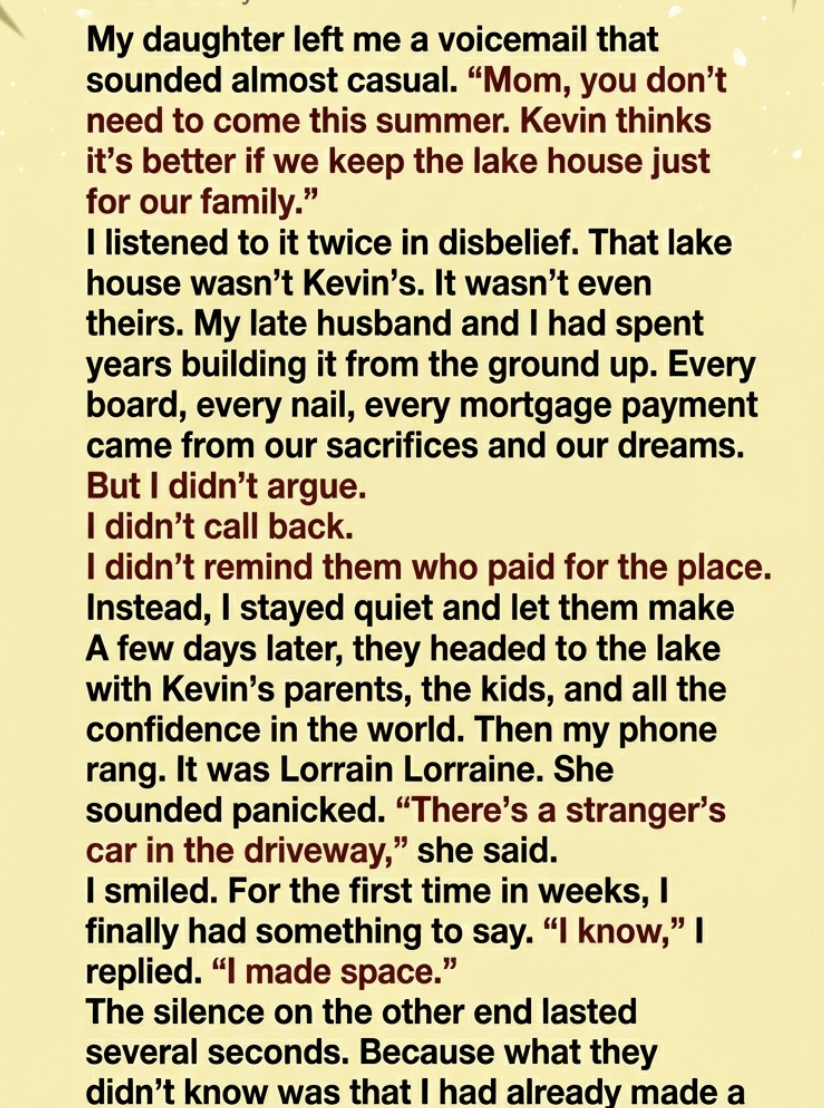
“Mom, you don’t need to come this summer.”
I frowned.
At first, I thought I’d heard her wrong.
Then she continued.
“Kevin thinks it’s better if we keep the lake house just for our family.”
I listened to the message twice.
Then a third time.
Not because I didn’t understand it.
Because I did.
Perfectly.
The lake house.
The one my late husband and I spent fifteen years building.
The one we paid for.
Maintained.
Loved.
The one where my children learned to swim.
The one where we celebrated birthdays, anniversaries, and countless Fourth of July weekends.
Apparently, I was no longer considered part of the family.
At least not according to Kevin.
My son-in-law.
I expected myself to be angry.
Instead, I felt something else.
Disappointment.
The kind that arrives when people reveal who they truly are.
I didn’t call back.
Didn’t argue.
Didn’t remind anyone whose name was on the deed.
I simply stayed quiet.
A few days later, they headed to the lake.
Kevin.
My daughter.
Their children.
Kevin’s parents.
Everyone.
They posted smiling photos online.
Pictures on the dock.
Pictures around the fire pit.
Pictures captioned:
“Family time.”
I noticed I wasn’t in any of them.
Then came the phone call.
It was Lorraine.
Kevin’s mother.
She sounded panicked.
“There’s a strange car in the driveway.”
I smiled.
For the first time in weeks.
“I know.”
Silence.
Then:
“What do you mean you know?”
I looked out my window.
Sipped my coffee.
And answered calmly.
“I made space.”
The silence grew longer.
Because what they didn’t know was that I’d already made a decision.
Two weeks earlier.
The day after the voicemail.
I met with an attorney.
Not out of spite.
Out of clarity.
The lake house had become something I never intended.
A source of entitlement.
A place people treated like an inheritance before I was even gone.
So I changed things.
Legally.
Permanently.
The stranger’s car belonged to the new property manager.
Because the lake house was no longer available for unlimited family use.
It had been transferred into a charitable family retreat foundation.
One dedicated to military widows, foster families, and families facing medical hardship.
Families who needed a place to heal.
To rest.
To reconnect.
The property manager was there to prepare the first guest family’s arrival.
A widow and her two children.
People who actually needed the space.
Not people arguing over ownership they didn’t have.
My daughter called minutes later.
Furious.
“What did you do?”
I stayed calm.
“I protected something your father and I built.”
“You gave away our lake house?”
Our.
That word caught my attention.
I took a deep breath.
“No.”
Then I corrected her.
“I gave away my lake house.”
The line went silent.
For years, I’d paid the taxes.
Covered repairs.
Maintained insurance.
Handled every expense.
Yet somehow everyone had begun acting as if ownership had magically transferred.
It hadn’t.
My daughter started crying.
Not angry tears.
Scared tears.
Then she asked the question she’d probably wanted to ask from the beginning.
“What happens now?”
I looked at a photo of my husband sitting on my desk.
Then smiled.
“The same thing that always should have happened.”
“What does that mean?”
“It means family visits are welcome.”
She sounded relieved.
Until I continued.
“Invited family visits.”
No assumptions.
No entitlement.
No claiming ownership.
Just gratitude.
And respect.
The first Fourth of July after the change felt different.
The retreat hosted its first family.
A young mother whose husband had died overseas.
Her children laughed from the dock exactly the way mine once had.
And for the first time in years, the lake house felt alive again.
Purposeful.
My daughter eventually came around.
Not immediately.
Growth rarely happens immediately.
But over time, she began to understand.
The lake house was never about property.
It was about values.
And somewhere along the way, she’d forgotten that.
Months later, she visited alone.
No Kevin.
No arguments.
Just the two of us.
We sat on the porch watching the sunset.
Finally she whispered:
“I’m sorry.”
I nodded.
Because I knew she meant it.
Then she asked:
“Do you think Dad would approve?”
I looked across the water.
And smiled.
“Your father always believed blessings should be shared.”
The lake house still stands today.
The same dock.
The same trees.
The same memories.
But now it creates new memories too.
And every time I see a family enjoying it, I remember something important.
The greatest legacy isn’t leaving people property.
It’s teaching them gratitude before they inherit anything at all.