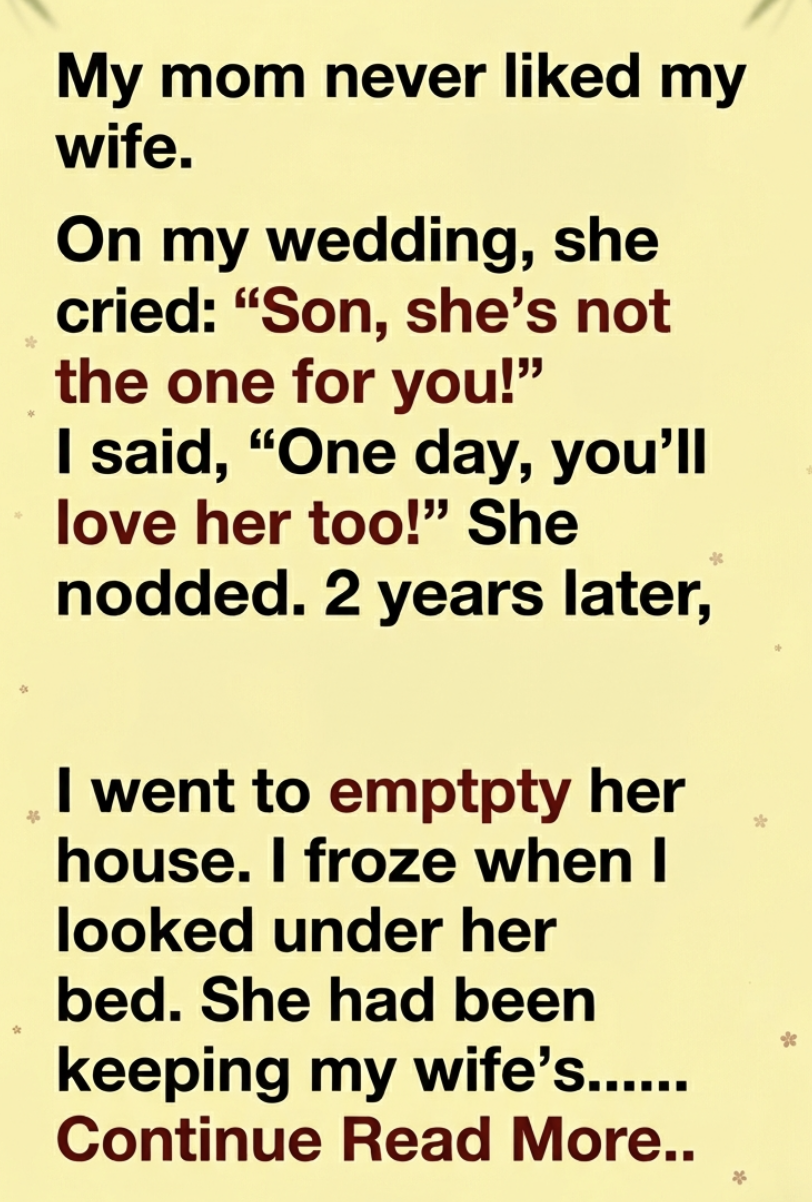
My mom never liked my wife.
At least, that’s what I believed.
On my wedding day, while guests danced and laughed, she pulled me aside.
Tears filled her eyes.
“Son, she’s not the one for you.”
I remember feeling angry.
Embarrassed.
Protective.
I loved my wife.
Deeply.
So I smiled and said:
“One day you’ll love her too.”
Mom nodded.
But she didn’t say another word.
For years, the relationship remained strained.
They were polite.
Never openly hostile.
But never close.
Family dinners felt awkward.
Holidays felt forced.
My wife always said she felt judged.
And honestly?
I agreed.
Then Mom died.
A stroke.
Sudden.
Unexpected.
Two years ago.
After the funeral, I spent weeks sorting through her belongings.
Most of it was ordinary.
Clothes.
Photographs.
Old paperwork.
Then one afternoon, while preparing to donate furniture, I looked under her bed.
And froze.
There was a large storage box.
Taped shut.
Covered in dust.
I pulled it out.
Opened the lid.
And my heart nearly stopped.
Inside were hundreds of photographs.
All of my wife.
My first reaction was shock.
Then confusion.
Then concern.
Why would my mother keep photographs of someone she supposedly disliked?
I started looking through them.
Birthday parties.
Family cookouts.
Christmas mornings.
Vacations.
Random moments.
My wife laughing.
My wife holding our daughter.
My wife gardening.
My wife reading on the porch.
Pictures I’d never seen before.
Pictures Mom had secretly taken.
Beneath the photographs sat several notebooks.
My hands shook as I opened the first one.
The pages were dated.
Like a journal.
The first entry mentioned my wedding.
“Today my son married a wonderful woman.”
I blinked.
Read it again.
Wonderful woman?
That didn’t sound like the mother I remembered.
I kept reading.
And everything I thought I knew started falling apart.
Apparently Mom hadn’t disliked my wife.
Not at all.
The problem was something else entirely.
Years before I met my wife, my father had left my mother for another woman.
The betrayal devastated her.
And when she saw how deeply I loved someone, she became terrified.
Not angry.
Terrified.
The journal revealed fears she’d never spoken aloud.
“I’m afraid he’ll get hurt like I did.”
“She seems kind, but I thought his father was kind too.”
“Maybe I’m looking for flaws because losing him would destroy me.”
Page after page.
Fear.
Not hatred.
Fear.
Then I found an envelope.
My wife’s name was written across the front.
Inside was a letter.
One Mom never mailed.
The date stunned me.
It had been written six months before her death.
The first sentence made me cry immediately.
“I owe you an apology.”
I sat on the floor reading every word.
Mom admitted she had judged her unfairly.
Admitted she’d allowed her own wounds to affect their relationship.
Then came the sentence that shattered me.
“You love my son better than I ever hoped someone would.”
Tears blurred the page.
Because my wife had spent years believing she wasn’t accepted.
And all along, my mother had been silently admiring her.
The letter continued.
Mom wrote about watching my wife care for our children.
Support me through job losses.
Stand beside me during difficult times.
She noticed everything.
Everything.
The final paragraph read:
“If you’re reading this, I probably waited too long to say it. Thank you for loving my son. And thank you for becoming the daughter I was too stubborn to appreciate.”
I couldn’t stop crying.
That evening, I handed the letter to my wife.
She read it silently.
Then read it again.
Halfway through, tears started rolling down her face.
When she finished, she looked at me and whispered:
“Why didn’t she ever tell me?”
I didn’t have an answer.
Maybe pride.
Maybe fear.
Maybe regret.
Probably all three.
At the bottom of the box was one final item.
A photo album.
On the cover, Mom had written:
“For the grandchildren.”
Inside were years of family memories.
And on the very last page was a note.
Just one sentence.
“Families don’t become perfect. They become precious.”
Today, that box sits in our living room.
Not hidden.
Not forgotten.
Sometimes my wife flips through the album with our children.
Sometimes she rereads the letter.
And every single time, I think about how much pain could have been avoided if people simply said what was in their hearts before it was too late.
For years, I thought my mother never accepted my wife.
The truth was far more complicated.
She accepted her.
She admired her.
She even loved her.
She just waited too long to say it.
And sometimes that’s the saddest secret of all.