My girlfriend made fried eggs for breakfast one Saturday morning.
Nothing fancy.
Just eggs, toast, and coffee.
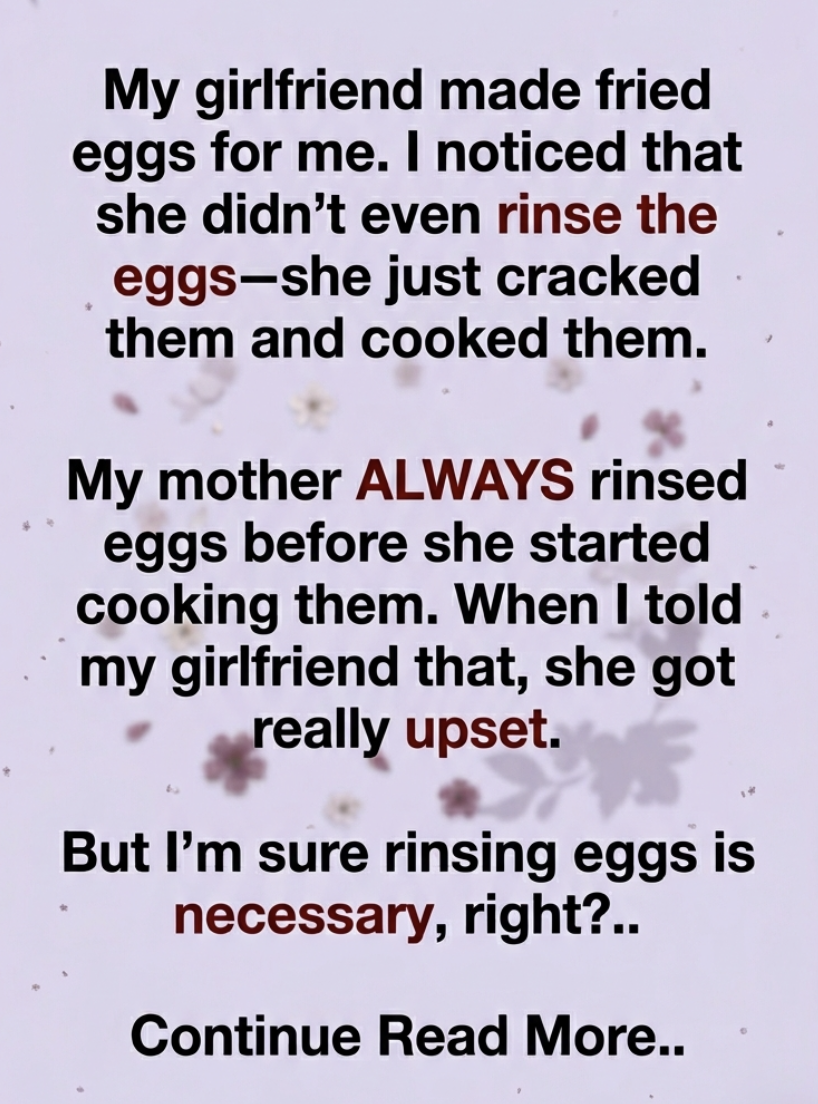
As she reached into the carton, I noticed something immediately.
She didn’t rinse the eggs.
Not even one.
She simply cracked them into the pan and started cooking.
I frowned.
“You’re not going to wash them first?”
She looked confused.
“Why would I?”
That answer surprised me.
Growing up, my mother always rinsed eggs before cooking them.
Always.
It was as automatic as turning on the stove.
She’d take each egg, run it under water for a second, then crack it into a bowl.
So naturally, I assumed everyone did the same thing.
“It’s more sanitary,” I explained.
“My mom always washed eggs.”
My girlfriend’s expression changed instantly.
Not angry.
Annoyed.
The kind of annoyed that suggests you’re about to learn something.
“Actually,” she said, “you’re not supposed to do that.”
I laughed.
“Of course you are.”
She crossed her arms.
“No. You’re really not.”
Now we were arguing about eggs.
Which is probably how most ridiculous arguments begin.
I spent the next ten minutes confidently explaining why rinsing eggs made perfect sense.
They come from chickens.
Chickens live outside.
Outside is dirty.
Therefore eggs are dirty.
Case closed.
My girlfriend finally grabbed her phone.
“Let’s look it up.”
Five minutes later, I wished I hadn’t suggested that.
Because apparently, in many countries, especially the United States, eggs are commercially washed before they ever reach the store.
More importantly, food safety experts generally advise against washing eggs at home.
Why?
Because water can actually push bacteria through tiny pores in the shell.
Meaning my “extra cleaning” could potentially do more harm than good.
I sat there staring at the screen.
Completely shocked.
For twenty-eight years, I’d believed rinsing eggs was the responsible thing to do.
Turns out it was just something my mother did.
When I called her later, she laughed.
“Of course I washed them.”
“Why?”
“Because your grandmother did.”
That was it.
No scientific reason.
No special safety precaution.
Just a habit passed down through generations.
A family tradition disguised as a rule.
The next morning, my girlfriend made eggs again.
This time I kept my mouth shut.
She slid a plate across the table.
Then smirked.
“Want me to rinse them first?”
I laughed.
“Absolutely not.”
The eggs tasted exactly the same.
And I learned something surprisingly valuable.
Sometimes the things we think are facts are really just family habits.
We grow up watching people do something a certain way.
Then we assume everyone else does it too.
Until one day someone cracks an egg differently and accidentally teaches us a lesson.
Not about cooking.
About assumptions.
And honestly?
That lesson was worth far more than breakfast.