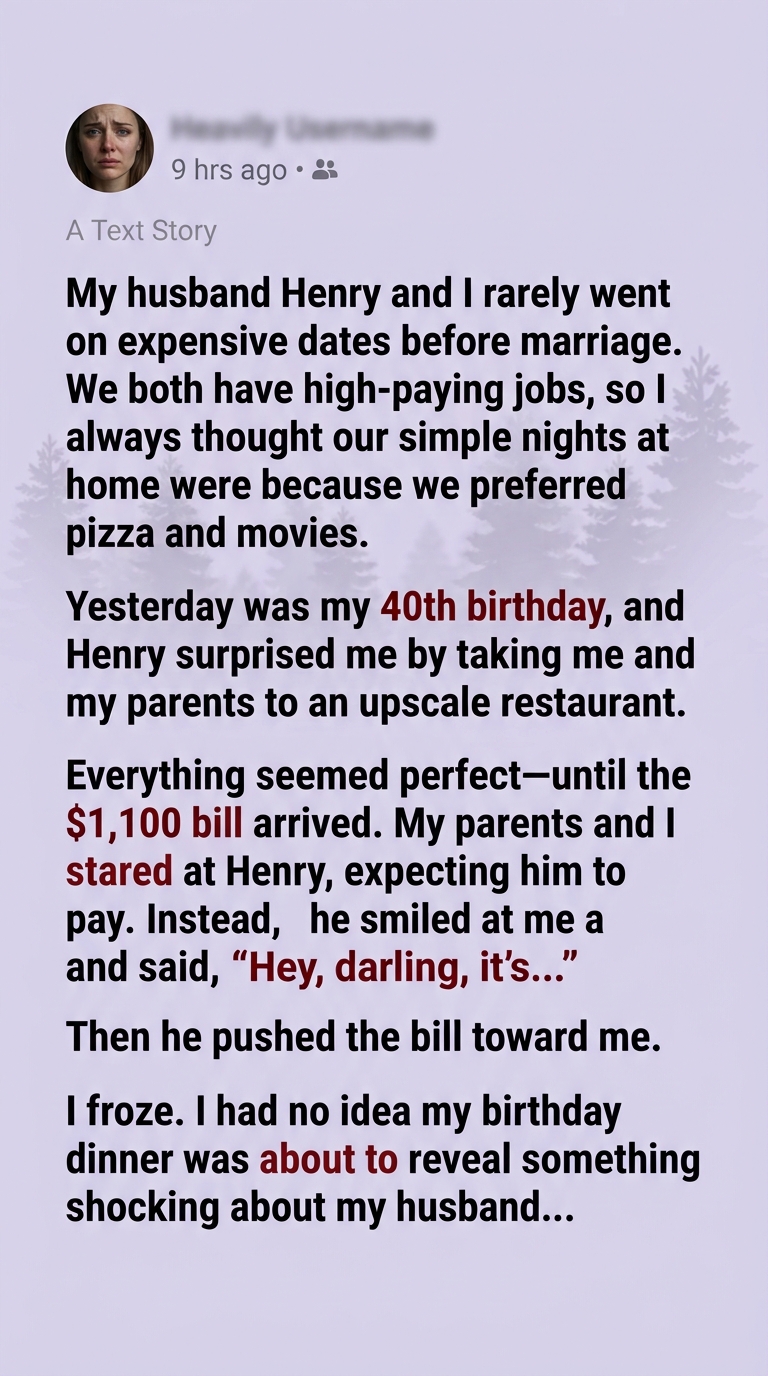
My husband Henry and I had never been the type of couple who spent hundreds of dollars on dinner.
We both had high-paying jobs, but we preferred simple nights at home.
Pizza.
Movies.
Takeout on the couch.
Sometimes we’d cook together while listening to music.
I never complained.
In fact, I loved our quiet life.
So when my 40th birthday arrived, I expected the usual.
Maybe a homemade cake.
Maybe flowers.
Maybe a nice dinner somewhere nearby.
Instead, Henry surprised me.
“Get dressed,” he said that afternoon.
“Where are we going?”
“You’ll see.”
A few hours later, he picked up my parents and drove us to one of the most expensive restaurants in the city.
The kind of place where the menus didn’t have prices printed beside some of the dishes.
My mother looked impressed.
My father whistled when he saw the wine list.
I looked at Henry.
“What is all this?”
He smiled.
“It’s your fortieth birthday. You deserve something special.”
I smiled back.
For the first time in years, I felt like Henry had planned something truly extravagant just for me.
Dinner was wonderful.
We ordered steak.
Seafood.
Desserts.
A bottle of wine my father jokingly called “more expensive than my first car.”
Everyone laughed.
Henry seemed relaxed.
He kept telling me how beautiful I looked.
He even raised his glass.
“To my beautiful wife,” he said.
“To forty amazing years.”
I felt loved.
Then the bill arrived.
The waiter placed the leather folder on the table.
My father reached for it.
Then he stopped.
His eyebrows rose.
My mother leaned closer.
I looked down.
$1,100.
I wasn’t shocked by the amount.
Henry could easily afford it.
So could I.
I simply assumed he would pay because he had planned the entire evening.
My father looked at Henry.
Henry looked at me.
Then he smiled.
“Hey, darling…”
He pushed the bill across the table.
“…it’s your birthday.”
I froze.
I thought he was joking.
“Henry?”
He laughed.
“What?”
“You’re paying, right?”
He leaned back.
“You make good money.”
My mother stared at him.
My father slowly put down his fork.
Henry shrugged.
“I thought we’d split it.”
“Split it with whom?”
He pointed at me.
“You invited your parents.”
My mother immediately said,
“Henry, you invited us.”
His smile disappeared.
“I invited everyone.”
“Then why am I paying?”
He looked annoyed.
“Because it’s your birthday.”
The table became silent.
I stared at my husband.
Something about the whole situation felt wrong.
Not because of the bill.
Because Henry had never behaved like this before.
Then he said something that made my stomach drop.
“You’re always talking about how independent you are. So be independent.”
I picked up the bill.
“Fine.”
I paid.
I didn’t argue.
I didn’t make a scene.
I didn’t want to ruin my birthday in front of my parents.
But something had changed.
On the drive home, Henry barely spoke.
My mother kept looking at me through the rearview mirror.
Finally, she whispered,
“Are you okay?”
I nodded.
But I wasn’t.
When we got home, Henry went straight upstairs.
I stayed in the kitchen.
My father looked at me.
“Something isn’t right.”
“I know.”
That night, Henry fell asleep quickly.
I didn’t.
I kept thinking about the dinner.
Then I remembered something.
Three weeks earlier, Henry had asked me a strange question.
“Do you know exactly how much money you have in your savings?”
I had laughed.
“Of course.”
He had smiled.
“Just curious.”
At the time, I hadn’t thought anything of it.
Now I did.
I opened my laptop.
I checked our joint account.
Then my personal accounts.
Everything looked normal.
But one thing caught my attention.
A transfer.
$250,000.
It had been moved from our joint investment account two months earlier.
I didn’t remember approving it.
I clicked the transaction.
The money had been transferred to a company I’d never heard of.
Harrison Equity Holdings.
My heart started pounding.
I checked the account again.
There were several transfers.
$50,000.
$75,000.
$125,000.
Altogether, more than $400,000.
I woke Henry.
“What’s Harrison Equity Holdings?”
He sat up.
For several seconds, he didn’t speak.
Then he said,
“Why are you going through our accounts?”
“Why did you move $400,000?”
His face changed.
“It’s an investment.”
“You didn’t tell me.”
“I was going to.”
“When?”
He rubbed his face.
“Eventually.”
I stared at him.
“Whose company is it?”
Silence.
“Henry.”
He finally said,
“Mine.”
My stomach dropped.
“What?”
“I started a company.”
“When?”
“Last year.”
I couldn’t believe it.
“You used our money.”
“It’s our money.”
“You transferred hundreds of thousands of dollars without telling me.”
“I was trying to build something.”
“Then why hide it?”
He looked away.
“Because I knew you’d say no.”
That sentence hurt more than the bill.
“You knew I’d say no?”
“Yes.”
“Why?”
He hesitated.
Then he said,
“Because the company is struggling.”
Everything suddenly made sense.
The cheap dinners.
The sudden questions about my savings.
The strange financial conversations.
The expensive birthday dinner.
He wasn’t celebrating me.
He was testing me.
“How much money have you lost?”
Henry didn’t answer.
I asked again.
“How much?”
“About $380,000.”
I sat down.
He continued.
“I thought I could recover it.”
“And the $1,100 dinner?”
He looked embarrassed.
“I wanted to see if you’d pay.”
I stared at him.
“Why?”
“Because I need to know whether you can carry us financially if things get worse.”
I couldn’t believe what I was hearing.
“You turned my birthday into a financial test?”
“I needed to know.”
“No.”
I stood up.
“You wanted to know how much you could take from me.”
He became defensive.
“That isn’t fair.”
I laughed bitterly.
“What’s not fair is using our joint savings to rescue a business you secretly created, then testing whether your wife will pay an $1,100 dinner.”
He didn’t respond.
The next morning, I contacted our financial adviser.
There was another surprise.
Henry hadn’t simply invested in his company.
He had used our home as collateral for a business credit line.
I stared at the documents.
Our house was at risk.
That was the moment I knew this wasn’t just a marriage problem.
It was a financial emergency.
I froze the accounts where I had legal authority to do so.
I contacted an attorney.
And I demanded that Henry disclose every business account, loan, investment, and liability.
For the first time in our marriage, he had no choice but to tell me everything.
His company wasn’t merely struggling.
It was almost bankrupt.
He had hidden the problem for months.
The $400,000 wasn’t his only debt.
There were nearly $700,000 in outstanding obligations.
My husband had been quietly gambling with our future while pretending everything was fine.
And the birthday dinner had been his final test.
He wanted to know whether I would simply keep paying.
I wouldn’t.
We separated financially that week.
I didn’t immediately decide whether our marriage could survive.
But I made one thing clear.
I would not use my income to cover debts he had deliberately hidden from me.
Months later, Henry sold the company.
He lost almost everything he had invested.
Fortunately, because I had acted quickly, we managed to protect our home and most of our legitimate savings.
One evening, he came to my apartment.
He brought a small box.
Inside was a photograph from our wedding.
“I owe you an apology,” he said.
I looked at him.
“You do.”
“I thought money was the problem.”
“It wasn’t.”
He nodded.
“I know that now.”
“The problem was that you stopped treating me like your wife and started treating me like your backup plan.”
His eyes filled with tears.
“I was scared.”
“I understand being scared.”
I handed the photograph back.
“But being afraid doesn’t give you permission to deceive me.”
He nodded.
We eventually agreed to attend counseling.
Not because everything was magically fixed.
It wasn’t.
Trust doesn’t return because someone says they’re sorry.
It returns slowly, through honesty, accountability, and consistent actions.
And I learned something important on my 40th birthday.
The $1,100 bill wasn’t what shocked me.
It was what the bill revealed.
For years, I thought our simple life meant Henry loved the same things I did.
But that night showed me something deeper.
A marriage isn’t measured by who pays the restaurant bill.
It’s measured by whether both people are honest about the life they’re building together.
And if someone has to secretly test how much you will sacrifice for them…
they already know they aren’t treating you like an equal.