My 9-year-old daughter whispered something at bedtime that I couldn’t stop thinking about.
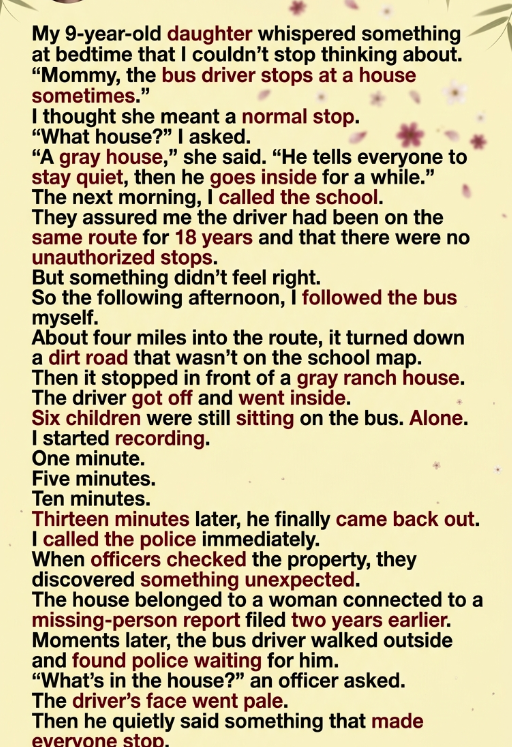
“Mommy, the bus driver stops at a house sometimes.”
I assumed she meant a regular stop.
Maybe a student lived there.
“What house?”
“A gray house.”
She pulled her blanket higher.
“He tells everyone to stay quiet, then he goes inside for a while.”
A strange chill ran through me.
“How long?”
She shrugged.
“Sometimes a long time.”
The next morning, I called the school transportation office.
The supervisor sounded confident.
The driver had been employed for eighteen years.
Perfect record.
No complaints.
No unauthorized stops.
“No need to worry, ma’am.”
But I did worry.
Because something about my daughter’s voice bothered me.
Children often notice things adults dismiss.
The following afternoon, I left work early.
I parked near the school.
And when the buses departed, I followed hers.
At first everything seemed normal.
Neighborhood stops.
Traffic lights.
Crosswalks.
Then, four miles into the route, the bus turned somewhere unexpected.
A dirt road.
I checked the route map on my phone.
The road wasn’t listed.
My heart started pounding.
A minute later the bus stopped in front of a gray ranch house.
Exactly as my daughter described.
I watched the driver step off the bus.
Six children remained inside.
Alone.
The door closed.
The driver walked to the house.
And disappeared inside.
I immediately started recording.
One minute.
Five minutes.
Ten minutes.
The children sat quietly.
Nobody moved.
Nobody seemed surprised.
Which somehow made it worse.
Thirteen minutes later, the driver emerged.
He climbed back onto the bus.
Started the engine.
And drove away.
I called the police before he reached the next stop.
An officer met me within minutes.
I showed him the video.
His expression changed immediately.
The next morning investigators were waiting.
Not just police.
School officials too.
The bus followed its route.
Reached the dirt road.
Stopped.
And once again the driver walked inside the gray house.
Only this time officers followed.
What happened next shocked everyone.
The property belonged to a woman named Eleanor Brooks.
The name immediately triggered something in the police database.
A missing-person report.
Filed two years earlier.
The woman had vanished after a series of medical issues.
Family members believed she had wandered away.
Searches found nothing.
The case eventually went cold.
Yet according to property records, this was still her home.
The officers approached carefully.
Then knocked.
No answer.
They entered.
Minutes later, the bus driver came outside.
Only this time police were waiting.
“What’s in the house?” an officer asked.
The driver’s face instantly lost color.
He looked toward the front porch.
Then back at the officers.
Finally he whispered:
“You don’t understand.”
The officer repeated the question.
The driver swallowed hard.
Then said:
“The woman in there is my mother.”
Everyone froze.
Including the officers.
Because according to official records, his mother had been missing for two years.
Yet she was inside the house.
Alive.
The explanation turned out to be heartbreaking rather than criminal.
Two years earlier, Eleanor had been diagnosed with rapidly progressing dementia.
After wandering away several times, she became terrified of leaving home.
Embarrassed.
Confused.
Ashamed.
The bus driver—whose real name was David—had quietly moved in to care for her.
At first he notified family.
Doctors.
Social workers.
But relationships fractured.
Arguments followed.
Accusations flew.
Eventually communication collapsed.
The missing-person report was never formally withdrawn after a bureaucratic mistake during a transfer between counties.
David assumed it had been handled.
It hadn’t.
Meanwhile he spent every day trying to keep his mother safe.
The unauthorized bus stops began months later.
His route happened to pass near the house.
Twice a day he would check on her.
Make sure she’d eaten.
Make sure she hadn’t fallen.
Make sure she remembered to take medication.
The problem was obvious.
His intentions didn’t matter.
Leaving children alone on a school bus was a serious violation.
A dangerous one.
And everyone knew it.
Including him.
When investigators entered the house, they found Eleanor sitting at a kitchen table.
Working on a puzzle.
Completely unaware of the chaos outside.
One officer later described the scene as “the saddest room he’d ever walked into.”
Photographs everywhere.
Medication bottles.
Sticky notes covering every wall.
Reminders.
Names.
Dates.
Instructions.
Evidence of a son desperately trying to hold his mother’s world together.
The school district suspended David immediately pending investigation.
Parents were furious.
Some demanded termination.
Others demanded criminal charges.
But as more details emerged, opinions became divided.
Because this wasn’t a story about a predator.
Or a kidnapper.
Or a criminal conspiracy.
It was a story about a man making terrible decisions while trying to solve an impossible problem.
The investigation concluded weeks later.
David lost his position as a driver.
That part was unavoidable.
Safety rules existed for a reason.
But the county also connected Eleanor with professional support services.
Adult care assistance.
Medical supervision.
Programs David never knew existed.
Programs he should have received long before reaching a breaking point.
Months later, I ran into him unexpectedly at a grocery store.
I almost walked away.
Instead, I introduced myself.
“My daughter was on your route.”
He nodded immediately.
“I know who you are.”
Neither of us spoke for a moment.
Then he said something I’ll never forget.
“I was angry at first.”
I waited.
“Then I realized your daughter did exactly what she should have done.”
He smiled sadly.
“She noticed something wasn’t right.”
The same thing he’d failed to admit himself.
That sometimes love isn’t enough.
Sometimes people need help.
Real help.
The kind no one can provide alone.
That night I told my daughter what happened.
A simplified version.
The kind a child could understand.
When I finished, she asked one question.
“Is the grandma okay?”
I smiled.
“Yes.”
She nodded.
Satisfied.
Then went back to her homework.
As if she’d simply done what anyone would do.
Maybe she had.
Because sometimes the smallest voice in the room is the one that notices the truth first.
And sometimes one quiet bedtime comment changes everything.