I found my mother’s life insurance policy in her attic.
Actually, I found two.
I was cleaning out old boxes while helping her move some winter clothes downstairs.
Mom is seventy-nine.
Early dementia.
Some days are good.
Some aren’t.
The attic was packed with decades of paperwork.
Tax returns.
Old utility bills.
Photo albums.
Then I found a folder labeled:
Insurance.
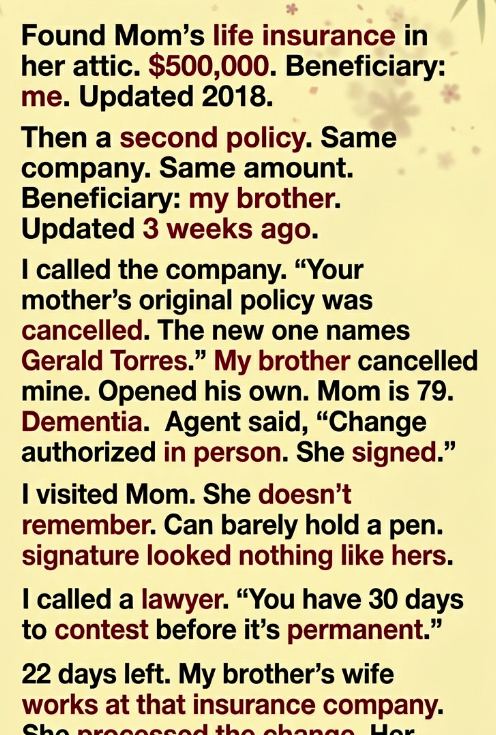
Inside was a life insurance policy.
Five hundred thousand dollars.
Beneficiary: Me.
Last updated in 2018.
Nothing unusual.
Then I found another policy.
Same company.
Same coverage amount.
Five hundred thousand dollars.
Only one difference.
Beneficiary: My brother, Gerald Torres.
Updated three weeks ago.
Three weeks.
My stomach immediately tightened.
Mom could barely remember breakfast.
Three weeks earlier she had forgotten her own address during a doctor’s appointment.
There was no way she had carefully reviewed insurance paperwork.
I called the insurance company.
The representative sounded confused.
According to their records, my mother’s original policy had been cancelled.
A new policy had replaced it.
Same insured person.
Different beneficiary.
My brother.
“Who authorized the change?”
The representative hesitated.
“Your mother appeared in person and signed the documents.”
I stared at the phone.
Then drove straight to Mom’s house.
When I asked about insurance, she looked puzzled.
“What insurance?”
The conversation lasted twenty minutes.
By the end she couldn’t remember discussing life insurance at all.
Then I showed her the signature.
Her eyes narrowed.
“That’s not mine.”
Neither of us were handwriting experts.
But she was right.
The signature looked wrong.
The letters were uneven.
The slant was different.
It resembled her name without resembling her handwriting.
I contacted an attorney the next morning.
After reviewing everything, he became very serious.
“You have thirty days to challenge this before it becomes significantly harder.”
I checked the dates.
Twenty-two days remained.
Twenty-two.
The clock was already running.
Then things became worse.
Much worse.
My attorney discovered that my brother’s wife worked for the insurance company.
Not in claims.
Not in customer service.
In policy administration.
The exact department responsible for processing beneficiary changes.
The room went silent when we learned that.
Because suddenly this didn’t look suspicious.
It looked coordinated.
Subpoenas followed.
Internal records.
Electronic logs.
Approval documents.
Every trail seemed to point toward the same question:
Who approved the change?
The answer nearly made me drop my coffee.
My brother’s wife’s supervisor.
The person who approved the beneficiary modification.
Was my college roommate.
A woman named Denise.
Someone I’d known for nearly twenty years.
Someone who attended my wedding.
Someone who absolutely knew my mother’s condition.
I called her immediately.
At first she refused to discuss anything.
Company policy.
Confidentiality.
Legal restrictions.
Then I mentioned the investigation.
Silence.
Long silence.
Finally she whispered:
“I didn’t know.”
My stomach tightened.
“Didn’t know what?”
“That your mother has dementia.”
According to Denise, the paperwork never mentioned it.
The file contained signed forms.
Witness verification.
Everything appeared legitimate.
Until she looked more closely.
Then she noticed something strange.
The witness signature belonged to a notary.
A notary whose commission had expired eight months earlier.
That discovery triggered a deeper internal audit.
The company launched its own investigation.
The findings were devastating.
Security footage from the branch office showed my mother entering the building.
But not alone.
My brother accompanied her.
He completed most of the conversations.
Most of the paperwork.
Most of the interaction.
Mom sat quietly.
Looking confused.
At one point she reportedly asked why they were there.
The employee helping them documented the comment.
Nobody followed up.
Nobody questioned capacity.
Nobody stopped the process.
Then forensic handwriting experts reviewed the signature.
Their conclusion was blunt.
The probability that my mother personally signed the document was extremely low.
The company panicked.
The legal exposure was enormous.
The potential fraud even larger.
Then investigators discovered emails.
Messages exchanged between my brother’s wife and another employee.
Messages discussing “getting everything finalized before anyone notices.”
That phrase changed everything.
The company immediately froze the policy.
The beneficiary change was suspended.
My brother was interviewed.
Then re-interviewed.
Then represented by counsel.
Family gatherings became impossible.
Relatives divided into camps.
Arguments exploded.
Old resentments surfaced.
But through all of it, Mom remained strangely calm.
One afternoon, while sitting beside her porch swing, she asked why everyone seemed upset.
I explained gently.
As simply as possible.
She listened quietly.
Then asked one question.
“Do they think I love one of my children more than the other?”
I felt tears building.
“No.”
She nodded.
“Good.”
Then she returned to watching birds in the yard.
As if the entire conflict made no sense.
And honestly, maybe it didn’t.
Six months later the matter settled.
The insurance company restored the original beneficiary designation.
Additional protections were added.
Independent reviews became mandatory whenever elderly policyholders requested major changes.
The company paid a substantial settlement.
Not because of the money.
Because they failed to protect a vulnerable customer.
My brother’s wife lost her job.
Several managers received disciplinary action.
Denise resigned shortly afterward.
She told me she couldn’t stay after realizing what had happened under her supervision.
As for my brother?
The relationship never recovered.
Some betrayals leave permanent scars.
Not because of the money.
Because of what people reveal about themselves while chasing it.
A year later I sat with Mom looking through old photographs.
She pointed at a picture of my brother and me as children.
Mud-covered.
Laughing.
Holding fishing poles.
Then she smiled.
“You boys used to share everything.”
I smiled back.
But didn’t answer.
Because some truths would only hurt her.
And after everything she’d already lost to dementia, she deserved peace more than explanations.
The insurance policy eventually remained exactly where she’d intended it to be.
But that wasn’t the real victory.
The real victory was discovering the truth before it became permanent.
With twenty-two days left on the clock.
Just enough time to protect the one thing my mother could no longer protect herself.