The last time I saw my mother before her execution, she looked smaller than I remembered.
Six years on death row had a way of doing that.
The prison uniform hung loosely from her shoulders.
Her hair had turned almost completely gray.
And yet her eyes remained exactly the same.
The same eyes that used to watch me play baseball.
The same eyes that tucked me into bed when I was sick.
The same eyes I had spent six years trying not to remember.
Because for six years, I believed she murdered my father.
Everyone did.
The police.
The prosecutors.
The jury.
The newspapers.
Even me.
Especially me.
I was nineteen when Dad died.
My little brother Noah was only seven.
Dad was found in the kitchen.
Stabbed once in the chest.
The murder weapon—a kitchen knife—was discovered beneath Mom’s car seat.
Her fingerprints were on it.
Their marriage had been struggling.
There were arguments.
Financial problems.
Witnesses.
Evidence.
Everything pointed directly at her.
The conviction came quickly.
The appeals failed.
And six years later, the state scheduled her execution.
I hated myself for being there.
But I couldn’t stay away.
Neither could Noah.
Now thirteen, he stood beside me in the prison visitation room.
Silent.
Nervous.
Holding a folded piece of paper.
Mom smiled weakly when she saw us.
Then Noah suddenly ran forward.
Wrapped his arms around her.
And whispered something into her ear.
I wasn’t supposed to hear it.
But I did.
Barely.
Seven words.
Words that changed everything.
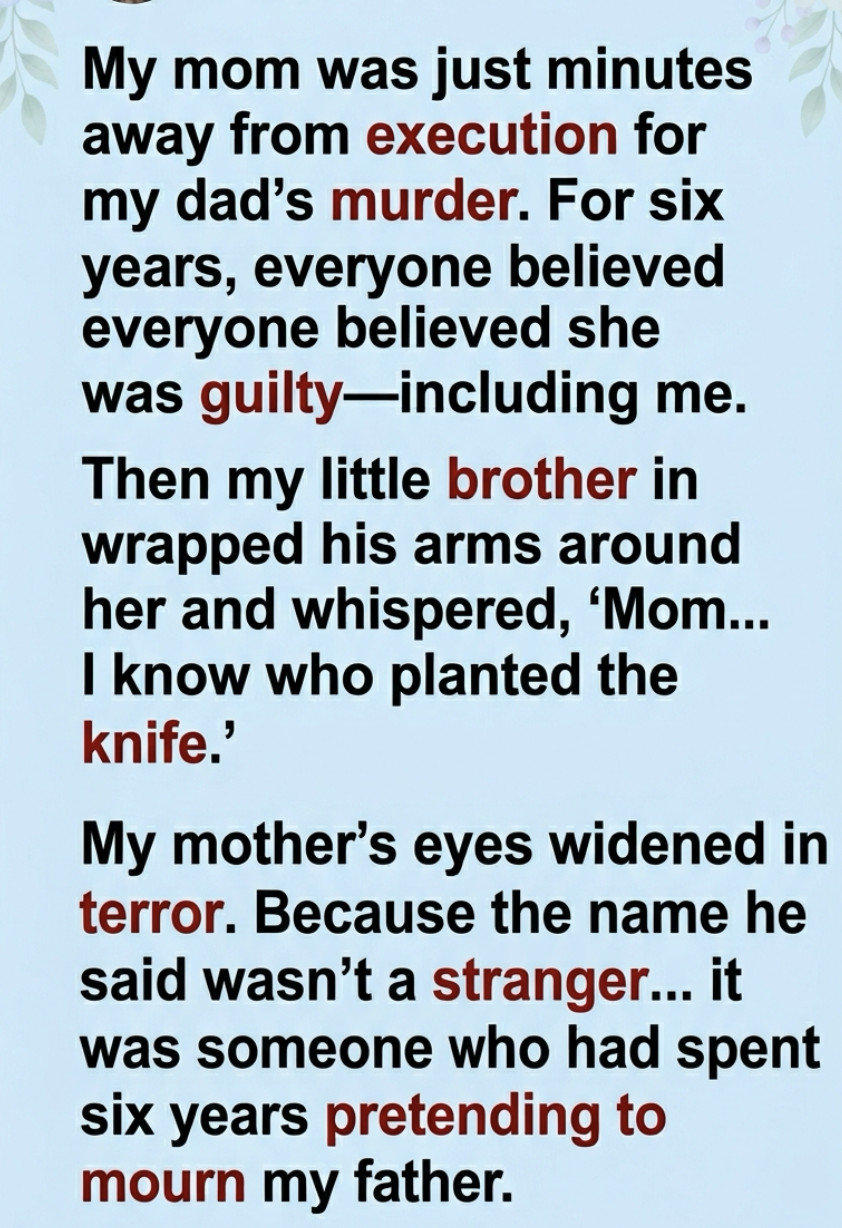
“Mom… I know who planted the knife.”
My mother’s body froze.
Completely froze.
Then Noah said a name.
A name that made the color drain from her face.
Not a stranger.
Not a criminal.
Not some mysterious figure from the past.
It was my father’s brother.
My Uncle Greg.
The man who spent six years pretending to grieve.
The man who sat beside us at every holiday.
The man who cried at Dad’s funeral.
The man who helped convince me Mom was guilty.
The room went silent.
Mom gripped Noah’s shoulders.
“How do you know that name?”
Noah looked terrified.
Then he unfolded the paper.
It was a drawing.
One he’d made when he was seven.
A child’s drawing.
Crayons.
Stick figures.
A kitchen.
A red knife.
And two adults.
One of them was Uncle Greg.
The other was Dad.
My heart started pounding.
“Noah… what is this?”
Tears filled his eyes.
“I remembered.”
Six years earlier, everyone assumed Noah had slept through the murder.
He was too young.
Too traumatized.
His testimony was considered unreliable.
But apparently he hadn’t forgotten.
Not really.
His memories had simply been buried.
Until a school counseling session months earlier.
Then pieces started coming back.
Small pieces.
The argument.
The shouting.
The kitchen.
Uncle Greg.
The knife.
And one sentence.
One sentence Noah heard before Dad died.
“You can’t tell them the truth.”
The prison immediately halted the execution.
Just hours before it was scheduled.
Not because a drawing proved innocence.
But because it created reasonable doubt.
Enough doubt to investigate.
And once investigators started digging, everything unraveled.
Fast.
The first discovery involved life insurance.
A lot of life insurance.
Dad had quietly changed beneficiaries three months before his death.
Removing Greg completely.
Something nobody knew.
Except Greg.
Then investigators found emails.
Deleted emails.
Threats.
Arguments.
Financial disputes.
Millions of dollars connected to a family business.
Money Greg desperately needed.
Then came the bombshell.
DNA technology had improved dramatically since the original trial.
The knife was retested.
The results shocked everyone.
The fingerprints weren’t just Mom’s.
A second partial print had always existed.
It had been ignored during the original investigation.
Now it matched Greg.
Exactly.
The case exploded.
News crews.
Court hearings.
Emergency motions.
Everything happened at once.
And for the first time in six years, I looked at my mother and wondered:
What if she’d been telling the truth all along?
Then came Greg’s mistake.
Investigators searched an old storage unit he believed had been forgotten.
Inside they found financial records.
Correspondence.
And one journal.
His journal.
The final entry was dated two weeks after Dad’s murder.
The words still haunt me.
“The knife worked better than expected.”
That was it.
The entire case collapsed.
Mom’s conviction was overturned.
Greg was arrested.
And eventually charged with murder, evidence tampering, and perjury.
The day Mom walked out of prison, cameras surrounded the gates.
Reporters shouted questions.
Microphones crowded forward.
Mom ignored all of them.
Instead, she walked directly to Noah.
The little boy who saved her life.
Then she hugged him and cried harder than anyone I’ve ever seen.
Not because she was free.
Because she almost wasn’t.
Months later, I finally asked Mom something I’d carried for years.
“Why didn’t you ever hate me?”
She looked surprised.
“I believed you were guilty.”
I couldn’t even meet her eyes.
She smiled sadly.
Then touched my hand.
And said:
“Because I knew someday you’d learn the difference between evidence and truth.”
I cried.
Right there at the kitchen table.
Because she had lost six years.
Six birthdays.
Six Christmases.
Six years of freedom.
And somehow she still found room for forgiveness.
Today, Mom is rebuilding her life.
Slowly.
Painfully.
But she’s rebuilding.
Noah is in college now.
Studying criminal justice.
He says he wants to help people who were wrongly convicted.
As for me?
I still think about that day.
The day a thirteen-year-old boy whispered seven words into his mother’s ear.
Seven words that stopped an execution.
Seven words that exposed a killer.
And seven words that gave our family a second chance.
Because sometimes the truth survives in the most unexpected place of all.
The memory of a child. ❤️
The End.