I stared at the report.
My hands were shaking so badly I could barely hold it.
At the bottom of the file sat a document I had never seen before.
A Power of Attorney.
Supposedly signed by me.
Supposedly granting my sister authority over our mother’s finances.
Except I had never signed it.
Never even heard of it.
Then I saw the notarization.
My stomach dropped.
The notary’s name was familiar.
Very familiar.
I read it again.
And felt sick.
It was my sister’s neighbor.
The same woman who attended her backyard barbecues.
The same woman who came to family cookouts.
The same woman who had known us for years.
I looked at the Adult Protective Services investigator.
“This can’t be legal.”
She shook her head.
“It isn’t.”
Then she pointed to another page.
The signature comparison.
My actual signature versus the forged one.
Not even close.
The investigator looked exhausted.
Apparently elder financial abuse cases were common.
But this one stood out.
Because of the duration.
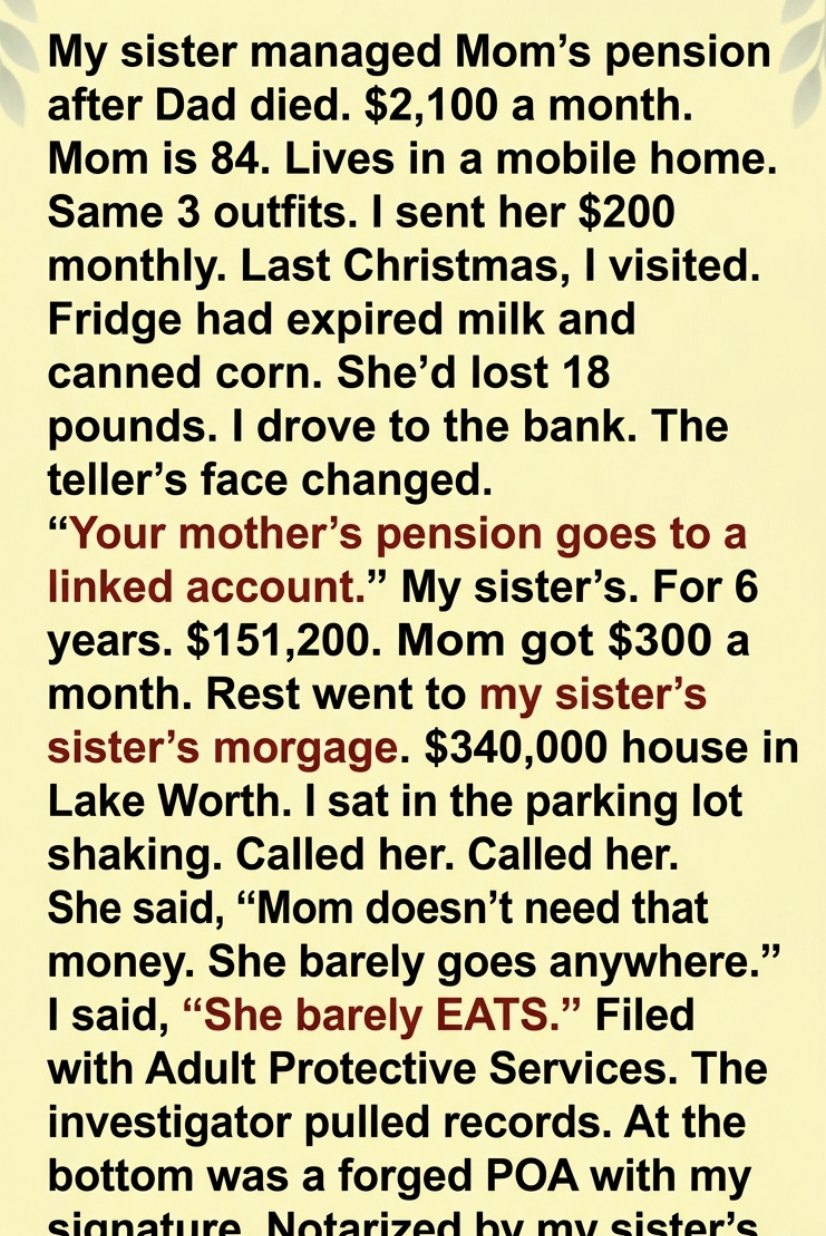
Six years.
Seventy-two monthly pension deposits.
Over $151,000 diverted.
Meanwhile my eighty-four-year-old mother was surviving on scraps.
Wearing the same clothes.
Eating expired food.
Skipping medications.
I felt physically ill.
Then came the worst part.
The investigator opened another folder.
Inside were text messages.
Messages recovered through subpoenas.
One from my sister to the mortgage company read:
“Use Mom’s deposit for this month’s payment.”
Mom’s deposit.
Not Mom’s pension.
Not Mom’s money.
Mom’s deposit.
Like she was talking about a paycheck.
Not a human being.
Then another message appeared.
This one made me see red.
“She doesn’t spend much anyway.”
I had to leave the room.
I walked outside.
Sat on the curb.
And cried.
Not because of the money.
Because my mother had spent her life sacrificing for us.
Working double shifts.
Skipping vacations.
Wearing old clothes so we could have new ones.
And this was how she was repaid.
Then the criminal investigation began.
The forged Power of Attorney wasn’t the only problem.
Investigators discovered forged bank authorizations.
Forged beneficiary forms.
Forged signatures.
Years of them.
The deeper they looked, the worse it became.
Then they interviewed Mom.
She sat quietly through most of it.
Confused.
Embarrassed.
Ashamed.
The investigator finally asked:
“Did you know your daughter was taking your pension?”
Mom looked down.
Then whispered:
“I thought she needed it more than me.”
The room went silent.
I couldn’t believe what I was hearing.
Then Mom explained.
Every time she questioned missing money, my sister promised she would pay it back.
Every month.
Every year.
The promises never stopped.
The repayments never came.
Mom simply kept believing.
Because mothers often do.
Then came the court hearing.
My sister arrived looking confident.
Too confident.
She thought family loyalty would save her.
It didn’t.
The prosecutor presented six years of bank records.
Mortgage statements.
Transfer histories.
Notary testimony.
Everything.
Then the forged Power of Attorney appeared on the screen.
My sister’s attorney looked defeated.
Because there was no explanation.
No misunderstanding.
No accounting error.
Just theft.
Then the judge asked my sister a question.
“Why didn’t you use your own money?”
The courtroom became quiet.
My sister looked toward Mom.
Then answered:
“I thought she’d never know.”
The entire room seemed to freeze.
Because for the first time, she told the truth.
Not that Mom didn’t need it.
Not that she intended to repay it.
Not that it was a misunderstanding.
The truth.
She thought she’d never get caught.
Then something unexpected happened.
Mom stood up.
Eighty-four years old.
Tiny.
Fragile.
But determined.
She looked directly at my sister.
Then said:
“I would have given it to you if you had asked.”
There wasn’t a dry eye in the courtroom.
Even the judge looked emotional.
Because that was the tragedy.
Not the money.
The betrayal.
My sister stole something she probably could have received freely.
If only she’d been honest.
Months later, the house in Lake Worth was sold.
Restitution was ordered.
Much of the money was recovered.
Not all of it.
But enough to change Mom’s life.
We moved her into a comfortable apartment.
Filled the refrigerator.
Updated her wardrobe.
Got her proper medical care.
For the first time in years, she gained weight.
Started smiling again.
Started gardening again.
Started living again.
One afternoon I found her sitting on the balcony watching birds.
She looked happier than she’d looked in years.
Then she said something I’ll never forget.
“I spent six years feeling like a burden.”
My heart broke.
Because while someone else was stealing her money, they had also stolen her dignity.
And that’s far harder to repay.
Today Mom is ninety.
Still stubborn.
Still independent.
Still insisting she doesn’t need expensive groceries.
I buy them anyway.
And every month when her pension arrives, she calls me just to make sure it went into the right account.
Then she laughs.
And says:
“This one belongs to me.”
And after everything that happened, hearing those words is worth more than every dollar we recovered. ❤️