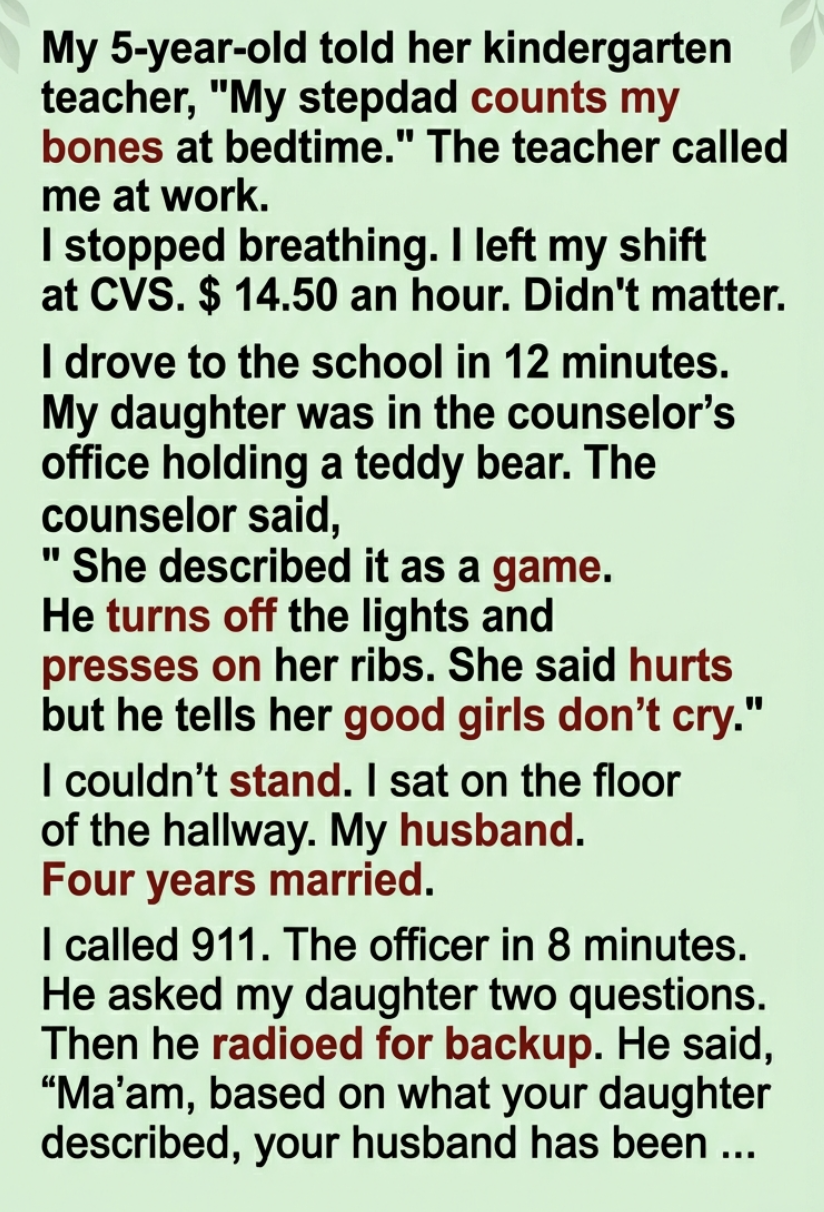
The officer looked at my daughter.
Then at the counselor.
Then back at me.
His expression was impossible to read.
Finally, he spoke.
“Ma’am, based on what your daughter described, your husband has been conducting a physical examination.”
I felt sick.
“What does that mean?”
The officer knelt beside my daughter.
“Sweetheart, can you show me exactly what he does?”
She nodded.
Then she hugged her teddy bear and gently pressed her fingers along its ribs.
“Like this.”
The officer asked:
“Anywhere else?”
“No.”
“Under your clothes?”
“No.”
“Does he ask you to keep it secret?”
“No.”
The officer’s face softened slightly.
Then he asked:
“Why does he count your bones?”
My daughter answered immediately.
“Because he gets scared.”
The room went silent.
“What do you mean?” the officer asked.
She shrugged.
“He says we have to make sure my bones are still hiding.”
My heart skipped.
Then, suddenly, a memory slammed into me.
Three years earlier.
My daughter had been diagnosed with a rare autoimmune disease.
For almost a year she lost weight rapidly.
Doctors monitored her rib visibility and body fat constantly.
One pediatric specialist even showed us how to watch for signs of dangerous weight loss at home.
My husband attended every appointment.
Every single one.
Then another memory surfaced.
One night after a doctor’s visit, my daughter cried because she hated being checked.
My husband had turned it into a game.
“The Bone Check.”
He’d pretend her ribs were secret superhero bones hiding under her skin.
Every night he’d gently check and tell her she was getting stronger.
Healthier.
Safer.
The game stuck.
I stared at my daughter.
Then whispered:
“The superhero bones?”
Her face lit up.
“Yeah!”
The counselor blinked.
The officer blinked.
Then my daughter added:
“When I was skinny, Daddy cried.”
My chest tightened.
Because he had.
I remembered it.
One hospital night when doctors weren’t sure the treatments were working.
My husband sat beside her bed and cried when he thought nobody was watching.
Then the officer asked:
“What does he say when he checks?”
She smiled.
“He says brave girls don’t have to cry anymore because they’re getting stronger.”
The room fell silent.
And suddenly I understood how a frightened five-year-old had translated years of medical routines into something that sounded horrifying.
But the investigation didn’t stop.
Nor should it have.
Teachers are mandatory reporters.
Counselors are mandatory reporters.
Police investigate.
That’s how children stay safe.
For the next week, social workers interviewed everyone.
Doctors reviewed records.
Medical specialists confirmed the history.
Every concern was examined.
Every question was asked.
Then the findings came back.
No abuse.
No inappropriate conduct.
No criminal behavior.
Just a misunderstanding filtered through the vocabulary of a five-year-old child.
When my husband finally learned what had happened, he sat quietly for a long time.
Then he cried.
Not because he was angry.
Because he realized how close he came to losing his family over words that sounded completely different outside their original context.
A few days later, the counselor apologized.
My husband immediately stopped her.
“Please don’t.”
She looked surprised.
He smiled sadly.
“If a child says something that sounds dangerous, you investigate.”
And he was right.
The teacher did her job.
The counselor did her job.
The officer did his job.
The system worked exactly as it should.
That night, my daughter climbed into my husband’s lap.
She looked worried.
“Are you mad at me?”
His eyes immediately filled with tears.
“Never.”
She thought for a moment.
Then asked:
“Can we still play the bone game?”
He laughed.
Then shook his head.
“Nope.”
“Why?”
He smiled.
“Because from now on we’re calling it the Superhero Health Check.”
My daughter grinned.
And for the first time in a week, so did everyone else.
Sometimes children tell the truth.
They just tell it in the language of childhood.
And sometimes the scariest stories have endings that remind us why listening carefully—to children and to facts—matters so much. ❤️