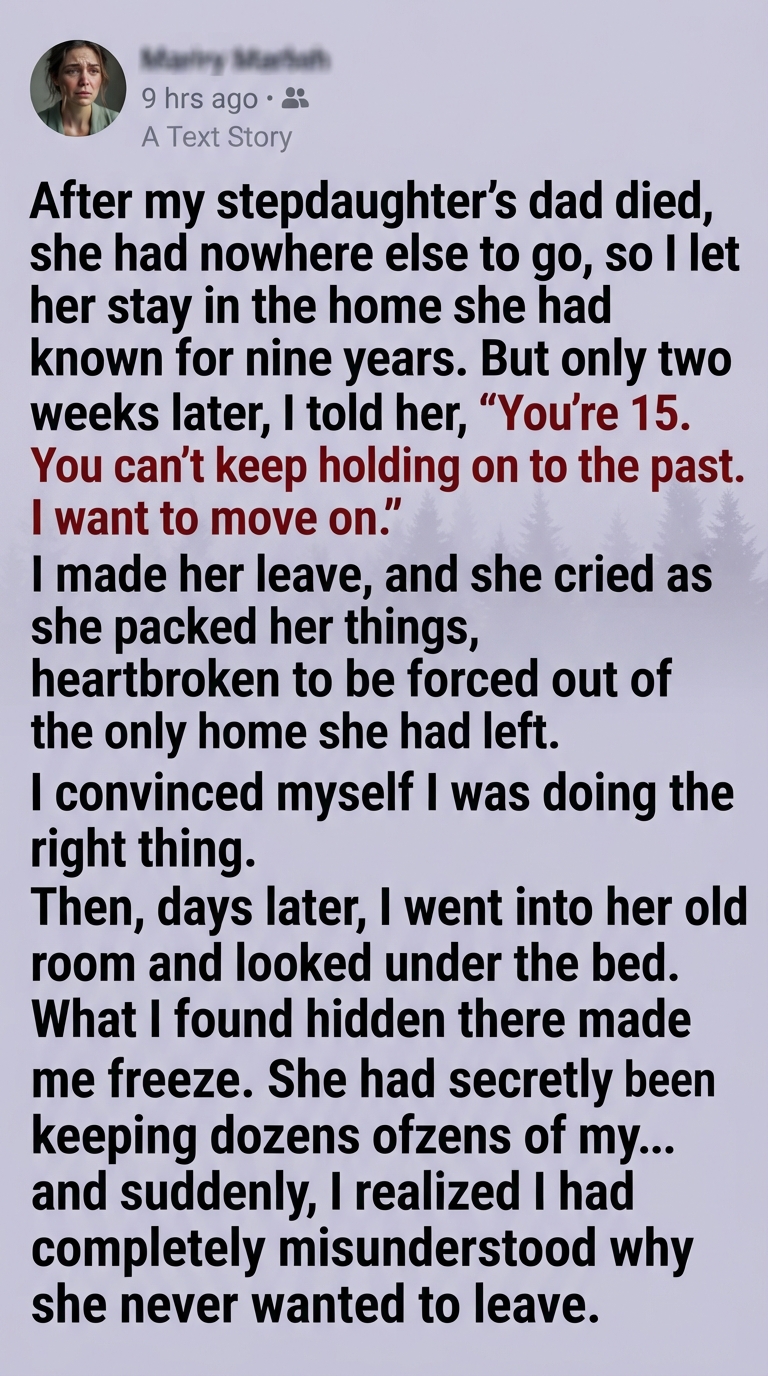
After my stepdaughter’s father died, she had nowhere else to go.
For nine years, she had lived in our home.
It was the only place she really remembered as home.
After her father passed away, I told her she could stay.
At least for a while.
She barely spoke during those first few days.
She spent hours in her bedroom, surrounded by photographs, old clothes, books, and little things her father had given her.
I understood that she was grieving.
Or at least, I thought I did.
My husband had been gone for only two weeks when I finally lost patience.
One evening, I stood in her doorway and said,
“You’re fifteen. You can’t keep holding on to the past forever.”
She looked up at me.
“I’m not trying to.”
“I want to move on,” I continued. “And I think you need to start moving on too.”
She stared at the floor.
Then she quietly asked,
“Where am I supposed to go?”
I told her I had already contacted a relative who could take her in temporarily.
She didn’t argue.
She just started crying.
That should have stopped me.
It didn’t.
She packed her clothes into two bags.
Then she carefully gathered the photographs from her desk.
Before leaving, she stood in the doorway of her bedroom and looked around for a long time.
I remember thinking she was being dramatic.
I remember telling myself that she was fifteen and would eventually understand.
Then she walked out.
The house became strangely quiet.
For the first time in nine years, her bedroom was empty.
Three days later, I went inside to clean it.
I opened the closet.
I cleared the desk.
I folded the blankets.
Then I noticed something underneath the bed.
A small cardboard box.
I pulled it out.
It was heavier than I expected.
I opened the lid.
And froze.
Inside were dozens of my things.
My old birthday cards.
Photographs of me.
A scarf I had worn on her first day of school.
A grocery list with my handwriting on it.
A faded movie ticket from a day we’d spent together years ago.
A Christmas ornament I thought I’d lost.
A receipt from a restaurant where I’d taken her after she got an award at school.
Even a broken bracelet I’d thrown away because I thought it was worthless.
I stared at everything in disbelief.
Why would she keep these?
Then I found something underneath them.
A small notebook.
My hands began shaking as I opened it.
The first page had a date from seven years earlier.
I read the first entry.
“Today she waited for me outside school because Dad was late.”
I turned the page.
“She made my favorite pancakes even though she was tired.”
Another page.
“She said she wasn’t my real mom, but she would always be there if I needed someone.”
I kept reading.
Page after page.
Years of memories.
Things I didn’t even remember doing.
The day I stayed up all night when she had a fever.
The first time I took her shopping for a dress.
The afternoon she failed a math test and cried at the kitchen table.
The day her father and I argued, and she secretly left a cup of tea outside my bedroom door.
The Christmas when she gave me a handmade ornament.
The notebook wasn’t about her father.
It was about me.
And then I found the last entry.
It was written only a few days before I made her leave.
“I know she’s not my mother.
But she is the closest thing I have left.
Dad is gone.
I don’t know what I’m supposed to do now.
She keeps saying she wants to move on.
I wish she knew that I’m not holding on to this house because I don’t want to accept Dad is gone.
I’m holding on because this is the last place where I still feel like I belong.
And she’s the last person who makes it feel like home.”
I couldn’t breathe.
I sat down on the floor.
Suddenly, every conversation we’d had made sense.
The way she always asked whether I’d be home for dinner.
The way she kept old photographs.
The way she couldn’t bear to pack.
The way she’d sit quietly in the living room after her father died.
She wasn’t refusing to move on.
She was terrified that if she left that house, she’d lose the last piece of her family.
And I had been the person who pushed her away.
I kept searching through the box.
At the bottom was an envelope with my name on it.
I opened it.
Inside was a photograph of the three of us.
My husband was standing in the middle.
She was holding his hand.
I was standing beside them.
On the back, in her handwriting, were six words:
“My family. My safest place. Always.”
I broke down.
I called the relative who had taken her in.
She answered.
I asked to speak to my stepdaughter.
When she came to the phone, I could barely get the words out.
“I found the box.”
Silence.
Then she whispered,
“You weren’t supposed to find that.”
“Why did you keep all of this?”
She started crying.
“Because I was scared you’d forget me.”
That sentence destroyed me.
I had thought she was the one refusing to let go.
But she wasn’t.
She had been trying desperately to hold on to me.
I apologized.
Not once.
Not quickly.
I told her I had been wrong.
I told her she didn’t have to leave.
And then I asked her something I should have asked two weeks earlier.
“Do you still want to come home?”
She didn’t answer immediately.
Then I heard her crying.
“Yes.”
I drove to get her that same afternoon.
When she got into the car, she didn’t say anything.
Neither did I.
When we reached home, she stood in front of the house for several seconds.
Then she turned toward me.
“Are you sure?”
I nodded.
“This is your home.”
She started crying.
So did I.
We walked inside together.
Her bedroom was exactly as she’d left it.
Except the box was sitting on the bed.
I handed it to her.
“I think these belong to you.”
She hugged the box against her chest.
Then she looked at me.
“You’re in most of them.”
I smiled through my tears.
“Then I guess we’re both allowed to remember.”
That night, we sat at the kitchen table and talked about her father.
For the first time since his death, she told me stories I’d never heard.
And for the first time, I understood something I had been too selfish to see.
Grief doesn’t always look like crying.
Sometimes it looks like refusing to pack a bedroom.
Sometimes it looks like keeping an old receipt.
Sometimes it looks like hiding photographs under a bed because you’re terrified that tomorrow, everyone you love will be gone.
And sometimes, the person who needs you most isn’t asking you to fix their grief.
They’re simply asking you not to leave while they learn how to live with it.
I thought my stepdaughter was holding on to the past.
The truth was much harder.
She was holding on to me.