Every Thanksgiving at my grandfather’s farmhouse followed the same routine.
The cousins arrived with their spouses and children.
They filled the kitchen.
They ate Grandpa’s food.
They drank his coffee.
They borrowed his tools.
They used his tractors.
And they treated his farm like it already belonged to them.
Nobody asked.
They simply assumed.
Grandpa was eighty-two and had lived on that property almost his entire life.
The farmhouse had belonged to his parents before him.
He knew every fence post, every field, every creek, and every tree.
But because he was quiet and rarely argued, the family had decided he was easy to take advantage of.
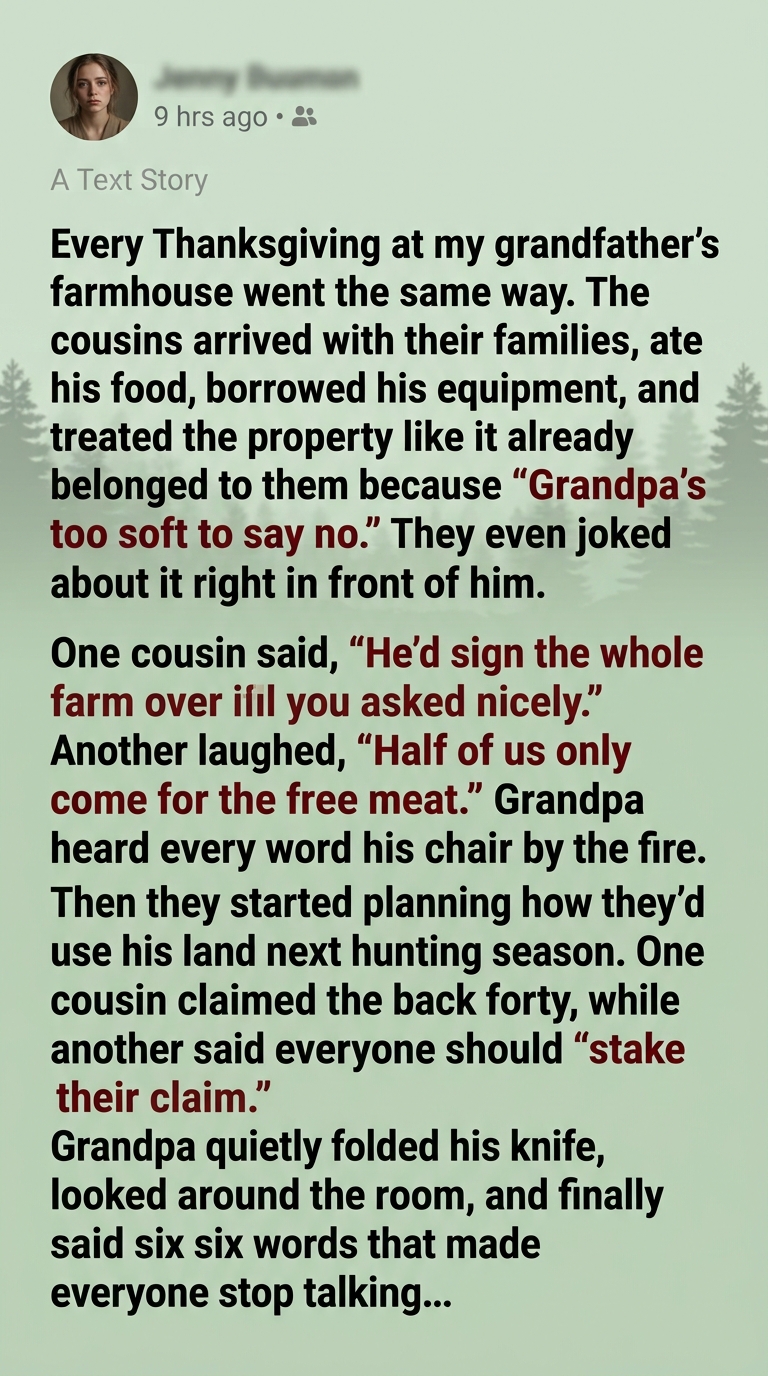
“He’s too soft to say no,” my cousin Mark once joked.
Everyone laughed.
Grandpa heard him.
He just kept eating.
That Thanksgiving was no different.
The dining table was overflowing with food.
Turkey.
Ham.
Mashed potatoes.
Cornbread.
Green beans.
Homemade pies.
Grandpa had cooked most of it himself.
After dinner, everyone moved toward the fireplace.
The children played on the floor.
The adults opened another bottle of wine.
And eventually, the conversation turned to the farm.
It started innocently.
Then Mark said,
“So, Grandpa, what are you thinking about next hunting season?”
Grandpa looked at him.
“Nothing yet.”
Mark laughed.
“Well, I’m claiming the back forty.”
Another cousin laughed.
“Forget it. I already called that area.”
“You don’t get to call it.”
“I just did.”
Someone else said,
“There’s plenty of land. Everybody can stake their claim.”
They were talking about Grandpa’s property as if he weren’t sitting three feet away.
One cousin started discussing where he wanted to build a hunting blind.
Another talked about putting a storage shed near the creek.
Someone even suggested cutting down several old trees.
I looked at Grandpa.
He was sitting quietly beside the fireplace.
His eyes were fixed on the flames.
Then Mark laughed.
“You know what’s funny?”
Everyone looked at him.
“Grandpa would probably sign the whole farm over if you asked nicely.”
Another cousin raised his glass.
“Half of us only come here for the free meat anyway.”
The room erupted in laughter.
Grandpa heard every word.
I expected him to get angry.
He didn’t.
He slowly reached for the small pocketknife he’d been using to cut his apple.
He folded the blade.
Click.
The sound was surprisingly loud.
Everyone went quiet.
Grandpa placed the knife on the table.
Then he looked around the room.
He looked at every cousin.
Every spouse.
Every grandchild.
Then he said six words.
“You won’t inherit what you don’t respect.”
Nobody moved.
Nobody laughed.
Grandpa leaned back in his chair.
Mark tried to smile.
“What does that mean?”
Grandpa looked at him.
“It means exactly what I said.”
Someone nervously cleared their throat.
“But Grandpa, we’re family.”
“I know.”
He pointed toward the dining table.
“You’ve eaten my food.”
Then toward the barn.
“You’ve used my equipment.”
Then toward the fields.
“You’ve made plans for my land.”
He paused.
“And you never once asked me what I wanted.”
Nobody had an answer.
Then Grandpa reached into the pocket of his flannel shirt.
He pulled out a small envelope.
“I’ve been working on something.”
Mark frowned.
“What?”
Grandpa opened the envelope.
Inside was a document.
“I met with my attorney last month.”
The room became completely silent.
My cousin Sarah leaned forward.
“What did you do?”
Grandpa smiled.
“I changed my will.”
Mark immediately stood up.
“Grandpa, you don’t have to do that.”
“I know.”
He looked at him.
“That’s why I did it.”
The family started talking all at once.
Grandpa raised one hand.
Everyone stopped.
“I spent my entire life building this farm.”
He looked around the room.
“I don’t owe it to anyone simply because we’re related.”
Then he said something I will never forget.
“If you want this place after I’m gone, you need to start treating it like something worth preserving while I’m still here.”
Mark looked embarrassed.
“But what do you want us to do?”
Grandpa smiled.
“Come here because you want to see me.”
Nobody spoke.
“Not because you want my turkey.”
A few people looked down.
“Not because you want my tractor.”
More eyes dropped.
“And certainly not because you’ve already divided up my land in your heads.”
The room was painfully quiet.
Then Grandpa stood.
He walked to the window overlooking the fields.
“You know what I hear when you talk about this farm?”
Everyone waited.
“I hear people dividing up something they didn’t build.”
He turned around.
“And that tells me you don’t understand what it means.”
My cousin Mark finally apologized.
Then another cousin did.
Then another.
Some apologies sounded sincere.
Others didn’t.
But Grandpa didn’t argue with anyone.
He simply told them the truth.
The farm wasn’t an inheritance yet.
It was his home.
And he was still alive.
Over the next year, things changed.
Grandpa started setting boundaries.
Nobody borrowed equipment without asking.
Nobody went hunting without permission.
Nobody cut trees.
Nobody brought extra guests without checking first.
And, most importantly, the family started visiting him without asking for anything.
Sometimes they just sat with him.
Sometimes they helped repair fences.
Sometimes they brought food.
And sometimes they simply listened to his stories.
Mark was the first cousin to really change.
One Saturday, he showed up with his son and spent six hours repairing a broken section of fence.
Grandpa watched him work.
At the end of the day, Mark wiped the sweat from his forehead.
“Grandpa?”
“Yeah?”
“I think I finally understand.”
Grandpa smiled.
“Understand what?”
“This was never about the land.”
Grandpa nodded.
“No.”
“It was about you.”
Grandpa smiled.
“Now you’re getting somewhere.”
Years later, Grandpa passed away peacefully in the farmhouse.
The family gathered around the same fireplace where he’d spoken those six words.
His attorney read the final will.
Nobody knew exactly what Grandpa had decided.
The farm was not divided among the cousins.
Instead, Grandpa had placed the property into a conservation trust.
The farmhouse would remain in the family.
The land could not be sold off piece by piece.
The fields would remain farmland.
The woods would remain protected.
And one condition was written into the trust:
Anyone who wanted to use the property had to contribute time and labor toward maintaining it.
Nobody received the farm for free.
But everyone received something more important.
A reason to keep it together.
After the reading, Mark walked outside.
I followed him.
He stood in the field for a long time.
Then he said,
“I used to think Grandpa was too soft to say no.”
I smiled.
“He wasn’t soft.”
Mark looked back at the farmhouse.
“He was patient.”
We stood there quietly.
The old barn creaked in the wind.
The fields stretched toward the horizon.
And for the first time, none of us were thinking about what the land was worth.
We were thinking about the man who had spent his entire life protecting it.
Grandpa had never needed to shout.
He never needed to threaten anyone.
He only needed six words.
“You won’t inherit what you don’t respect.”
And somehow, those six words became the most valuable inheritance he ever gave us.