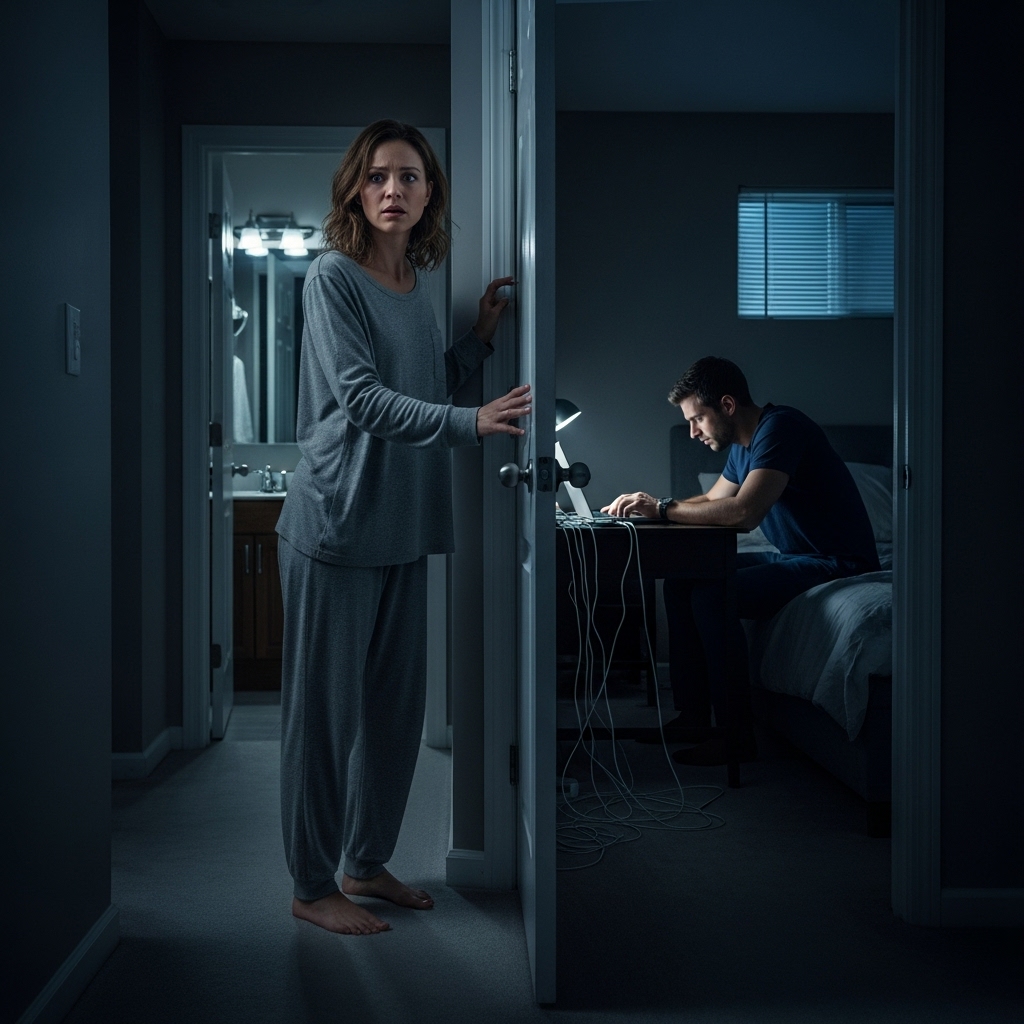
I pushed the door open just a little wider.
Jason was hunched over the desk, shoulders rounded, staring at his laptop like it might disappear if he blinked. The screen reflected in his glasses. His hands were shaking.
He jumped when the floor creaked beneath my foot.
“Jesus—” He slammed the laptop shut. “You scared me.”
For a second, neither of us spoke. The room smelled faintly of coffee and stale air. Clothes were folded neatly in piles. A toothbrush sat in a cup by the desk. He really had been living in here.
“What are you doing?” I asked quietly.
He ran a hand through his hair and let out a long breath. “I didn’t want you to find out like this.”
My heart started pounding. “Find out what?”
He pulled the laptop back toward him, hesitated, then opened it again and turned the screen so I could see.
It wasn’t another woman.
It wasn’t porn.
It wasn’t anything dramatic.
It was spreadsheets. Medical portals. Insurance forms. Emails titled Sleep Study Results, Neurology Follow-Up, Next Steps.
“I’ve been lying awake for months,” he said. “Not because of your snoring. Because I can’t sleep. At all.”
I stared at the screen. “Then why didn’t you tell me?”
“Because I was scared,” he said, his voice cracking. “And because every time you finally fell asleep, I stayed awake listening to you breathe and thinking… what if I can’t do this forever?”
He explained it all then.
He’d been having panic attacks at night. Chest tightness. Racing thoughts. Fear he couldn’t explain. The guest room wasn’t about comfort — it was about control. About having a place where he could pace, work, distract himself, not feel like he was failing next to me.
“I didn’t want you to worry,” he said. “And I didn’t want you to think it was because of you. So I made it about you.”
That hurt more than I expected.
“You let me blame myself,” I said. “I tried everything. I was embarrassed. I felt rejected.”
“I know,” he whispered. “And I hate myself for that.”
We sat on the edge of the bed, the silence thick between us.
“Why lock the door?” I asked.
He swallowed. “Because some nights I cried. And I didn’t want you to see me like that.”
For a long moment, neither of us moved.
Then I reached for his hand.
“You don’t get to shut me out,” I said. “But you also don’t have to do this alone.”
The next week, we made changes.
He started therapy. I went with him to one appointment, then stepped back when he needed space. Some nights he still slept in the guest room — but the door stayed open. The lies stopped.
We didn’t magically fix everything.
But we stopped pretending.
And sometimes, late at night, when I wake up and hear him pacing down the hall, he’ll come sit beside me, exhausted but honest.
That’s when I realize something important:
It wasn’t the separate beds that almost broke us.
It was the silence between them.