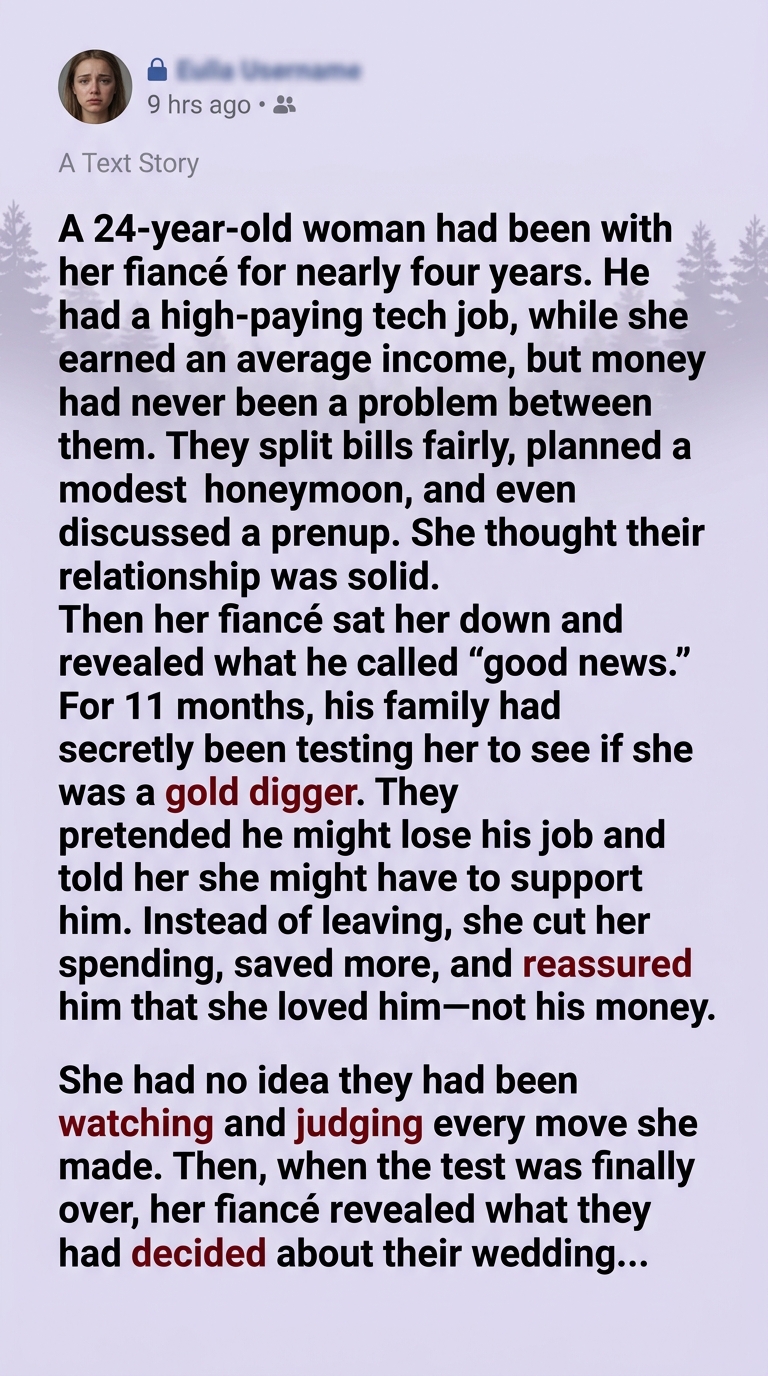
I was 24 years old when my fiancé told me he had “good news.”
At first, I smiled.
We had been together for almost four years, and I thought I knew him better than anyone.
He had a high-paying job in tech.
I had an average salary.
But money had never been an issue between us.
We split the bills fairly.
We lived within our means.
We had planned a modest honeymoon instead of an expensive luxury trip.
We had even discussed signing a prenup because we both believed protecting finances could make a marriage stronger, not weaker.
I thought our relationship was solid.
Then one evening, he asked me to sit down.
His expression was strangely serious.
“I need to tell you something.”
My stomach tightened.
“Are you okay?”
He nodded.
“I’m fine.”
Then he said,
“My family has been testing you.”
I stared at him.
“What?”
“For eleven months.”
I actually laughed because I thought he was joking.
He wasn’t.
He explained that his parents and older sister had secretly been watching how I behaved after they gave us a false story about his finances.
They told me his company might be downsizing.
Then they said he might lose his job.
Eventually, they told me he could be unemployed for a long time.
They wanted to see what I would do.
Would I leave?
Would I demand that he maintain the lifestyle I was used to?
Would I complain about having to support him?
Or would I stay?
I felt sick.
“But why?”
“They wanted to know whether you loved me or my money.”
I stared at him in disbelief.
Then he told me what they had been observing.
When they told me he might lose his job, I didn’t panic.
I simply changed my spending.
I canceled a few subscriptions.
I stopped buying clothes unless I really needed them.
I started cooking more instead of ordering food.
I increased my savings.
When he worried about our future, I told him,
“We’ll figure it out together.”
When he apologized for possibly becoming financially dependent on me, I told him,
“You’re my partner, not my paycheck.”
Apparently, they had been watching all of it.
They noticed every purchase.
Every conversation.
Every decision.
I felt humiliated.
“You’ve all been spying on me?”
He looked down.
“Yes.”
“And you let them?”
He didn’t answer.
That silence hurt more than anything.
I stood up.
“So what happens now?”
He took a deep breath.
“The test is over.”
I folded my arms.
“And?”
“My parents are extremely impressed.”
I almost laughed.
“Impressed?”
“They said you passed.”
That sentence made something inside me snap.
“I wasn’t taking an exam.”
He looked shocked.
“I know.”
“No, you don’t.”
I shook my head.
“You and your family spent almost a year secretly judging me while I thought we were building a life together.”
“I know I handled it badly.”
“You didn’t handle it badly.”
I looked directly at him.
“You betrayed my trust.”
He looked devastated.
But I wasn’t finished.
“And what exactly is the prize for passing?”
He hesitated.
Then he said,
“They want to pay for our wedding.”
I stared at him.
“What?”
“My parents want to give us a large wedding fund.”
I shook my head.
“No.”
He looked confused.
“You don’t want them to pay?”
“That’s not the point.”
I sat down again.
“The point is that they shouldn’t have needed to test me in the first place.”
He nodded slowly.
Then he reached into his pocket.
“I knew you’d say that.”
He pulled out a small envelope.
I didn’t take it.
“What is that?”
He placed it on the table.
“Something my parents gave me this morning.”
I finally opened it.
Inside was a letter.
It wasn’t an apology.
It was a wedding contract.
My eyes moved down the page.
Then I saw a sentence that made my heart stop.
They weren’t simply offering to pay for the wedding.
They wanted conditions.
They wanted control over the wedding budget.
They wanted financial disclosures.
They wanted a say in where we lived.
And they wanted a clause stating that any major financial decision during our first five years of marriage would require their approval if they contributed a substantial amount of money.
I looked at my fiancé.
“You didn’t sign this, did you?”
“No.”
“Did you know about it?”
“Not until today.”
I breathed out slowly.
Then I closed the envelope.
“Then we aren’t accepting their money.”
He nodded.
“I agree.”
“And we’re postponing the wedding.”
His eyes widened.
“What?”
“I need time.”
He looked hurt.
“Are you leaving me?”
I shook my head.
“I don’t know yet.”
That was the first completely honest answer I’d given him that night.
For the next few weeks, we barely discussed the wedding.
Instead, we talked about trust.
About boundaries.
About his family.
About what marriage actually meant.
He admitted that he’d known about the test almost from the beginning.
That was the hardest part.
He said his parents had convinced him it was harmless.
He believed that if I passed, everything would be fine.
But he finally understood what I had been trying to explain.
Love isn’t proven by surviving a secret test.
Trust is built through honesty.
Eventually, he sat down with his parents.
He told them we wouldn’t accept their money.
He told them they would not control our finances.
And he told them that if they wanted to be part of our marriage, they needed to respect our boundaries.
His father was furious.
His mother cried.
His sister called me a gold digger anyway.
That accusation actually made me laugh.
After eleven months of secretly watching me save money, cut expenses, and prepare to support the man I loved, I had nothing left to prove.
My fiancé stood beside me.
For the first time, he chose our relationship over his family’s expectations.
Six months later, we got married.
There was no extravagant ceremony.
No giant ballroom.
No expensive destination wedding.
Just our closest friends and family.
We paid for it ourselves.
Our honeymoon was exactly what we’d originally planned: a small trip to the coast.
Years later, my husband still jokes about the “eleven-month test.”
I don’t.
Because it taught me something I’ll never forget.
Being willing to stay with someone when they lose money is not proof that you should tolerate being treated without trust.
And loving someone doesn’t mean accepting every condition their family places on your relationship.
The real test wasn’t whether I would stay if he became poor.
The real test was whether we could build a marriage where neither of us had to secretly test, monitor, or manipulate the other.
And eventually, my husband understood that too.
One night, years after our wedding, he apologized again.
“I should have trusted you from the beginning.”
I smiled.
“Yes.”
He took my hand.
“And I’m never testing you again.”
I squeezed his hand.
“Good.”
Then I added,
“Because if you ever do, I’ll give you a test too.”
He laughed.
“What kind?”
I smiled.
“Whether you can survive sleeping on the couch.”
That finally made him laugh harder than he had in years.
And for the first time, there was no secret behind the laughter.
Just two people who had finally learned that a marriage shouldn’t be an examination.
It should be a partnership.