My father was the quietest man I knew.
Even when he was sick, he rarely complained.
He lived alone in the house where I had grown up, surrounded by the routines he had followed for decades.
He woke up at 6:30 every morning.
He drank his coffee in the same chair.
He watched the evening news at exactly 6 p.m.
And every Sunday, he cooked the same simple dinner.
He didn’t need much.
He just wanted peace.
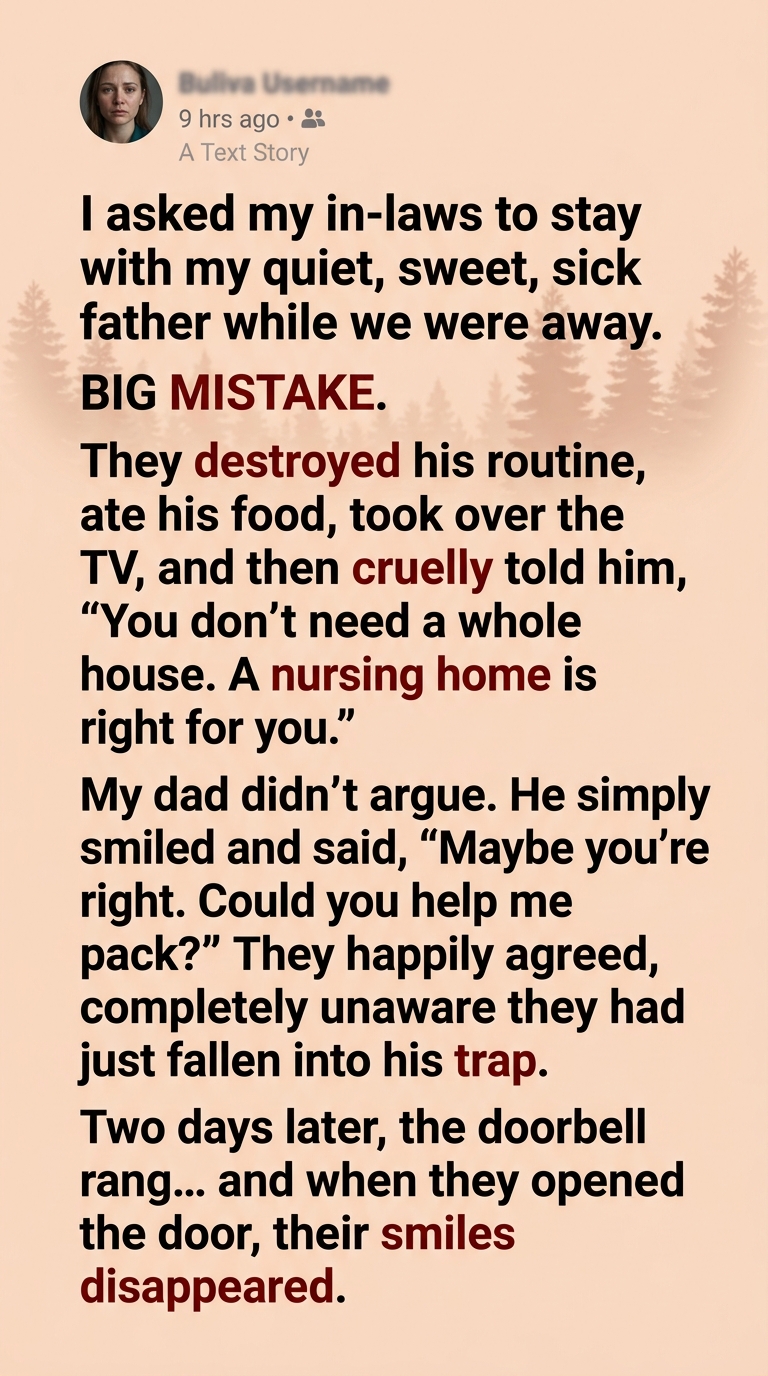
When my husband and I planned a short trip, I worried about leaving Dad alone.
His health wasn’t great, and although he could still take care of himself, I wanted someone nearby in case he needed help.
So I asked my in-laws if they could stay at Dad’s house for a few days.
My mother-in-law immediately smiled.
“Of course. He’s family.”
I should have known better.
The first evening away, I called Dad.
“How are you?”
“I’m fine, sweetheart.”
His voice sounded different.
“Are they treating you okay?”
There was a long pause.
“They’re… energetic.”
I laughed nervously.
“What does that mean?”
“Nothing.”
He didn’t want to complain.
That was my father.
The next morning, my mother-in-law called me.
“We’re going to have to make a few changes around here.”
“What changes?”
“Well, your father’s routine is ridiculous.”
I frowned.
“His routine?”
“He wakes up too early. He watches too much television. And honestly, this house is far too much for someone his age.”
I felt my stomach tighten.
“Please just let him have his routine.”
She sighed.
“You worry too much.”
Then she hung up.
I called Dad again.
This time, he didn’t answer.
That evening, my husband finally spoke to his mother.
“Mom, please don’t upset him.”
She laughed.
“We’re helping him.”
But they weren’t.
They started eating the food Dad had carefully stocked for himself.
They changed the television schedule.
They moved his furniture.
They complained about the temperature.
They even threw away his old newspapers because they said the house looked cluttered.
Dad didn’t argue.
He simply watched.
Then, on the third day, something happened.
My mother-in-law walked into the living room carrying a stack of boxes.
“Your father doesn’t need this much space,” she said.
Dad looked up from his chair.
“What do you mean?”
She smiled.
“We’ve been talking about it.”
Her husband nodded.
“A nursing home would be better for you.”
Dad was silent.
My mother-in-law continued.
“You’d have people around you. Meals. Nurses. Activities.”
Dad looked around the living room.
At the photographs.
At the books.
At the old clock my mother had bought decades earlier.
Then he smiled.
“Maybe you’re right.”
My mother-in-law looked pleased.
“I knew you’d understand.”
Dad nodded.
“Could you help me pack?”
They happily agreed.
They thought they had won.
They spent the rest of the afternoon packing his clothes into boxes.
My mother-in-law even made a list of things she thought should be thrown away.
Dad didn’t complain once.
He simply pointed at different things and said,
“Take that.”
“Put that in the box.”
“Leave that one.”
I didn’t understand what was happening until Dad called me that night.
“Sweetheart.”
“Yes?”
“Don’t worry about me.”
“What happened?”
“I think your in-laws are going to learn something very soon.”
I was confused.
“Dad, what did you do?”
He chuckled.
“Nothing.”
Then he hung up.
Two days later, my husband and I returned home.
I expected to find Dad upset.
Instead, I found him sitting peacefully in his favorite chair.
He was drinking coffee.
The house was quiet.
Almost too quiet.
My mother-in-law came downstairs.
“Finally!”
She smiled.
“We’ve made some decisions.”
I looked at Dad.
He simply smiled back.
My mother-in-law handed me a folder.
“We’ve found a wonderful nursing facility for your father.”
I stared at her.
“You what?”
“He agreed.”
My father nodded.
“I did.”
I couldn’t believe it.
“Dad?”
He smiled.
“Don’t worry.”
Then the doorbell rang.
My mother-in-law frowned.
“Who could that be?”
She opened the door.
Her smile disappeared instantly.
Standing outside were two lawyers, a realtor, and a representative from the county.
My mother-in-law looked at them.
“Can I help you?”
One of the lawyers held up a document.
“Are you Mrs. Harrison?”
“Yes.”
“We’re here regarding the property.”
She looked confused.
“What property?”
The lawyer glanced at Dad.
“This residence.”
My mother-in-law laughed nervously.
“What about it?”
The lawyer handed her the document.
“Mr. Miller has decided to sell the house.”
She stared at the paper.
“Sell?”
Dad nodded.
“Yes.”
My mother-in-law looked at me.
“But where is he going?”
Dad smiled.
“I’ll be moving.”
Her face brightened.
“To the nursing home?”
Dad shook his head.
“No.”
He pointed toward the lawyer.
“To the lake house.”
Silence.
My father owned a small lake house I’d almost forgotten about.
It had belonged to my mother before she died.
Dad rarely talked about it.
My mother-in-law looked shocked.
“But… this house?”
Dad smiled.
“I’ve already sold it.”
Her mouth fell open.
“What?”
The lawyer explained.
“The sale was arranged before your family arrived. Your father has been considering downsizing for some time.”
My mother-in-law looked at the boxes scattered throughout the room.
“But we packed everything!”
Dad nodded.
“Thank you.”
She stared at him.
“For what?”
“For helping me.”
She looked confused.
Dad continued.
“You moved my furniture.”
“You packed my clothes.”
“You organized my belongings.”
“And most importantly…”
He smiled.
“You showed me exactly how you would treat me if I became dependent on you.”
Nobody said a word.
My husband looked at his mother.
“Mom…”
She turned toward him.
“We were trying to help!”
Dad shook his head.
“No.”
His voice remained calm.
“You were trying to control me.”
That was the first time I’d ever heard anger in my father’s voice.
But it wasn’t loud.
It didn’t need to be.
He walked toward the front door.
Then stopped.
“Oh, one more thing.”
My mother-in-law looked at him.
Dad pointed at the boxes.
“You can take those.”
She blinked.
“Why?”
“Because they’re yours.”
She looked horrified.
“What?”
Dad smiled.
“You packed them.”
“You decided I didn’t need them.”
“So I thought you might find them useful.”
My husband suddenly laughed.
My mother-in-law glared at him.
Dad walked outside.
The realtor followed.
And I stood there watching the people who had tried to take control of his life suddenly realize they had no control at all.
A week later, Dad moved into the lake house.
It was smaller.
Quieter.
And exactly what he wanted.
He kept his old chair.
His coffee maker.
His books.
And his Sunday dinner routine.
As for my in-laws, they apologized.
Not immediately.
It took time.
My mother-in-law eventually called Dad.
“I was wrong,” she admitted.
Dad listened.
Then he said,
“I know.”
She asked if he was angry.
He paused.
“No.”
“Then why did you do all this?”
Dad looked out over the lake.
“Because sometimes people don’t show you who they are until they think you’re too weak to stop them.”
There was silence.
Then he added,
“I wanted to make sure I knew who I could trust.”
He never shouted.
He never insulted them.
He simply changed his life.
And made sure they could no longer control it.
Months later, I visited him at the lake house.
He was sitting on the porch with a cup of coffee, watching the sunset.
I sat beside him.
“Dad?”
“Yes?”
“Did you really plan all of that?”
He smiled.
“Not all of it.”
I laughed.
“What part wasn’t planned?”
“The part where they packed my clothes.”
He chuckled.
“I honestly didn’t expect them to be that enthusiastic.”
We both laughed.
Then he looked at me.
“You know what the best part was?”
“What?”
“I didn’t have to fight them.”
He took another sip of coffee.
“I just let them show me who they were.”
I looked at my father and realized something.
He hadn’t set a trap to hurt them.
He had simply stopped protecting them from the consequences of their own behavior.
And that was enough.
Because sometimes the strongest response isn’t yelling.
It’s quietly taking back control of your own life.
My father had spent his entire life being gentle.
They mistook that gentleness for weakness.
They never realized that a quiet man can still know exactly where the door is…
and exactly when to walk through it.